Reading the AR chamber’s panel without touching the machine
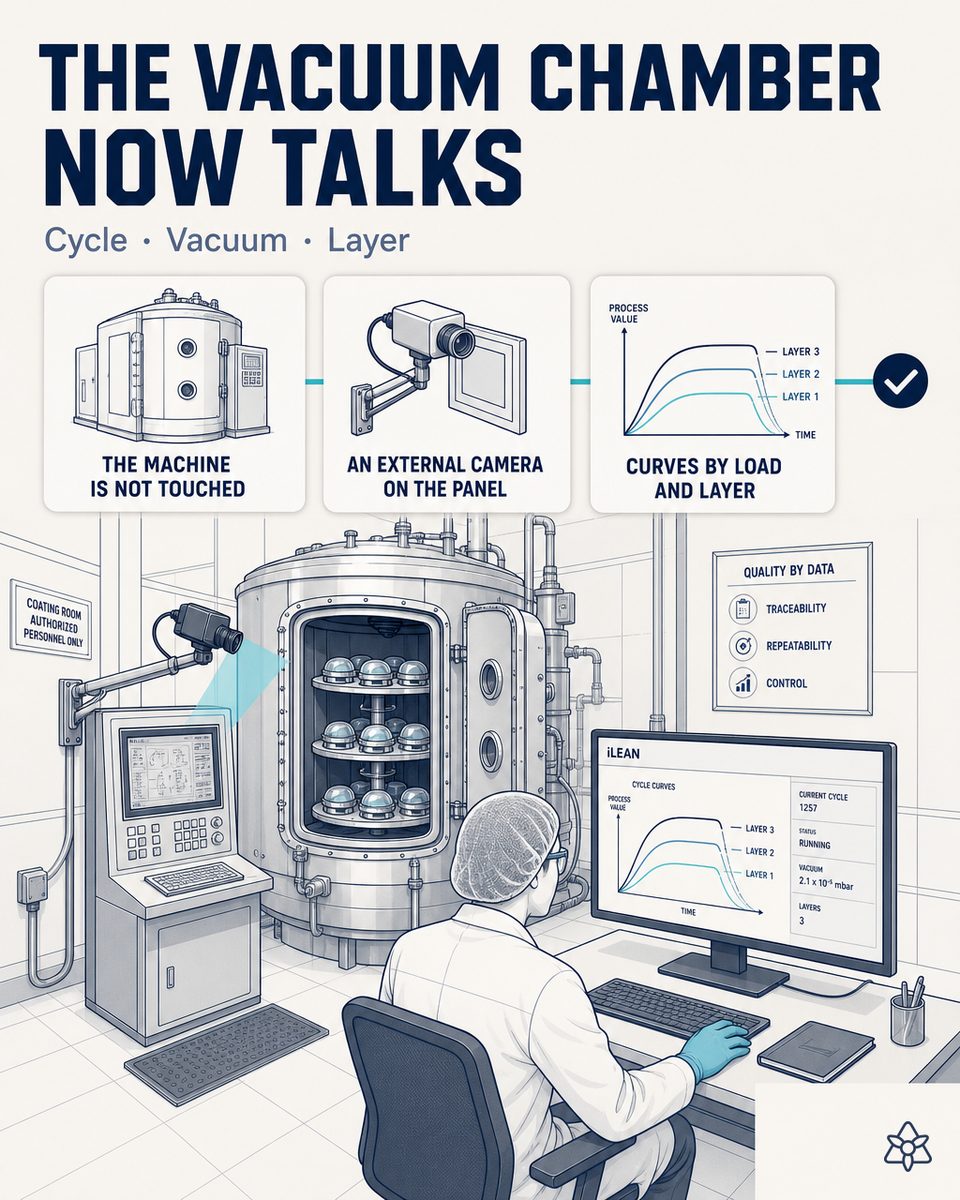
The vacuum chamber depositing the anti-reflective coating is an optical plant's most delicate asset, and its panel is usually a 10-to-25-year-old proprietary computer isolated on purpose. Replacing it costs what it costs and stops the coating line for weeks. With Connect an external camera aimed at the panel is enough: the machine stays itself, but the plant now has each load's curve digitized and cross-referenced with the lenses that were inside.
The asset that decides the finish is the only one leaving no trace.
An anti-reflective recipe is several layers of nanometric thickness, with its vacuum curve, its pumping times, its ion gun and its temperature. The panel shows it all, cycle by cycle — and overwrites it. The result is a hole exactly at the point where whether the lens comes out right is decided:
- Zero correlation between load and defect — when poor adhesion, an off-pattern reflection color or a halo appears, nobody can check what the chamber did in that specific load. The data existed during the cycle and is no longer anywhere.
- Root cause analysis depends on one person — it is solved by the veteran technician's intuition, which is usually right. The problem is not their judgment: it is that that judgment cannot be cloned when the workforce grows fast, and it leaves with them when they leave.
- The alternative is a CAPEX nobody signs — replacing the equipment costs what it costs and stops the coating line for weeks. The project is postponed year after year, and the data hole stays.
So the plant lives with a black box in its most delicate process, and every coating defect investigation starts with the variable that would explain the most — simply absent.
Connect in photo mode on the panel — looking at the screen instead of integrating the machine.
The missing information is already on the screen: the panel shows it load after load. What does not exist is the path from that glass to the central system. Connect solves it the cheap way — by looking — without opening the machine's network, without touching its software and without voiding the manufacturer's warranty.
A fixed industrial camera in front of the screen, capturing every few seconds. OCR with an anchored model interprets each frame, the load's complete time curve is reconstructed and cross-referenced with the lab system to know which lenses were in the domes. Everything stays in central memory, queryable by batch.
How Connect operates on the AR chamber's panel:
- External camera, zero intervention — a mount is installed in front of the panel and that is where the intervention on the equipment ends. The cabinet is not opened, the network is not tapped, the machine's software is not touched. For the vacuum chamber, nothing has happened — and the manufacturer's warranty stays intact.
- OCR anchored to that specific panel — the model knows that screen's real layout: where the vacuum curve is, where the pumping times, where the ion gun and where the temperature. It reads values at known positions, it does not guess text.
- The complete curve, not snapshots — the capture every few seconds is reconstructed as the whole load's time series, from pumping to venting. That is what makes a drift visible, which is exactly what a loose photo does not show.
- Cross-reference with the lenses inside — the curve is associated with the lab system to know which lenses occupied the domes on that load. Without that cross-reference the curve is a pretty chart; with it, it is traceability.
- Drift detected before the defect — with several loads accumulated, progressive deviations start to show — a pumping that takes a bit longer each week — announcing the problem before the first lens comes out wrong.
Vacuum chamber as a black box vs. chamber digitized with Connect
| Aspect | Isolated proprietary panel | With iLEAN Connect on the panel |
|---|---|---|
| Load ↔ coating defect correlation | Nonexistent | Root cause analysis per batch, in minutes |
| The load's curve (vacuum, pumping, ions, temperature) | Shown and overwritten | A complete time series, queryable by batch |
| Traceability of which lenses were in the domes | Reconstructed, if possible | Automatically cross-referenced with the lab system |
| Detection of equipment drift | When there is already a defect | Before the defect appears |
| The veteran technician's knowledge | Lives in one person and leaves with them | Backed by data anyone can query |
| Equipment replacement | Pending, undated, on the table | Deferrable indefinitely without going blind |
Impact estimate for your plant — to be validated with your own numbers.
The block below is an estimate to be validated against your plant's actual data. We put it forward so the committee has an order of magnitude; we refine it during the assessment.
- Optical plant with a 10-to-25-year-old anti-reflective vacuum chamber, an isolated proprietary panel and coating defects whose cause cannot be attributed to the load today.
- Connect pilot on the panel: fixed industrial camera, model anchoring to that specific screen and cross-reference with the lab system. First value expected within a few weeks.
- Indicative payback between 5 and 10 months, adding the replacement CAPEX not executed and the coating scrap avoided. Estimate to be validated.
- The deferred CAPEX is usually the figure that moves the committee: the replacement project is postponed without giving up the data that justified it.
- The underlying lever is closing the hole in the most delicate process: from here on, every coating defect has something to correlate against, and the veteran technician's judgment stops being the only record that exists.
And the fair question from the coating manager
"What if the camera misreads a value from a twenty-year-old panel and we make decisions on false data?" — hallucination is a problem of free generation, not of anchored tasks. Here the AI reads a numeric value at a known position on a known panel: in that class of task the best models brought the error below 1.5% [1]. On top of that the reading is redundant over time — many frames per load —, so a discordant reading is discarded against its neighbors instead of propagating, and when a frame does not reach the confidence threshold it is flagged instead of a value being forced.
[1] OpenAI paper "Why Language Models Hallucinate", 2025 — on the reliability of AI in anchored tasks.
What people ask about digitizing the vacuum chamber without touching it
Does the machine's network have to be opened or its software touched?
No, and that is exactly the approach. A fixed industrial camera is mounted in front of the panel and that is where the intervention ends: the cabinet is not opened, nothing is connected to the equipment's network, its software is not modified and neither the manufacturer's warranty nor the process validation is compromised. For the vacuum chamber nothing has changed. That is why the installation can be done without stopping the coating line and why there is no need to open an integration project with the manufacturer — which is what has been blocking access to the data for years in most optical plants.
How accurate is reading a screen with a camera?
Highly, because it is not generic OCR: the model is anchored to that specific panel's layout and knows what value to expect at each position — vacuum curve, pumping times, ion gun, temperature. On top of that the reading is redundant over time: it captures every few seconds throughout the load, so a discordant reading is discarded against its neighbors instead of propagating. What gets stored is not a loose photo but a coherent time series. And if the panel gets covered or the reading degrades, the system detects it and warns instead of inventing values.
How is the curve cross-referenced with a specific coating defect?
Each load stays tied to the lenses occupying the domes, because Connect cross-references the curve with the lab system. When poor adhesion, an off-pattern reflection color or a halo appears on a specific pair, that defect is born already associated with the curve of the load that treated it: what vacuum it reached, how long the pumping took, how the ion gun behaved and at what temperature. The question "what did the chamber do on that load?" goes from an argument to a query, and with several weeks of history patterns start showing per recipe and per dome position.
Does it detect that the machine is degrading?
Yes, and it is the return usually discovered later. A vacuum chamber does not fail suddenly: it degrades. Pumping takes a bit longer each week, one zone's temperature drifts a few degrees, the ion gun loses stability. None of those signals is visible looking at an isolated load on the panel — they only appear when comparing successive loads over time, which is exactly what the central memory allows. The practical result is being able to schedule an intervention before the drift produces the first batch of defective coatings.
What if the panel changes view or someone navigates to another screen?
Connect detects it as a layout deviation and stops automatically structuring that reading until the model is re-anchored to the new arrangement — a documented configuration adjustment, not a reinstall or an intervention on the machine. In the meantime it invents no data: the capture is flagged for review and the earlier curve history remains intact and traceable per load and per batch. On proprietary panels of this age, with no firmware changes, it is an infrequent situation, but the system is designed to fail loudly instead of failing silently.
More cases from this series
- The medical device audit, always readyImpact test, coating tests, optical verification and operator competence: the batch dossier assembles…
- Receiving semi-finished lenses and monomer, with a photoA photo of the delivery note and the pallet labels: batch, quantity and expiry enter the ERP with one…
- Mounting without typing: the prescription travels from the job to the machineTracer, edger and laser marking stitched to the lab management system and the ERP: zero typing of axis…
- The GEMBA walk that enters the system by talkingThe supervisor dictates through an earpiece what they see while walking; iLEAN structures it with line,…
- The test laboratory’s Excel reaches the ERP on its owniLEAN reads the test sheet when it is saved, structures it and feeds it into the ERP after human…
- Catching the prescription change before the lockoutiLEAN reads the email that changes or cancels a prescription, locates the job in transit and stops it…
Which critical machine in your plant is not connected? We start with it.
We work on your plant's real data, not ours. We show you the reading working on your own panel, without touching the equipment. Assessment with no commitment.
See how we would apply it in your plant — demo on your panel ‹ See all 12 eyewear cases See apparel, footwear & accessories