The test laboratory’s Excel reaches the ERP on its own
Every shift, the test laboratory fills spreadsheets with adhesion, abrasion, coating thickness and color, impact test results and tint bath control. They are the process quality's living data, and they live in a folder the ERP does not see. Connect watches the folder, reads the file when it is saved and, after validation, feeds it into the ERP.
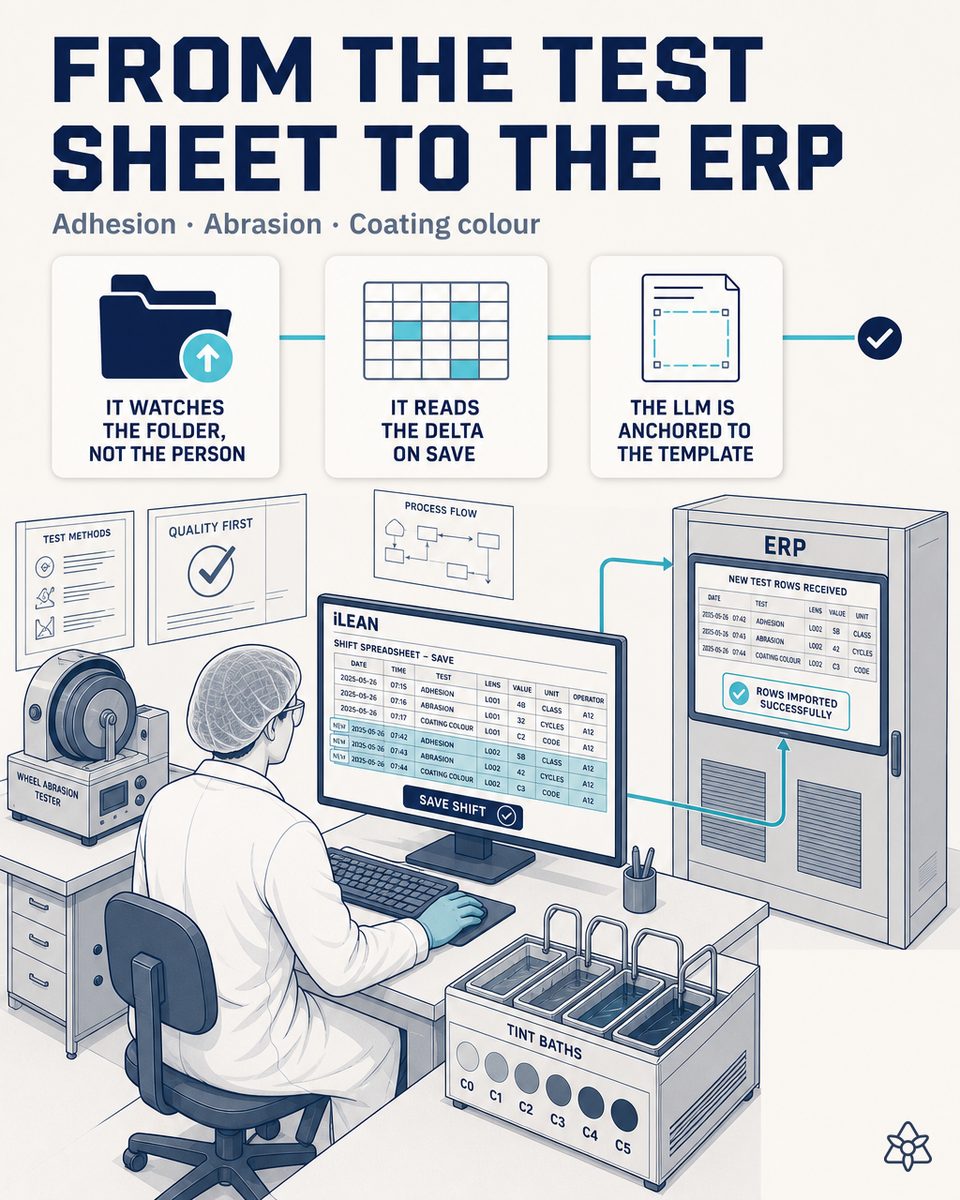
Two parallel worlds: the Excel where the data is and the official system where it should be on record.
An optical plant's test laboratory works with spreadsheets, and it is not bad practice: it is the tool that fits how testing is really done — adhesion, abrasion, coating thickness and color, impact test, tint bath control. The problem appears afterwards:
- Weeks of lag between the test and the official record — the real data lives in the folder and the official system receives a transcribed copy much later. What the corporation considers "the truth" runs behind what happened in the laboratory.
- Transcription consumes expensive technical staff — and introduces errors precisely into the records a quality system auditor will ask for. It is not that the technician types badly: it is that typing is not their job.
- The same folder holds the skills matrix — the living document maintained by continuous improvement and human resources, which no system sees either and which is needed to decide who can be at which station.
And the cost is not only audits or lag: it is licenses. For that typing to be possible, several people need access to the ERP's quality module — not because they manage quality in the system, but because it is the only way to enter their own tests.
Connect in inward-listening mode — it watches the folder, not the person.
The test sheet does not need to disappear or change format. The data that already exists in it needs to reach the ERP without anyone typing it again. Connect watches the shared folder — not the technician filling it — and acts when the file is saved.
Connect reads the delta on save, parses it with an anchored model that understands the Excel as it is — without asking anyone to redo it —, shows it to the responsible person for validation and feeds it into the ERP or the quality system via API. The same piece keeps the skills matrix alive and available to the rest of the cases.
How Connect operates on the test laboratory's sheets:
- On the folder, not the workstation — a shared network location is watched. Nothing is installed on the technician's computer, their activity is not logged and their performance is not measured: only the moment the file is saved is detected.
- It reads the delta, not the whole file — on save, it identifies which tests are new since the last reading. It does not reprocess the history or duplicate records.
- A model anchored to the real sheet — it understands the Excel as it is, with its usual columns and order. Nothing to normalize, no template to redo: the adapting is done by the system.
- Validation before the feed — the responsible person confirms on screen what will enter the ERP. A single person validates what several used to type.
- The skills matrix, alive — the same piece keeps the matrix living in that folder up to date and available to the other cases, starting with the cross-reference the GEMBA earpiece makes when an observation points to training.
Disconnected Excel and ERP vs. Excel fed in by Connect
| Aspect | Manual transcription into the ERP | With iLEAN Connect inward listening |
|---|---|---|
| Test → official record lag | Weeks | Second zero, on saving the file |
| Manual transcription | Hours per month of technical staff | Zero — API feed after validation |
| Errors in the records the auditor asks for | Introduced while typing | Doubtful data flagged before entering |
| Quality and laboratory module licenses | One per person who feeds data | One: the validator's |
| History for an audit | Reconstructed | A direct query, cross-referenced by batch |
| Skills matrix | A living document no system sees | Kept alive and available to the rest of the cases |
Impact estimate for your plant — to be validated with your own numbers.
The block below is an estimate to be validated against your plant's actual data. We put it forward so the committee has an order of magnitude; we refine it during the assessment.
- Optical plant with its own test laboratory, results in spreadsheets and a corporate ERP with the quality module billed per active user.
- Connect pilot on the laboratory folder with an ERP feed via API after validation. Without touching the sheets or the laboratory's way of working. First value expected within a few weeks.
- Direct financial angle — if today five laboratory people enter the ERP only to feed in tests, that is five licenses. With Connect only the validator enters: typical reduction of 50-80% in quality and laboratory module licenses, recurring.
- Estimated payback between 4 and 9 months, plus that annual saving. Estimate to be validated against the ERP's real invoice.
- An audit benefit: the history that today gets reconstructed becomes a direct query cross-referenced by batch, because the laboratory's data and the official system's are the same data.
And the fair question from the finance manager
"What if the model misreads a cell and an out-of-tolerance test result enters as good?" — hallucination is a problem of free generation, not of anchored tasks. Here the AI reads cells from a known sheet and maps them to known fields: it is the class of task where the best models brought the error below 1.5% [1]. And that remainder does not reach the ERP: Connect holds the feed until the responsible person validates, and a value outside its plausible range gets flagged instead of slipping through.
[1] OpenAI paper "Why Language Models Hallucinate", 2025 — on the reliability of AI in anchored tasks.
What people ask about feeding the test sheets into the ERP
Do the laboratory's sheets have to change, or do we migrate to a LIMS?
No. The approach is the opposite: the sheets stay as they are because they work and are tuned to how testing is really done in that laboratory — its adhesion and abrasion columns, its way of recording coating thickness and color, its tint bath control. The model anchors to that structure, not the other way round. Nothing to normalize and no LIMS to buy: the goal is not replacing the laboratory's tool, but eliminating the later transcription, which is where the cost, the lag and the error live.
Does Connect access the laboratory technician's computer?
No. Connect watches a shared folder, not a workstation or a person. No software is installed on the technician's computer, their activity is not logged and their performance is not measured. All that happens is that, when the file is saved in that folder, the system detects which tests are new and processes them. It is a distinction worth framing well with the team: what is watched is a process file, and the goal is taking the transcription off their hands, not monitoring them.
How exactly does this translate into fewer ERP licenses?
By counting how many people enter the quality and laboratory module today only to feed in tests. If it is five, that is five licenses paid for a data-feeding function, not for using the system. With Connect the results enter via API and a single person validates: the rest no longer need access to that module. The typical reduction is between 50 and 80%, and it is a recurring annual saving, not a one-off. Putting a figure on it takes only the ERP contract and the current user count — which is why the first step is calculating it on your real invoice.
Where does the skills matrix come into this?
It lives in the same folder and suffers the same problem: it is a living document maintained by continuous improvement and human resources, and no system sees it. Connect keeps it updated with the same mechanism — watch, read the delta, validate — and makes it available to the rest of the case matrix. The most immediate example is the GEMBA walk earpiece: when an observation points to training, the system can instantly cross-reference with the certification of whoever was at that station because that matrix is alive and accessible, instead of a file someone updates when they can.
Does it work with any test sheet format?
Yes. The anchored model parses the sheet as your laboratory generates it — the equipment's native export, an in-house template per test type or a sheet with particular columns and order. If the laboratory adds a column or renames a test, Connect does not break silently: it detects the variation and, if ambiguous, flags it for the responsible person's review instead of feeding in a misinterpreted value. And since it writes via API, it does not depend on a specific ERP brand either: it works wherever there is an endpoint to write the validated result to.
More cases from this series
- The medical device audit, always readyImpact test, coating tests, optical verification and operator competence: the batch dossier assembles…
- Reading the AR chamber’s panel without touching the machineAn external camera reads the anti-reflective chamber’s panel and digitizes each load’s curve without…
- Receiving semi-finished lenses and monomer, with a photoA photo of the delivery note and the pallet labels: batch, quantity and expiry enter the ERP with one…
- Mounting without typing: the prescription travels from the job to the machineTracer, edger and laser marking stitched to the lab management system and the ERP: zero typing of axis…
- The GEMBA walk that enters the system by talkingThe supervisor dictates through an earpiece what they see while walking; iLEAN structures it with line,…
- Catching the prescription change before the lockoutiLEAN reads the email that changes or cancels a prescription, locates the job in transit and stops it…
How many of your ERP licenses exist only to enter data?
We work on your plant's real data, not ours. With your quality module's user count we calculate the recurring saving. Assessment with no commitment.
See how we would apply it in your plant — calculation with your licenses ‹ See all 12 eyewear cases See apparel, footwear & accessories