The medical device audit, always ready
The day the auditor arrives, someone spends one or two weeks reconstructing the period's traceability: impact test records that must be kept for years, coating tests, optical verification, and the proof that whoever did each operation was certified. With Edge and Agents the evidence is collected when it happens and the dossier assembles itself.
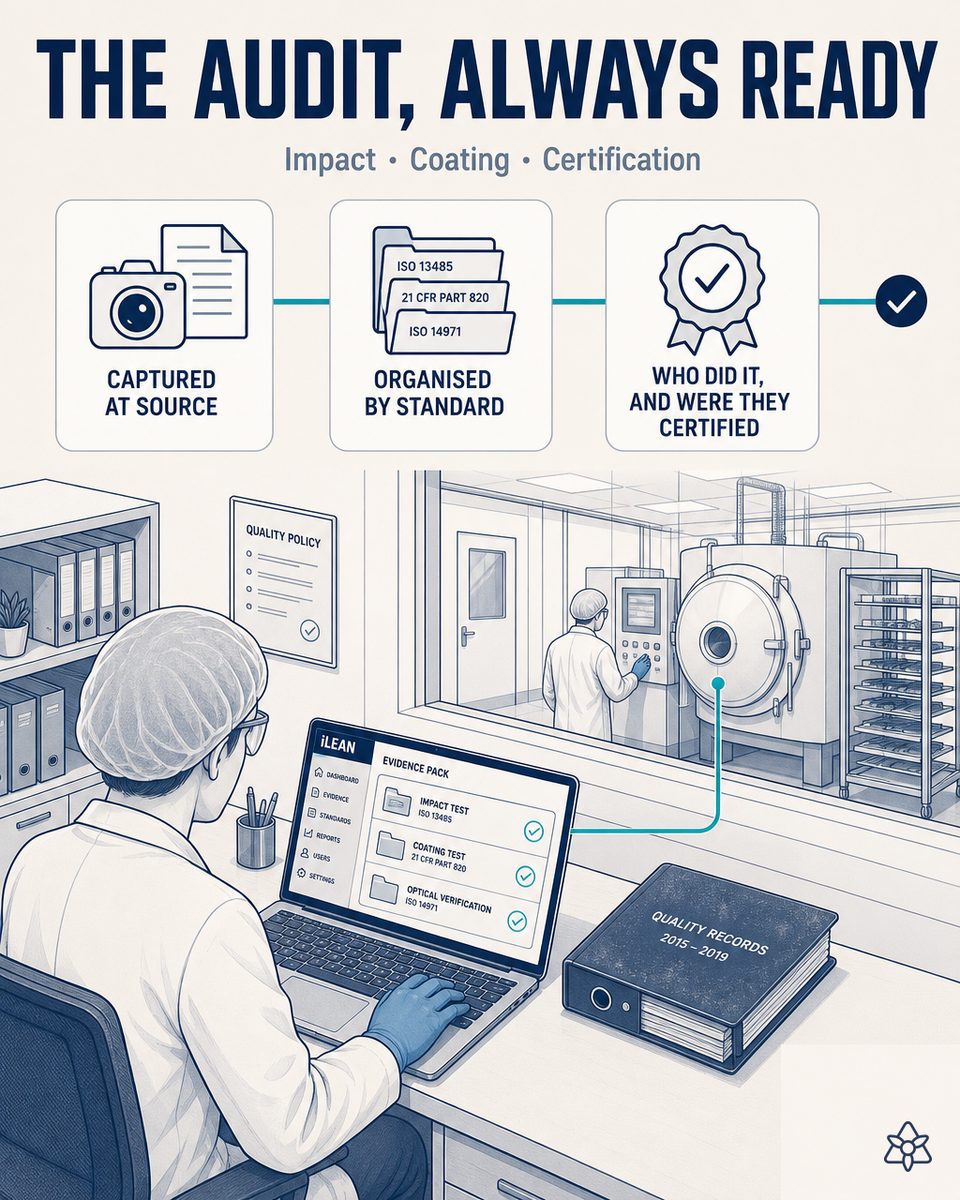
The plant shows folders, the auditor finds gaps, and the gaps are nonconformities.
A plant manufacturing a medical device has the evidence: it tests, verifies, records. What it does not have is that evidence together and organized as the standard asks, and gathering it is work that repeats at every audit:
- One or two weeks of reconstruction per audit — hunting impact test records that must be kept for years, coating tests, optical verifications and the proof that whoever executed each operation was certified to do it.
- The real cost is not the paper — it is that the people reconstructing the evidence are exactly the same ones who should be improving the process. Two weeks of technical team on documentary archaeology are two weeks not spent bringing the remake rate down.
- And the burden is double — a medical device that also crosses a customs border accumulates an enormous documentary load, sustained today by human effort after the fact.
And what is at stake is not a folder: it is market access. Without certification there is no sale, and a documentary gap discovered by the auditor is exactly the most absurd way to put it at risk.
Edge captures the physical evidence, Agents organizes it by standard.
The way for audit preparation to cost zero is not preparing it: having every critical event generate its evidence the moment it happens. The layers already in the rest of the matrix do that; Agents only has to order it — and warn of what is missing while it can still be corrected.
Edge collects photos, measurements and states in the moment. Connect collects reports, tests and validations. Agents organizes it all by certifying standard, detects the gap before the audit — "this batch has no impact test record" — and warns while it can still be corrected. The auditor downloads the period's package without anyone stopping.
How the batch evidence pack is composed:
- Edge — physical evidence in the moment — photos, measurements and states of the critical events: the vacuum chamber's preparation, the cosmetic inspection, the optical verification. It is not a later report: it is the event itself.
- Connect — reports, tests and validations — the shift report, the test laboratory's sheets and the verification station's signatures enter already structured and tied to their batch.
- Agents — organization by certifying standard — the same evidence is presented as each framework asks. The data is not duplicated, the view is reordered.
- Gap detection before the audit — the difference that weighs most: Agents warns that this batch has no impact test record while it can still be corrected, instead of the auditor finding it as a nonconformity.
- Competence evidence included — who executed each operation, with which certification and since when, cross-referenced with the skills matrix Connect keeps alive. It is the hardest part to reconstruct by hand and the one the auditor asks for without fail.
A hand-reconstructed audit vs. an evidence pack assembled at the source
| Aspect | Manual reconstruction | With iLEAN Edge + Connect + Agents |
|---|---|---|
| Preparation per audit | 1-2 weeks of technical team | Zero: it is downloaded |
| Origin of the evidence | Loose folders and systems | The event itself, in the moment |
| Documentary gaps | The auditor finds them — a nonconformity | Detected and closed while hot |
| Operator competence evidence | Reconstructed by hand-cross-referencing | Included: who, with which certification and since when |
| Adaptation to each standard | The dossier is redone | Same evidence, different view |
| Who does the work | The team that should be improving the process | Nobody: the package already exists |
Impact estimate for your plant — to be validated with your own numbers.
The block below is an estimate to be validated against your plant's actual data. We put it forward so the committee has an order of magnitude; we refine it during the assessment.
- Optical plant under a medical device quality system, with periodic audits and an additional documentary load from operating across a customs border.
- Deployment resting on the Edge and Connect cases already running: they generate the evidence, Agents structures it by standard and period. First value expected within a few weeks of events being recorded.
- What is protected is market access — without certification there is no sale —, plus the technical team's time recovered. Estimated payback between 6 and 12 months depending on audit frequency. Estimate to be validated.
- Detecting the gap before the audit is, in practice, the most appreciated return: it turns a potential nonconformity into a routine correction.
- A side effect that appears on its own: when the evidence is always available, the audit stops being an event that disrupts the plant for two weeks.
And the fair question from the quality manager
"Will an auditor accept a dossier assembled by AI?" — the auditor does not accept the dossier, they accept the evidence: the photo, the measurement, the test, the signature and the date, which are the same ones previously scattered. Agents generates no new content: it orders existing evidence against a known standard, which is an anchored task — where the best models brought the error below 1.5% [1] — and every piece is traceable to its origin. And if an event is missing, the pack shows it as a gap, it does not disguise it.
[1] OpenAI paper "Why Language Models Hallucinate", 2025 — on the reliability of AI in anchored tasks.
What people ask about the batch evidence pack in an optical plant
Does the AI write the evidence? What if it invents something?
It does not write evidence: it organizes it. Every element of the package is a record that already existed — an image captured by Edge at the vacuum chamber's preparation, a test fed in by Connect from the laboratory's sheet, a verification station signature with its date and its responsible person — and is traceable to its origin. That is the key point against the hallucination concern: there is no free content generation, there is classification and ordering of existing documents against a known index. And before the dossier leaves the plant, quality reviews it, just as they would review one prepared by hand.
What happens if a record is missing for a specific batch?
The pack shows it as an explicit gap, it neither fills nor disguises it — and that is precisely this case's most valuable function. Today documentary gaps appear when the auditor is already in the plant, and at that moment they are a nonconformity. With the evidence captured at the source, Agents can warn that "this batch has no impact test record" weeks earlier, when the test can still be repeated, the exception documented or the process that caused it corrected. A visible, explained gap before the audit is manageable; a dossier that looks complete without being so is what triggers a major nonconformity.
How is the operator's competence evidence included?
By cross-referencing each operation with the skills matrix Connect keeps alive from the laboratory folder. For each batch, the pack can accredit who executed each operation, with which certification and since when it was valid. It is the hardest part to reconstruct by hand — it demands cross-referencing shift reports, assignment sheets and a training file that is almost always out of date — and it is among the first things a medical device auditor asks for. With the matrix alive and accessible, that cross-reference stops being work and becomes one more column of the dossier.
How much history is needed for it to be useful?
The pack starts having value from the first month of recorded events, but it is worth understanding this case does not work alone: it rests on Edge and Connect already capturing at the source. That is why in the deployment sequence it usually comes after the cosmetic inspection, the preparation validation, the shift report and the laboratory sheets: when those are operating, the evidence pack is practically a consequence. Evidence prior to the deployment keeps being supplied as always, so during the first audit the two forms coexist and from the next one on the manual one is no longer needed.
Does it serve the different frameworks that apply to us?
Yes, and that is why the evidence is kept separate from its presentation. The base data — the impact test, the coating tests, the optical verification, batch traceability and the competence of whoever executed — are the same regardless of who asks. What changes is how they must be ordered and what counts as sufficient proof in each certifying framework. Agents maintains a single source of evidence and several views, so the same period serves one standard or another without reassembling anything from scratch. The auditor picks period and standard, and downloads.
More cases from this series
- Reading the AR chamber’s panel without touching the machineAn external camera reads the anti-reflective chamber’s panel and digitizes each load’s curve without…
- Receiving semi-finished lenses and monomer, with a photoA photo of the delivery note and the pallet labels: batch, quantity and expiry enter the ERP with one…
- Mounting without typing: the prescription travels from the job to the machineTracer, edger and laser marking stitched to the lab management system and the ERP: zero typing of axis…
- The GEMBA walk that enters the system by talkingThe supervisor dictates through an earpiece what they see while walking; iLEAN structures it with line,…
- The test laboratory’s Excel reaches the ERP on its owniLEAN reads the test sheet when it is saved, structures it and feeds it into the ERP after human…
- Catching the prescription change before the lockoutiLEAN reads the email that changes or cancels a prescription, locates the job in transit and stops it…
How many weeks a year do you spend preparing audits?
We work on your plant's real data, not ours. We review what evidence you generate today and what would be missing to download the package. Assessment with no commitment.
See how we would apply it in your plant — review of your next audit ‹ See all 12 eyewear cases See apparel, footwear & accessories