Mounting without typing: the prescription travels from the job to the machine
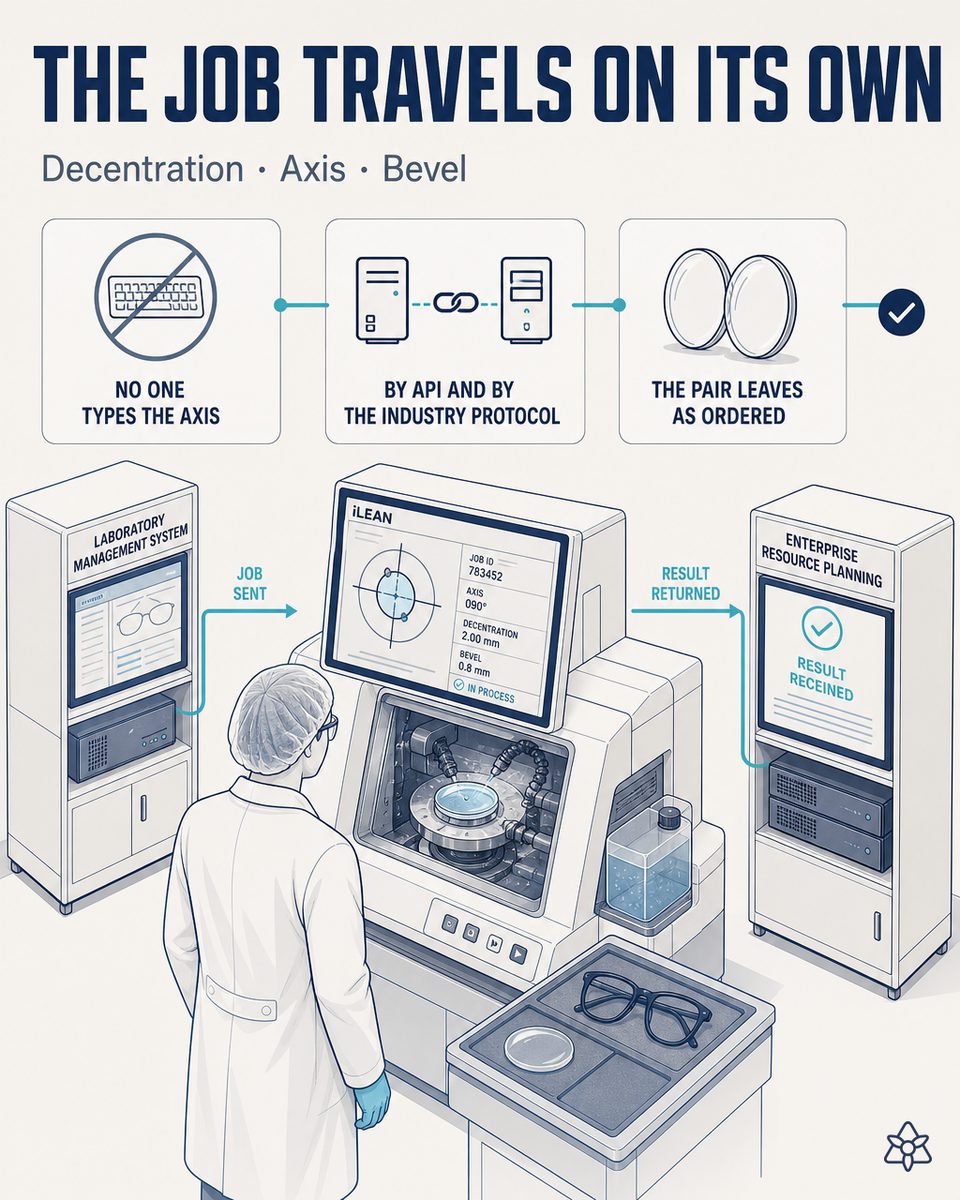
In an optical plant's mounting area the machines already know how to talk: the sector has had a communication standard between the lab software and the machines for years. And yet, someone ends up typing the decentration or the axis into the edger's panel. One misplaced digit is an out-of-tolerance pair reaching the end user. iLEAN stitches the equipment bidirectionally.
The "almost finished" integration is these machines' natural state.
No technology is missing here: the tracer, the edger and the laser marking speak a standard the sector has used for years, and the lab system does too. The problem is where that conversation gets cut off:
- It works for 80% of jobs — the standard job enters through the digital route and comes out fine. Nobody perceives a gap, because most pairs never touch it.
- The remaining 20% is resolved by hand — rimless frames, special drill jobs, new geometries. And that 20% concentrates almost all mounting errors, precisely because it is where someone types the decentration or the axis into the panel.
- It is the last operation before the customer — mounting is where there are the most hands per piece and where no downstream station is left to catch the error. A misplaced digit goes out the door.
The result is a gap invisible in the global indicator — the integration "works" — but which explains a disproportionate share of the remake rate. And it is the most frustrating gap of all, because both sides already know how to talk.
Connect stitching modern systems — via API and the sector's own protocol.
When both ends already have a way to communicate, stitching is not a multi-year project: it is closing a specific gap, that of the jobs falling off the digital route today. Connect does it without replacing any machine and without touching the lab system's insides.
The lab system releases the job and publishes prescription, trace, decentration and marking to the right machine. The machine executes with no intermediate typing and, when finished, returns confirmation and real parameters — which remain as evidence of the mounted pair.
How Connect operates in an optical plant's mounting area:
- Special jobs enter the digital route — rimless frames, special drill jobs and new geometries stop being the exception that gets typed: they are published to the machine just like the standard job. The 20% gap closes where it was open.
- Via the sector's protocol and via API — Connect uses the communication standard these machines already speak, complemented with API where needed. No machine is replaced and the lab software's insides are not touched.
- Bidirectional, not one-way — the machine returns confirmation and the real parameters it executed with. That is what turns the integration into evidence: not only what was requested, also what the machine did.
- Evidence of the mounted pair — those parameters stay associated with the specific pair, so if a claim comes later, the answer exists instead of being reconstructed.
- The operator stops typing and starts verifying — which is where their judgment adds value: checking the first pair of a special series is worth far more than transcribing an axis.
Typing in special jobs vs. the prescription published to the machine
| Aspect | "Almost finished" integration | With bidirectional iLEAN Connect |
|---|---|---|
| Standard job | Enters through the digital route | Same — no change |
| Rimless frames, drill jobs and new geometries | Typed by hand at the panel | Published to the machine, no typing |
| Origin of the decentration and the axis | A copy typed by a person | The job released in the lab system |
| Mounting errors | Concentrated in that 20% | Human-origin error eliminated |
| Confirmation of what was executed | Does not exist | The machine returns real parameters |
| Evidence of the mounted pair | Reconstructed if there is a claim | Recorded at the moment of mounting |
Impact estimate for your plant — to be validated with your own numbers.
The block below is an estimate to be validated against your plant's actual data. We put it forward so the committee has an order of magnitude; we refine it during the assessment.
- Optical plant with a mounting area equipped with tracer, edger and laser marking that already speak the sector's standard, and integration solved for the standard job but not for the special ones.
- Connect pilot stitching the lab system and the mounting equipment bidirectionally. Without replacing machines or touching the lab software's insides. First value expected within a few weeks.
- Estimated payback between 3 and 6 months, through a direct reduction of mounting remakes. Estimate to be validated with your plant's remake cause history.
- It is among the matrix's fastest-return cases because the gap is narrow and the manual work it eliminates is constant — every special series passing through mounting.
- The underlying lever: mounting is the last physical operation before the customer. An error leaving there is caught by no one, and on a prescription lens it is not corrected — the whole pair is remade.
And the fair question from the mounting manager
"Does this force me to open the lab system or change machines?" — no. Connect uses the communication standard these machines already speak, complemented with API where needed: it replaces no machine and does not touch the lab software's insides. On reliability, here the AI does not generate data, it transports it anchored: prescription, trace, decentration and marking come straight from the released job. It is an anchored task, where the best models brought the error below 1.5% [1] — and on top of that the machine confirms back what it executed.
[1] OpenAI paper "Why Language Models Hallucinate", 2025 — on the reliability of AI in anchored tasks.
What people ask about stitching mounting to the lab system
If the machines already speak a standard, why is there still typing?
Because the integration gets deployed for the standard job, which covers most of the volume, and there it works. The special jobs — rimless frames, drill jobs with their own geometry, new shapes that did not exist when the integration was configured — fall outside the planned flow and get resolved the way they always have: someone types the decentration or the axis into the edger's panel. Nobody perceives a problem because the global integration indicator looks fine; what reveals the gap is the remake cause analysis, where that 20% of jobs shows up with disproportionate weight.
Does the edger or the tracer have to be replaced?
No. Connect connects to what the machines already expose — the sector's communication standard and, where needed, their API — and to the lab system through its interface. No hardware is replaced, the lab system's insides are not changed and the mounting circuit is not redone. What gets integrated is not the machine but the data flow: the job is released, published to the right machine and the machine executes. If you change an edger tomorrow, that side's connection is re-pointed and the rest stays the same, because the integration lives in Connect and not in the machine model.
What does bidirectional integration mean?
That it is not one-way. Most integrations publish the prescription to the machine and end there: what was requested is known, not what the machine did. Connect also reads back the confirmation and the real parameters the machine executed with, and associates them with the specific pair. That difference matters for two reasons: it allows detecting in the moment if what was executed does not match what was published, and it leaves evidence of the mounted pair. When a claim arrives weeks later about a specific pair of glasses, the answer exists instead of being reconstructed from memory.
Why is a mounting error so expensive?
Because it is the last physical operation before the customer and where there are the most hands per piece. Everything not caught there goes out the door: no downstream station is left to detect it. And on a prescription lens there is no reprocessing — a wrongly entered axis or a wrong decentration is not corrected, the whole pair is remade, with its substrate, its surfacing and its coating already consumed. Add that the error reaches the end user, who is the one noticing the glasses do not work for them, with the commercial cost that drags along.
How is this case's return sized?
With a figure the plant already has: the remake cause history. It is enough to separate how many remakes originate at mounting and, within those, how many come from a parameter typed by hand in a special job. That subset is exactly what this case eliminates. The estimated 3-to-6-month payback comes from there, and it is among the fastest in the matrix because the gap is narrow and the manual work removed is constant — repeating in every special series passing through mounting. It is an estimate to be validated with your own numbers.
More cases from this series
- The medical device audit, always readyImpact test, coating tests, optical verification and operator competence: the batch dossier assembles…
- Reading the AR chamber’s panel without touching the machineAn external camera reads the anti-reflective chamber’s panel and digitizes each load’s curve without…
- Receiving semi-finished lenses and monomer, with a photoA photo of the delivery note and the pallet labels: batch, quantity and expiry enter the ERP with one…
- The GEMBA walk that enters the system by talkingThe supervisor dictates through an earpiece what they see while walking; iLEAN structures it with line,…
- The test laboratory’s Excel reaches the ERP on its owniLEAN reads the test sheet when it is saved, structures it and feeds it into the ERP after human…
- Catching the prescription change before the lockoutiLEAN reads the email that changes or cancels a prescription, locates the job in transit and stops it…
What percentage of your remakes is born at mounting?
We work on your plant's real data, not ours. We look at your equipment and your lab system and size the gap. Assessment with no commitment.
See how we would apply it in your plant — demo on your equipment ‹ See all 12 eyewear cases See apparel, footwear & accessories