The cosmetic inspection station, powered by AI vision
The cosmetic inspection station is an optical plant's hardest: looking at lenses against the light, one after another, hunting a micron-scale scratch or a speck under the lacquer. The human eye is extraordinary for twenty minutes and degrades measurably from the second hour. Edge puts up a camera with controlled lighting that infers in milliseconds and leaves the decision to the person.
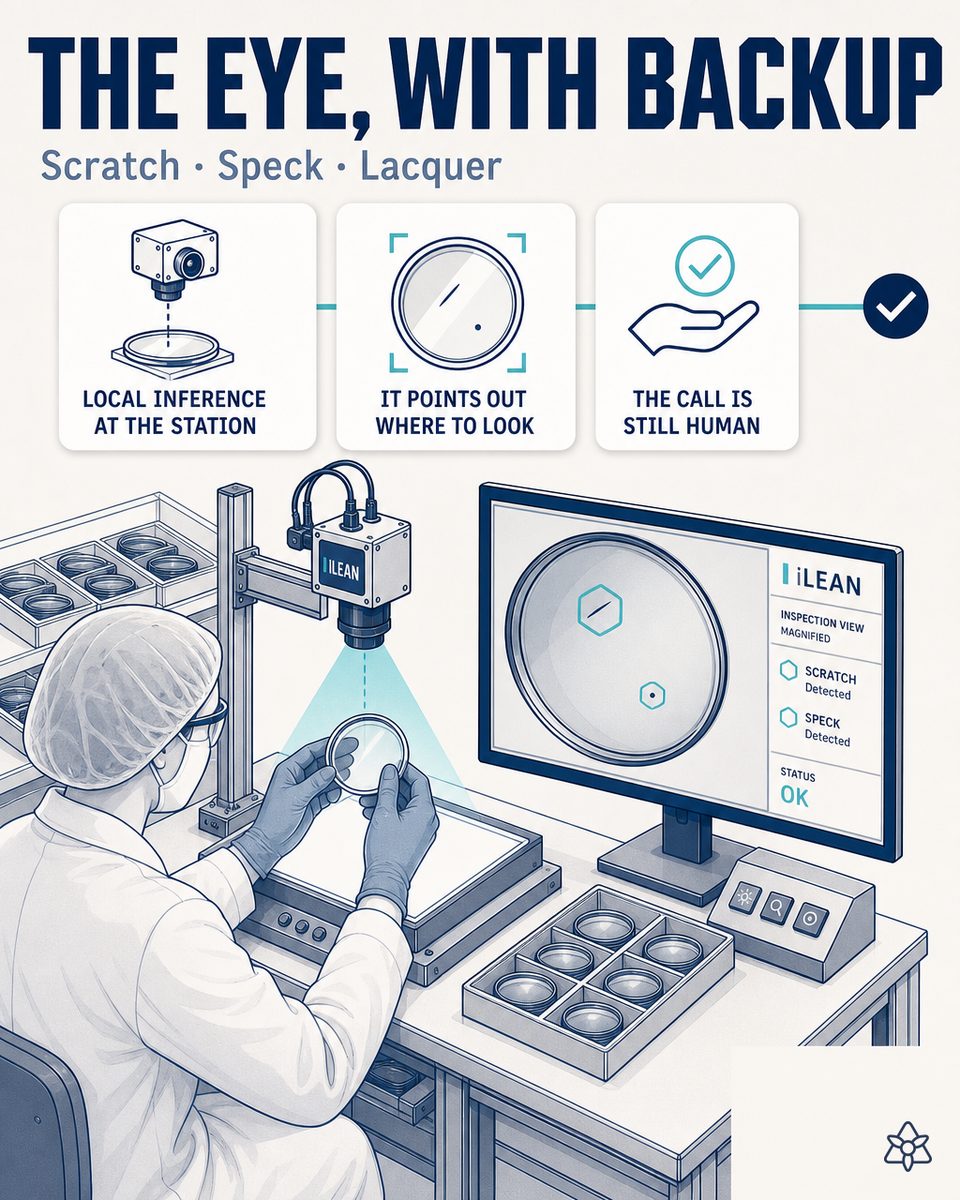
The eye is extraordinary for twenty minutes — and the shift lasts eight hours.
Inspecting lenses against the light hunting a micron-scale scratch or a speck under the lacquer is a task demanding sustained attention, and sustained attention has a physical limit. From there come two problems, and the second is the expensive one:
- What escapes does not come back — it reaches the optician and returns as a return, or reaches the end user and returns as lost trust in the brand. In neither case is the lens recovered: it is remade.
- The criterion varies between inspectors and between shifts — what one rejects, another passes. It is less visible than the defect leakage and costs more, because it produces returns and unnecessary rejections of good product at the same time.
- In ramp-up, that variation explodes — with people training at the station just when the most volume has to ship, the criterion scatters at exactly the worst moment.
And there is no fixing it with training alone: without a common, measurable reference, each inspector builds their own threshold and defends it rightly, because nobody has given them another.
Edge — local inference at the coating exit, and the decision stays human.
The problem is not one of judgment: the veteran inspector tells a real scratch from a reflection perfectly. It is one of rate and sustained attention, which is exactly where machine vision does not tire. Edge does not replace the judgment — it makes it constant and puts it in writing.
A camera with controlled lighting at the coating exit. A model trained on those coatings' real defects, not a generic catalog. Inference in milliseconds per lens, with no image sent to the cloud. The suspect lens is set aside and shown to the person with the defect highlighted — and their decision retrains the criterion.
How Edge operates at the cosmetic inspection station:
- Controlled lighting, not room light — half the problem of cosmetic inspection is lighting. A camera with its own stable lighting sees the scratch the same way on the shift's first lens and its last.
- Trained on your coatings — an anti-reflective and a hard coat do not fail the same way, and a generic defect catalog cannot tell what in your plant is a reject from what is normal finish. The model learns from your product's real defects.
- Local inference, no cloud — the decision is taken in the plant itself, in milliseconds per lens. Neither the latency nor the cost of continuously uploading images is compatible with the real rate, and without network the inspection keeps working.
- The machine proposes, the human decides — the suspect lens is set aside and shown with the defect highlighted. It is not rejected on its own: the person confirms or dismisses, and that is where their judgment keeps ruling.
- Each decision retrains the criterion — the discrepancy between what the model flagged and what the person decided is exactly the signal that unifies the threshold. The criterion stops living in each inspector's head and becomes single, measurable and traceable.
Human cosmetic inspection vs. Edge-powered inspection
| Aspect | Human eye only | With iLEAN Edge |
|---|---|---|
| Consistency along the shift | Degrades measurably after the second hour | The same on the first lens and the last |
| Criterion across inspectors and shifts | Each builds their own threshold | A single, measurable, traceable criterion |
| Cosmetic defect leakage | Returns as a return or as lost trust | Drastic reduction, with evidence per lens |
| Lighting | The room's, variable | Controlled and stable |
| Who decides | The person, with no common reference | The person, with the defect highlighted and a common reference |
| A plant in ramp-up | Criterion variation explodes | The criterion holds while new people enter |
Impact estimate for your plant — to be validated with your own numbers.
The block below is an estimate to be validated against your plant's actual data. We put it forward so the committee has an order of magnitude; we refine it during the assessment.
- High-volume optical plant with a cosmetic inspection station at the coating exit and returns for scratch, speck or halo.
- Edge pilot on the coating exit: camera with controlled lighting, a local inference terminal and training on your coatings' real defects. First value expected within a few weeks.
- Indicative payback between 5 and 12 months depending on the current cosmetic return rate and the cost of the remade pair. Estimate to be validated.
- The least obvious and most durable return is the unification of the criterion: it reduces both leakage and unnecessary rejections of good product, a cost that is almost never measured.
- In a ramping plant, moreover, it is what lets the inspection station stop depending on how many years the person there that night has.
And the fair question from the quality manager
"What if the camera sets good lenses aside and sinks my yield?" — the right concern, and that is why the threshold is calibrated with your lenses and your coatings, not from the factory. Hallucination, moreover, is a problem of free generation: classifying an image against a pattern trained on your own product is an anchored task, where the best models brought the error below 1.5% [1]. And the lenses set aside are not rejected on their own: they pass through the person, who decides — and that decision is what refines the model.
[1] OpenAI paper "Why Language Models Hallucinate", 2025 — on the reliability of AI in anchored tasks.
What people ask about cosmetic inspection with AI vision
Does this replace the inspector?
No, and the design prevents it on purpose: the machine proposes and the human decides. Edge sets the suspect lens aside and shows it to the person with the defect highlighted, but they sign the rejection. What changes is not who decides, but with what: instead of hunting a micron-scale scratch against the light in the shift's seventh hour, the person reviews an already-located candidate and decides whether it is a defect or not. The station stops being a task of visual endurance and becomes one of judgment, which is where a person adds value and a camera does not.
Why does the model have to be trained on our lenses?
Because in optics what counts as a defect depends on the coating and the product. A high-end anti-reflective shows a speck a hard coat conceals; a halo can be a reject in one product and within specification in another. A generic defect catalog does not know those borders and produces two problems at once: it rejects the good and lets the bad through. Training on your coatings' real defects, the model learns where your limit is — which is the one the optician and the end user later argue about.
Can it keep up with the station's real rate?
Yes, because inference happens locally, in the plant itself, and is counted in milliseconds per lens. That is the reason for not using the cloud: neither the latency nor the cost of continuously uploading images fits the station's pace. And it has a welcome side effect: if the plant loses connectivity, the inspection keeps working, because the critical cycle does not depend on the network. What syncs afterwards is the per-lens record, not the decision.
How exactly is the criterion unified across shifts?
Because all shifts share the same reference and all discrepancies get recorded. When the model flags a lens and the inspector passes it, or the reverse, that difference is noted and serves two purposes: refining the model's threshold and making visible that the night shift is applying a different criterion from the morning's. The latter cannot even be demonstrated today — it is intuited. With evidence per lens, the conversation stops being "I feel like more get through at night" and rests on data, which is the only way to correct it without pointing at anyone.
Are the physical reference patterns we already keep useful?
Yes, and they are an excellent starting point. If the plant already maintains physical patterns of the cosmetic defect — reference lenses with the borderline scratch, speck or halo — that collection is exactly the calibration material the model needs, because it embodies the criterion the house has already agreed. If they do not exist, they are built during the pilot by marking real conforming and nonconforming lenses. In both cases the result is the same: the criterion stops being tacit and becomes written in something that can be consulted, audited and taught to newcomers.
More cases from this series
- The medical device audit, always readyImpact test, coating tests, optical verification and operator competence: the batch dossier assembles…
- Reading the AR chamber’s panel without touching the machineAn external camera reads the anti-reflective chamber’s panel and digitizes each load’s curve without…
- Receiving semi-finished lenses and monomer, with a photoA photo of the delivery note and the pallet labels: batch, quantity and expiry enter the ERP with one…
- Mounting without typing: the prescription travels from the job to the machineTracer, edger and laser marking stitched to the lab management system and the ERP: zero typing of axis…
- The GEMBA walk that enters the system by talkingThe supervisor dictates through an earpiece what they see while walking; iLEAN structures it with line,…
- The test laboratory’s Excel reaches the ERP on its owniLEAN reads the test sheet when it is saved, structures it and feeds it into the ERP after human…
Do you keep physical reference patterns for the cosmetic defect?
We work on your plant's real data, not ours. With your own lenses we show you what it detects and with what margin. Assessment with no commitment.
See how we would apply it in your plant — test with your lenses ‹ See all 12 eyewear cases See apparel, footwear & accessories