Validating the vacuum chamber’s preparation before starting
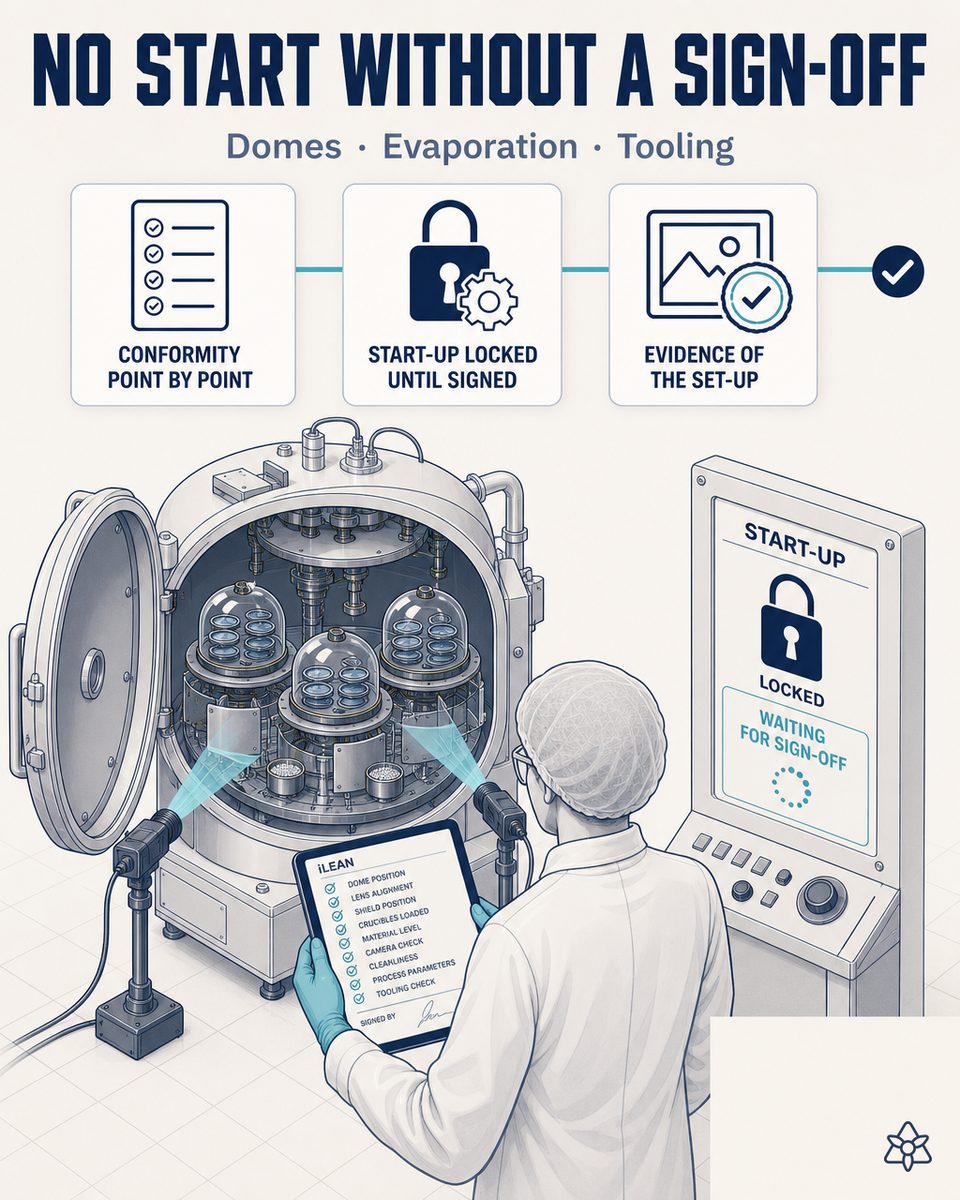
Between loads, and above all after maintenance, the vacuum chamber has to be prepared: shields, evaporation material, tooling and lenses in the domes. If something is off, it is not noticed until three or four hours later, with an entire load of already surfaced and hard-coated lenses lost. Edge compares against the reference state and does not let the cycle start until the signature.
The plant's most expensive critical changeover is signed on one person's word.
The vacuum chamber's preparation resembles no other changeover in the plant: the error does not show at startup, but three or four hours later, when the cycle ends. And by then there is nothing left to save:
- A lost load is scrap of nearly finished product — lenses already surfaced and hard-coated, with all their added value on them, plus several hours of the plant's most expensive machine. It is not an expensive failure: it is the expensive failure.
- Today it depends on a signature with no evidence — a technician signs "prepared" with nothing but their word behind it. Not because it is taken lightly, but because no cheap way exists to check it point by point.
- It is the operation most dependent on individual experience — exactly what is scarce when the workforce grows fast and there are new technicians on the night shift.
The result is a risk everyone knows and nobody can bound: the plant knows a load is lost every so often, and knows it almost always comes from the preparation, but has nothing to prove it with or a way to avoid it.
Edge + JIDOKA AI — point-by-point conformity and a startup block until the signature.
Here the AI does not replace the technician's judgment: it puts evidence in front of them and takes off their shoulders the burden of assuming alone a risk they had no way to check. Fixed cameras at the critical points compare the real state against the reference state and return a verdict per point.
Fixed cameras at the preparation's N critical points, with models trained to tell "prepared" from "not prepared" at each. JIDOKA AI prevents the cycle's startup until all give conformity, the responsible person signs on that evidence — not on their memory — and the preparation is timed point by point.
How Edge operates on the vacuum chamber's preparation:
- A verdict per point, not one global one — shields, evaporation material, tooling and lenses in the domes are evaluated separately. If something fails you know exactly what to redo, instead of redoing the whole preparation.
- Comparison against the reference state — each model learns how that point looks when well prepared in that installation. It does not measure generically: it compares against what the house has defined as correct.
- JIDOKA AI: a block, not an alert — while one point does not give conformity, the cycle does not start. It is not an alert that schedule pressure can skip: it is a block until the evidence is complete.
- The signature stays human — the responsible person signs, but on the visual evidence of each point instead of on their memory. What changes is not who authorizes, but with what.
- The preparation timed point by point — and comparable between shifts. That is exactly the raw material missing today for a real SMED project on the plant's bottleneck.
Signing blind vs. a preparation validated with evidence
| Aspect | Preparation signed without evidence | With iLEAN Edge + JIDOKA AI |
|---|---|---|
| Basis of the signature | The technician's word | Visual evidence point by point |
| When the error is detected | 3-4 h later, with the load lost | Before starting the cycle |
| A lost load | Scrap of nearly finished product + hours of the most expensive machine | Avoided |
| Startup with a nonconforming point | Possible | Blocked until conformity |
| Dependence on individual experience | Maximum — and critical on the night shift | The reference state is the same for everyone |
| Preparation time | Not measured | Timed point by point and comparable between shifts |
Impact estimate for your plant — to be validated with your own numbers.
The block below is an estimate to be validated against your plant's actual data. We put it forward so the committee has an order of magnitude; we refine it during the assessment.
- Optical plant with an anti-reflective vacuum chamber, whose between-load and post-maintenance preparation is signed today without structured evidence.
- Edge + JIDOKA AI pilot on the preparation's critical points, with startup blocking and a timed record. Without changing the procedure or who signs. First value expected within a few weeks.
- Indicative payback between 4 and 10 months, dominated by the lost loads avoided; the preparation time saving is additional. Estimate to be validated with the lost-load history.
- The figure that best sizes the case is not an external estimate: it is how many loads your plant lost this year and what each was worth in lenses and machine hours.
- A return that appears later: with the preparation timed point by point, for the first time there is data for a real SMED on the bottleneck — today it cannot be done because the operation is not measured.
And the fair question from the coating manager
"Won't this block my machine every five minutes?" — the block only acts when a critical point does not give conformity, which is exactly the startup you do not want to make: the one ending in a lost load. On the verdict's reliability, comparing a point's image against its validated reference state is an anchored task, not free generation, and there the best models brought the error below 1.5% [1]. And if a camera loses its reading, the system fails closed: absence of data is not conformity.
[1] OpenAI paper "Why Language Models Hallucinate", 2025 — on the reliability of AI in anchored tasks.
What people ask about validating the vacuum chamber's preparation
Which points exactly are checked?
The ones determining whether the load will come out right: the shields, the evaporation material, the tooling and the lenses placed in the domes. Each has its camera and its verdict, because bundling everything into a single "prepared" loses the information that is needed: if something fails, you must know which point to redo without redoing the whole preparation. The concrete list is tuned at the assessment to the real installation, because not all vacuum chambers have the same configuration or the same points where the preparation goes wrong.
Why does the error take three or four hours to show?
Because that is how long the vacuum chamber's cycle lasts. A badly placed shield, insufficient evaporation material or a lens badly seated in the dome do not prevent the cycle from starting or running: the problem appears on opening, when the coating is already deposited — badly — over the whole load. That asymmetry between the moment of the error and the moment of the consequence is what makes this case so expensive and what explains why the control is worth placing before the startup: it is the only instant when correcting still costs minutes.
Who signs in the end, the system or the technician?
The technician, always. JIDOKA AI enables the startup when all points give conformity, but the responsible person's signature still exists and is still what authorizes. What changes is what it is signed with: today "prepared" is signed with one's own memory as the only backing; with Edge it is signed with the visual evidence of each point in front. It is an important difference on the human side too, because it relieves the technician of assuming alone a risk of thousands of euros they had no cheap way to check — above all if they are new and on the night shift.
What happens if a camera fails or cannot read a point?
The system fails closed: absence of data is not interpreted as conformity. If a camera loses its reading — dirty optics, an obstruction, anomalous lighting — the point is left without a verdict and the startup stays blocked until a person resolves it, whether by cleaning the optics or validating that point manually and leaving a record. It is deliberately the conservative option: in an operation where the failure costs an entire load of nearly finished product, assuming conformity by default would be exactly the behavior you do not want.
How does this help run a SMED on the vacuum chamber?
Because for the first time the preparation is measured. Today its total duration is known, approximately; how long each point takes and what differences exist between shifts or technicians is not. With it timed point by point and comparable, the raw material of a real SMED project on the plant's bottleneck appears: where the time goes, which operations could be made external to the cycle and which differences between people point to a good practice worth standardizing. It is a return that was not in the initial calculation and that tends to weigh as much as the avoided loads.
More cases from this series
- The medical device audit, always readyImpact test, coating tests, optical verification and operator competence: the batch dossier assembles…
- Reading the AR chamber’s panel without touching the machineAn external camera reads the anti-reflective chamber’s panel and digitizes each load’s curve without…
- Receiving semi-finished lenses and monomer, with a photoA photo of the delivery note and the pallet labels: batch, quantity and expiry enter the ERP with one…
- Mounting without typing: the prescription travels from the job to the machineTracer, edger and laser marking stitched to the lab management system and the ERP: zero typing of axis…
- The GEMBA walk that enters the system by talkingThe supervisor dictates through an earpiece what they see while walking; iLEAN structures it with line,…
- The test laboratory’s Excel reaches the ERP on its owniLEAN reads the test sheet when it is saved, structures it and feeds it into the ERP after human…
How many loads have you lost this year to a bad preparation?
We work on your plant's real data, not ours. With your lost-load history we calculate the case with you. Assessment with no commitment.
See how we would apply it in your plant — demo on your preparation ‹ See all 12 eyewear cases See apparel, footwear & accessories