The human gate that makes AI signable in a medical device
What separates iLEAN from an autonomous agent inserting data on its own is a simple rule: nothing it captures crosses into the central system without a human having seen it. In an optical plant that is a tablet at the verification station confronting prescribed and measured prescription, highlighting the deviation, signed with two taps.
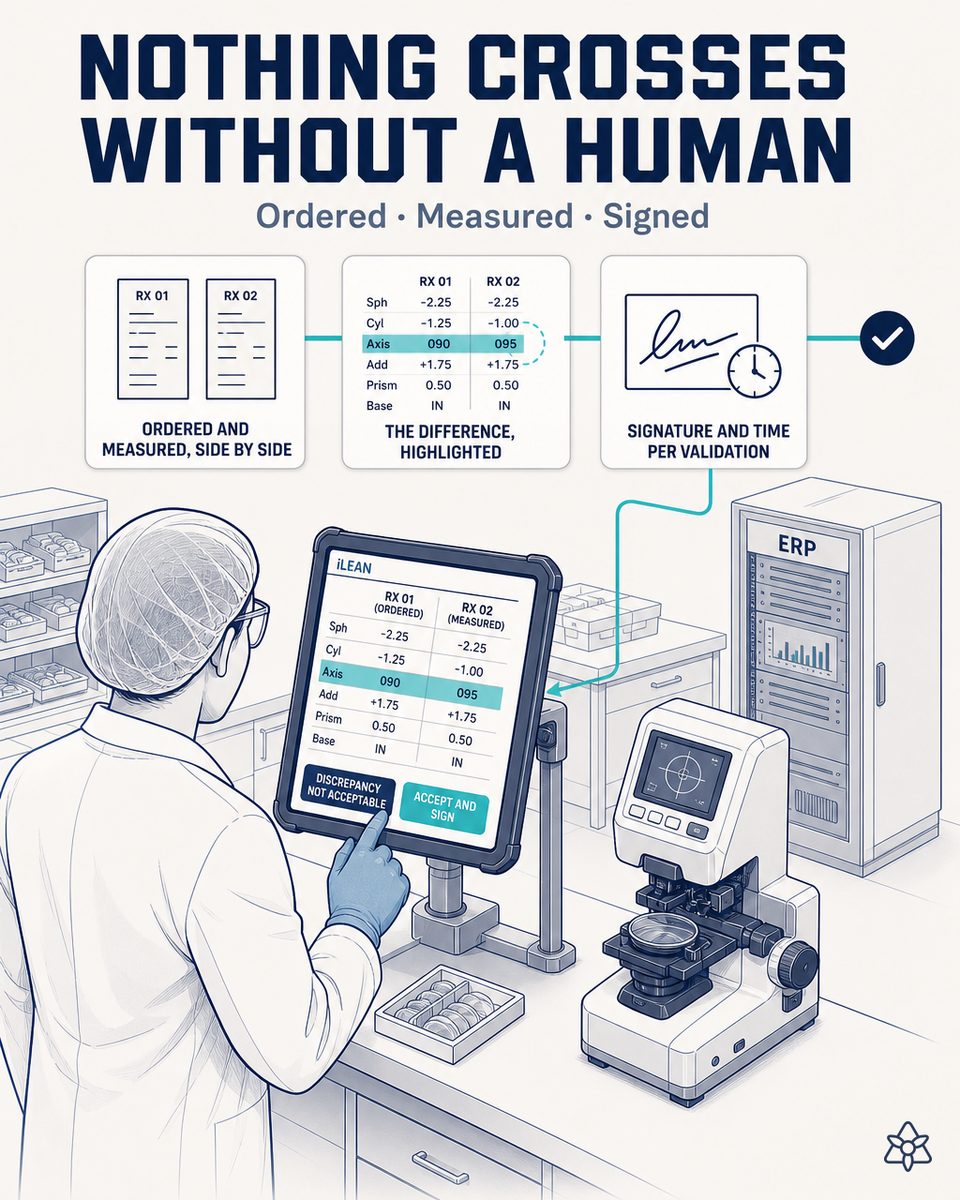
The two brakes stopping digitization in medical devices — and both are legitimate.
In a plant manufacturing a medical device, the quality master sustains the conformity of everything leaving through the door. That is why when automatic data capture is proposed, two objections appear in the first meeting, and neither is irrational:
- "An automatic system is going to write into the quality master" — it is the fear that stalls any digitization, and it is legitimate: cleaning a contaminated master costs more than not having filled it. Whoever signs conformity does not want a system writing on its own.
- "The operator does not want to type either" — and they are right: every second on a form is a second not verifying lenses. Any solution adding screens and fields to the station gets abandoned in weeks.
- The usual way out is the worst of both worlds — data captured by hand, late and partial, and a quality system that does not reflect what really happened on the line.
The contradiction is only apparent: what is needed is not choosing between automating and controlling, but separating the capture (which can be automatic) from the validation (which must be human, but can take two seconds).
Connect in early-human-verification mode — a UI for validating, not for typing.
The design key is in the verb. A data entry screen asks for writing and gets abandoned. A validation screen shows what the AI understood and asks for a gesture: correct, or fix me. The first competes with the operator's work; the second takes less than picking up a pen.
Everything iLEAN captures — the lensmeter reading, the report photo, a voice dictation, a parsed email — appears on the station's tablet as a two-second visual summary, confronting prescribed and measured prescription with a tolerance traffic light from the prescription standard. The person accepts or corrects with two taps. Only then does the data cross into the lab system and the ERP.
How early human verification operates at the verification station:
- Prescribed versus measured prescription — the screen does not show loose numbers: it confronts what the order asked for with what the lensmeter measured, which is exactly the comparison the operator already makes mentally.
- A tolerance traffic light from the standard — the deviation is highlighted against the applicable prescription tolerance, so what demands attention jumps out and the rest is confirmed at a glance.
- Two taps, not a form — the default interaction is accepting. Correcting is the exception, and when it applies the specific field is corrected, the whole record is not rewritten.
- Any origin, the same screen — whether the data comes from the lensmeter, a photo, a dictation or a parsed email, Connect normalizes it to the same summary before showing it. The operator does not learn one interface per channel.
- Who validated and when is recorded — every signature carries person and moment, and that later feeds the batch evidence pack with no extra work: not only the data, but who answered for it.
Automating without validating vs. early human verification
| Aspect | "Autonomous" automatic capture | With iLEAN Connect + tablet |
|---|---|---|
| The quality master | Risk of silent contamination | Only what a person signed enters |
| The operator's time | Forms that get abandoned | Two taps on a visual summary |
| Prescribed ↔ measured comparison | Mental, unrecorded | On screen, with a tolerance traffic light |
| Low-confidence data | Enters all the same, indistinguishable | Arrives highlighted and is reviewed first |
| Traceability of the signature | The data is known, not who backed it | Person and moment recorded |
| The quality system's stance | Project blocked | The responsible person keeps control |
Value of this piece — enabling and regulatory, before monetizable.
This case is deliberately not presented with a payback in months: its value is structural, and it is what lets the rest get signed.
- Optical plant under a medical device quality system that wants to automatically capture readings, reports and notices, but needs to guarantee the master's integrity.
- Pilot of the tablet at the verification station together with the first capture case. It is not deployed on its own: it is the piece that makes the others signable. First value expected within a few weeks.
- Its value is strategic and regulatory before directly monetizable: without early human verification, the rest of the architecture does not get signed in a regulated environment. Estimate to be validated together with the cases it enables.
- The measurable effect appears in the other cases: they are the ones bringing payback, and they only pass the committee if this piece is in front.
- A data governance benefit: every record keeps its origin, its confidence level and the person who validated it — which is exactly what a quality system auditor asks for and does not find today.
And the fair question from the quality director
"If every capture must be validated, don't we end up as loaded as when typing?" — no, because validating and typing do not cost the same. Typing a record is tens of seconds plus the load of remembering what goes in each field; validating is reading a summary with the deviation already highlighted and confirming. In practice the gesture is counted in seconds and concentrates at the station that already has that function. And it is precisely that validation which lets the AI work on anchored tasks safely: even with an error below 1.5% [1], that remainder never reaches the master.
[1] OpenAI paper "Why Language Models Hallucinate", 2025 — on the reliability of AI in anchored tasks.
What people ask about early human verification in optics
Why not let the AI write directly into the quality system?
Because the cost of a contaminated master far exceeds the saving of skipping validation, and in a medical device that cost is not only economic. An erroneous data point does not stay still: it propagates to the batch's traceability, to the audit evidence and to the decisions taken downstream, and cleaning it afterwards costs more than reviewing it beforehand. That is why in iLEAN human validation is not a configuration option but a design principle: capture can be automatic, entry into the master cannot. It is also what lets the quality manager back the project before the committee instead of blocking it.
How long does validating at the station really take?
The interaction is designed to take a few seconds per capture, because it is not a data entry screen but a confirmation one: prescribed and measured prescription are confronted, the deviation is highlighted against the standard's tolerance and the default gesture is accepting. Correcting is the exception, and when it applies the specific field is corrected, the record is not rewritten. Compared with what the operator does today — verifying mentally and noting by hand afterwards, time permitting — the difference is not only speed: there is a record that the verification happened and of who did it.
What happens if the operator does not validate in time?
The data stays pending and visible, it is neither lost nor entered by administrative silence. The capture is already made and stored with its evidence; what waits is the signature. If pending validations pile up, that itself is a management signal — either the volume is badly sized, or a station needs covering. What never happens is an unsigned data point appearing in the master as if validated: that boundary is what sustains the whole system's trust and what an auditor will check.
Does the same tablet serve all capture origins?
Yes, and it is deliberate. The tablet is the convergence point: whether the data comes from the lensmeter reading, the photo of a shift report, a voice dictation at the GEMBA or a parsed email with a prescription change, Connect normalizes it to the same visual summary before showing it. The operator does not have to learn a different interface depending on where the data came from or remember which channel demands which gesture. A single two-tap pattern, whatever the origin.
How does this help in a quality system audit?
Because it completes the chain that today is almost always broken. Every record keeps three things an auditor values: the origin (the reading, photo or email it came from), the confidence level with which the AI interpreted it and the person who validated it, with their moment. Against the classic model — a transcribed data point with no record of where it came from or who entered it — the difference is substantial. And that same information later feeds the batch evidence pack without anyone preparing it twice.
More cases from this series
- The medical device audit, always readyImpact test, coating tests, optical verification and operator competence: the batch dossier assembles…
- Reading the AR chamber’s panel without touching the machineAn external camera reads the anti-reflective chamber’s panel and digitizes each load’s curve without…
- Receiving semi-finished lenses and monomer, with a photoA photo of the delivery note and the pallet labels: batch, quantity and expiry enter the ERP with one…
- Mounting without typing: the prescription travels from the job to the machineTracer, edger and laser marking stitched to the lab management system and the ERP: zero typing of axis…
- The GEMBA walk that enters the system by talkingThe supervisor dictates through an earpiece what they see while walking; iLEAN structures it with line,…
- The test laboratory’s Excel reaches the ERP on its owniLEAN reads the test sheet when it is saved, structures it and feeds it into the ERP after human…
Would you let an AI write into your quality master unsigned?
We work on your plant's real data, not ours. We show you the validation working on your own captures. Assessment with no commitment.
See how we would apply it in your plant — validation demo ‹ See all 12 eyewear cases See apparel, footwear & accessories