Print defects detected meter by meter
Printed fabric runs at tens of meters per minute, over two and a half meters wide. An inspector can watch it for hours, but the eye tires: a color stain, a misregistered design, a weft bar or a doctor-blade streak go unseen and show up later, sewn into a finished comforter. iLEAN Edge places cameras at the printer exit and on the inspection frame, analyzes every meter in milliseconds and marks the exact position of the defect in the roll. The cutting room receives the roll's defect map and avoids them when spreading. The inspector stops searching and starts deciding.
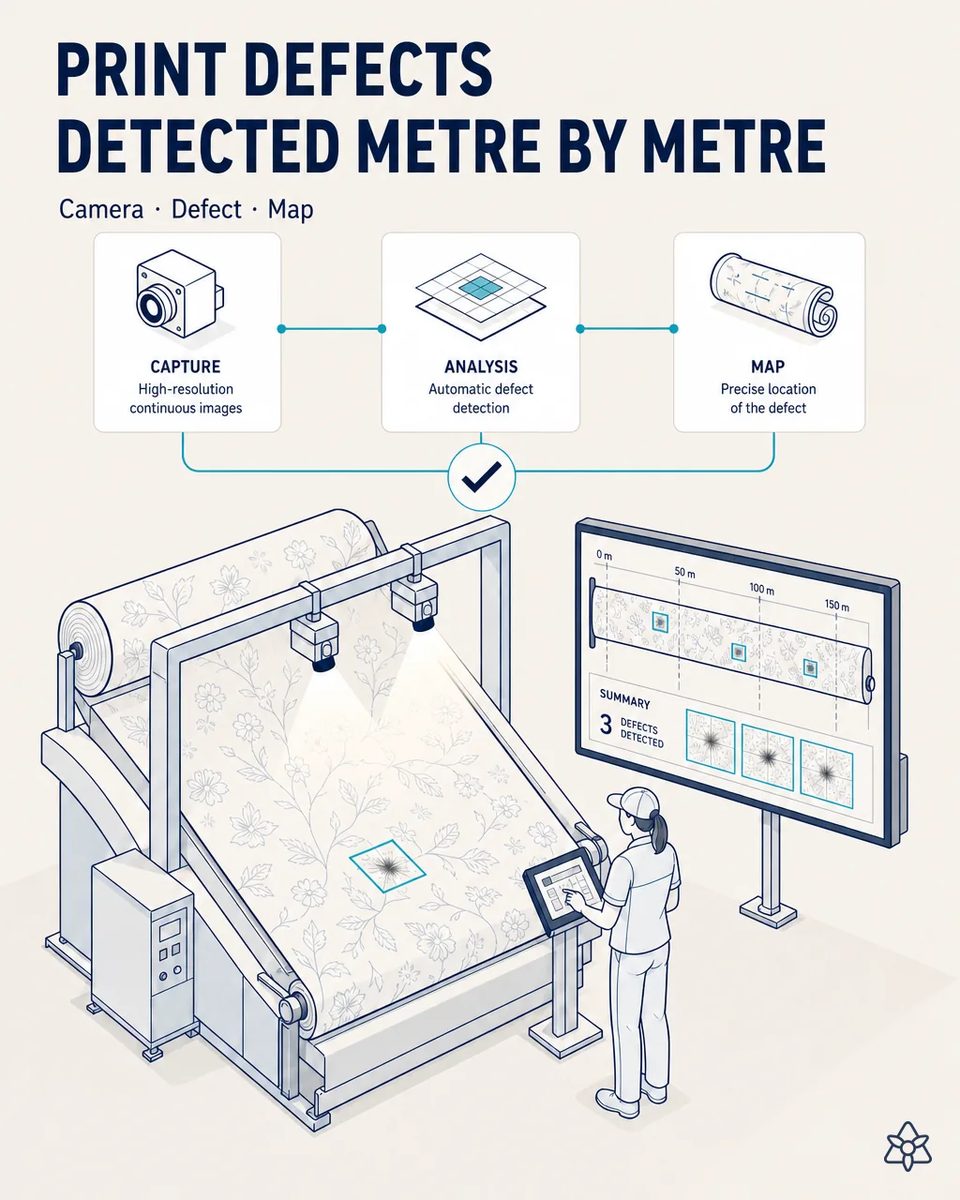
A doctor-blade streak can run for hundreds of meters before a tired eye sees it.
One hundred percent visual inspection, at machine speed and for a whole shift, is humanly impossible. Print defects that slip through are found in sewing, with all the value already added, or in the customer's home. A continuous defect, such as a blade streak or a misaligned screen, can repeat for hundreds of meters before anyone sees it. Every extra meter is fabric, ink, water and energy that cannot be recovered.
- Printed fabric runs at tens of meters per minute and over two and a half meters wide. Inspecting all of it by eye for a whole shift is humanly impossible.
- A color stain, a misregistered design, a weft bar or a doctor-blade streak goes unseen and shows up later, sewn into a finished comforter.
- A continuous defect, such as a blade streak or a misaligned screen, repeats for hundreds of meters, and every extra meter is fabric, ink, water and energy that cannot be recovered. The inspector who finally sees it usually cannot say where on the roll it started.
- Defects that slip through are found in sewing, with all the value already added, or in the customer's home as a return. By then the cost includes fiberfill, quilting, sewing, packing and freight, not just the printed fabric.
Edge vision at the printer exit — every meter classified locally, defect map per roll.
Edge: neural-network vision running locally, next to the machine, without sending images to the cloud. The model is trained on the plant's real designs and defects. Immediate alert to the operator on a continuous defect; defect map per roll sent to cutting. Stopping the machine is the operator's decision. Step-by-step flow:
The inspector stops searching and starts deciding. The cameras do the part people cannot sustain, watching every meter, and the operator decides whether to stop the printer. The cutting room receives the roll's defect map and spreads around the defects instead of sewing them into a comforter. Value is added only to fabric that deserves it.
- Cameras see the full fabric width at the printer exit.
- The local model classifies each defect and records the exact meter.
- If the defect repeats, the operator gets the alert and decides to stop and correct.
- Cutting receives the roll's defect map and avoids them when spreading.
Printed fabric inspection by eye versus Edge vision
| Aspect | Today | With iLEAN Edge |
|---|---|---|
| Share of printed meters inspected | Sampling or a tired eye | 100% of the width and length |
| Doctor-blade streak or misaligned screen | Seen after hundreds of meters | Alert within the first meters |
| Where a print defect is found | In sewing or at the customer's home | At the printer exit |
| Defect position on the roll | A chalk mark, sometimes | Exact meter on the roll's defect map |
| Spreading around defects | Depends on who notices | Cutting receives the map |
| Stopping the printer | The operator | Still the operator, with the alert |
Sampling or tired-eye inspection becomes one hundred percent of meters seen. A continuous defect running for hundreds of meters becomes an alert within the first meters.
Impact estimate — to be validated with your current share of seconds.
The block below is an estimate to be validated against your plant's actual data. We put it forward so the committee has an order of magnitude; we refine it during the assessment.
- Estimated reduction in seconds of 30% or more, measured against the current share of printed fabric downgraded.
- Estimated payback 5-12 months, depending on the current level of seconds and reprocessing in printing and in sewing.
- Fewer meters of fabric, ink, water and energy lost to a continuous defect nobody saw in time, because the alert arrives within the first meters.
- Defects avoided at the spreading table instead of discovered in a finished comforter or a returned parcel. Each roll arrives at cutting with its defect map, so the spreader cuts around flaws instead of sending them on to quilting and sewing.
Estimated payback of 5 to 12 months depending on the current level of seconds and reprocessing; a reduction in seconds of 30% or more. Estimate to be validated.
And the fair question from the production manager
“What if the camera flags our own design as a defect?” — that is the real risk with busy florals and geometrics, which is why the model is trained on your real designs and defects, not on a generic one. Classifying a known defect type at a known position is an anchored task, where the best models drop below 1.5% error [1], and borderline cases go to the operator to decide, feeding back into training. A new collection is added with a short training round on its designs.
[1] OpenAI paper "Why Language Models Hallucinate", 2025 — on the reliability of AI in anchored tasks.
What people ask about AI vision on printed bedding fabric
Does it keep up with the printer's speed and full width?
Yes. Inference runs locally next to the machine, resolves each frame in milliseconds and does not depend on the plant network or the cloud. Cameras cover the full width of the fabric at the printer exit.
Which print defects does it detect?
Color stains, misregistration, weft bars, doctor-blade streaks and screen misalignment, plus any defect your inspectors already classify. The catalog of defects is built with your quality team at commissioning.
Does it stop the printer automatically?
No. On a continuous defect it alerts the operator, who decides whether to stop and correct. Stopping the machine remains a human decision. The alert includes an image of the defect and its meter so the decision takes seconds.
How does the cutting room use the defect map?
Each roll arrives with the meter position of every defect, so the spreader can cut around them instead of sending a flawed panel to sewing. Fewer flawed panels mean fewer comforters reworked or sold as seconds.
Do images of our designs leave the plant?
No. The model runs on Edge hardware next to the machine and images are processed locally, which also protects unreleased catalog designs. Only defect records, positions and statistics per roll are shared with central memory.
More cases from this series
- What the catalog showed is what arrives homeFour verification rings, from fabric received to parcel, so the product delivered is the one in the…
- Every lot's file, ready for auditEvery fabric lot generates its own file: lab results, validated start-up, photos and signatures, sorted…
- The cutting order reaches the system with a photoPhotograph the cutting order and traveler sheet: rolls, dye lot and meters reach the system in seconds,…
- The fabric supplier's notice becomes a decisioniLEAN reads the fabric supplier's notice, matches it against the production plan and proposes which…
- The textile lab spreadsheet reaches the ERP by itselfiLEAN reads the textile lab spreadsheet when saved and, after human validation, posts it to the ERP.…
- Marker and cutter, stitched to the ERPiLEAN stitches marker CAD and the automatic cutter to the ERP: orders flow down and real fabric…
Tell us what share of your printed fabric ends up as seconds today.
We work on your plant's real data, not ours. Assessment with no commitment.
Request estimated ROI within 48h ‹ See all cases of bedding See apparel