The textile lab spreadsheet reaches the ERP by itself
In a plant that prints, dyes and sews bedding, the lab tests every fabric lot: color fastness to washing and rubbing, shrinkage, fabric weight, width and color difference against the approved standard. The results go into a spreadsheet in a shared folder. The ERP, which releases the lot for cutting, cannot see that file: someone has to retype it. iLEAN Connect observes the folder, reads the file every time it is saved, structures the results per lot and, once the lab lead validates them, posts them to the ERP through its API. The lab keeps its spreadsheet and the lot is released with data, not with a phone call.
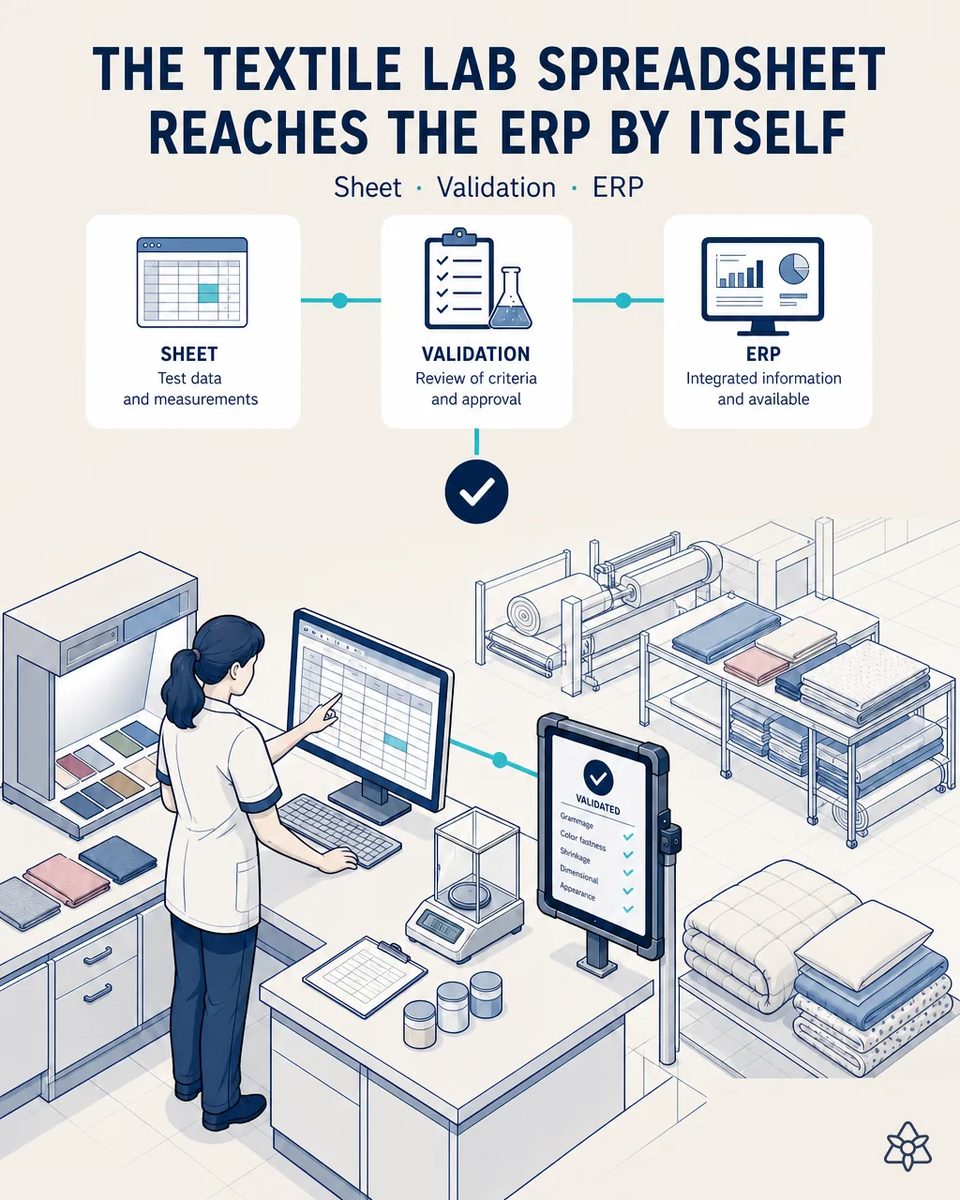
The fabric lot is released for cutting by phone, and the test results stay in a file.
There are two parallel worlds: the real spreadsheet, with the lab's live data, and the official ERP, with data retyped late or incomplete. The lot is released for cutting by a call or a message, and the evidence stays in a file nobody cross-checks. When a complaint arrives about shrinkage or color bleeding, finding that lot's lab result means opening files one by one. And several people keep an ERP user only to enter quality results.
- The lab tests every fabric lot: color fastness to washing and rubbing, shrinkage, fabric weight, width and color difference against the approved standard.
- The results go into a spreadsheet in a shared folder. The ERP that releases the lot for cutting cannot see that file, so someone retypes it, late or incomplete. Meanwhile cutting either waits for a call or starts on a lot whose tests nobody has confirmed, which is how a lot that bleeds color ends up sewn into a full set.
- Meanwhile the lot is released by a call or a message, and the evidence stays in a file nobody cross-checks against the order.
- When a complaint about shrinkage or color bleeding arrives, finding that lot's results means opening files one by one. And several people keep an ERP user only to enter quality data, a license cost paid month after month for typing.
Connect watching the lab folder — the spreadsheet read on save, validated, then posted.
Connect in inward-listening mode: it observes the shared folder (not the person), reads the change when the file is saved, interprets it with a grounded LLM, shows the summary for validation and posts to the ERP via API. CFO angle: the ERP charges per active user. If five lab and quality people log in only to enter results, that is five licenses; with Connect only the validator needs access, from five to one. A typical 50-80% reduction in quality-module licenses, a recurring saving whose amount depends on the ERP vendor's price list. Step-by-step flow:
The lab keeps its spreadsheet and its way of working. What changes is that the lot is released, or held, with its fastness and shrinkage results attached in the ERP, and that only one person needs a quality-module license to make that happen. Cutting stops waiting for a call and the next complaint finds its evidence in seconds.
- The analyst saves the results spreadsheet in the usual folder.
- iLEAN detects the change, reads the results and links them to the fabric lot.
- The lab lead validates the summary on screen.
- The result enters the ERP and the lot is released, or held, with evidence.
The lab spreadsheet in parallel versus the lab spreadsheet in the ERP
| Aspect | Today | With iLEAN Connect |
|---|---|---|
| Fastness and shrinkage results | Retyped days later | Available when the file is saved |
| Releasing a fabric lot for cutting | A phone call or a message | Release with evidence tied to the lot |
| Color difference against standard | In a cell nobody cross-checks | Linked to the lot and the design |
| Complaint about color bleeding | Open files one by one | One query by lot |
| Quality-module ERP users | Five people log in to type | One validator |
| The lab's template | — | Unchanged |
Results retyped days late become available when the file is saved. Lot release by phone becomes release with evidence tied to the lot. Hours of monthly retyping drop to zero.
Impact estimate — to be validated against your ERP vendor's license price list.
The block below is an estimate to be validated against your plant's actual data. We put it forward so the committee has an order of magnitude; we refine it during the assessment.
- Estimated payback 4-9 months.
- Plus a recurring saving of a typical 50-80% in quality-module ERP licenses: from five people logging in to enter results to one validator.
- Hours of monthly retyping of fastness, shrinkage and weight results drop to zero, and the lab spends that time testing instead of typing.
- Lots released with fastness and shrinkage evidence instead of a phone call, which is exactly what a later complaint or a corporate customer audit asks for.
Estimated payback of 4 to 9 months, plus the recurring saving of a typical 50-80% in quality-module ERP licenses. Estimate to be validated.
And the fair question from the production manager
“What if it attaches a shrinkage result to the wrong fabric lot?” — reading a lab template whose columns and lot codes are known is an anchored task, where the best models drop below 1.5% error [1]. And nothing reaches the ERP before the lab lead sees the summary per lot and validates it, so a mismatch is caught at the same desk where the test was run.
[1] OpenAI paper "Why Language Models Hallucinate", 2025 — on the reliability of AI in anchored tasks.
What people ask about posting textile lab results to the ERP
Does the lab have to change its results spreadsheet?
No. Connect reads the template you already use, including several tabs per test. If a column is added later, the mapping is adjusted once. Analysts keep working in the file exactly as they do today.
Does it read the whole folder or the people working in it?
Only the folder. It detects when a results file is saved, reads the change and links it to the fabric lot; it does not look at anyone's screen. Drafts are ignored until the analyst saves the final results.
Can a lot be held automatically if fastness fails?
The result is posted with its verdict against the standard and the lot appears as held or released in the ERP. The release decision stays with the lab lead. Cutting sees the status in the ERP instead of waiting for a phone call.
Where exactly does the license saving come from?
The ERP charges per active user. If five lab and quality people log in only to enter results, with Connect only the validator needs access. The exact amount depends on your ERP vendor's price list, so we calculate it with your invoice.
Does it help with a shrinkage complaint months later?
Yes. Each result is stored with its lot and design, so the evidence that the lot was within tolerance is one query away. The same applies to color difference against the standard when a customer claims a sheet faded after washing.
More cases from this series
- What the catalog showed is what arrives homeFour verification rings, from fabric received to parcel, so the product delivered is the one in the…
- Every lot's file, ready for auditEvery fabric lot generates its own file: lab results, validated start-up, photos and signatures, sorted…
- The cutting order reaches the system with a photoPhotograph the cutting order and traveler sheet: rolls, dye lot and meters reach the system in seconds,…
- The fabric supplier's notice becomes a decisioniLEAN reads the fabric supplier's notice, matches it against the production plan and proposes which…
- Marker and cutter, stitched to the ERPiLEAN stitches marker CAD and the automatic cutter to the ERP: orders flow down and real fabric…
- Fabric roll receiving with a photoPhotograph the packing list and each roll label: lot, meters, width and shade enter the ERP validated…
Tell us how many people log into your ERP only to type lab results.
We work on your plant's real data, not ours. Assessment with no commitment.
Request estimated ROI within 48h ‹ See all cases of bedding See apparel