The fabric supplier's notice becomes a decision
A bedding plant selling through seasonal catalogs buys greige fabric, printed fabric and fiberfill from domestic and overseas suppliers, with transit times of weeks. Mid-morning an email arrives from the freight forwarder: the microfiber container is held ten days at port. It lands in the inbox of a buyer who is in a negotiation and is read in the afternoon, when the weekly plan is already released. With iLEAN Connect, the system reads the notice as it arrives, matches it against purchase orders and the production plan, and hands purchasing and planning the concrete action: which orders run short, which catalog styles are affected and which alternatives are in stock.
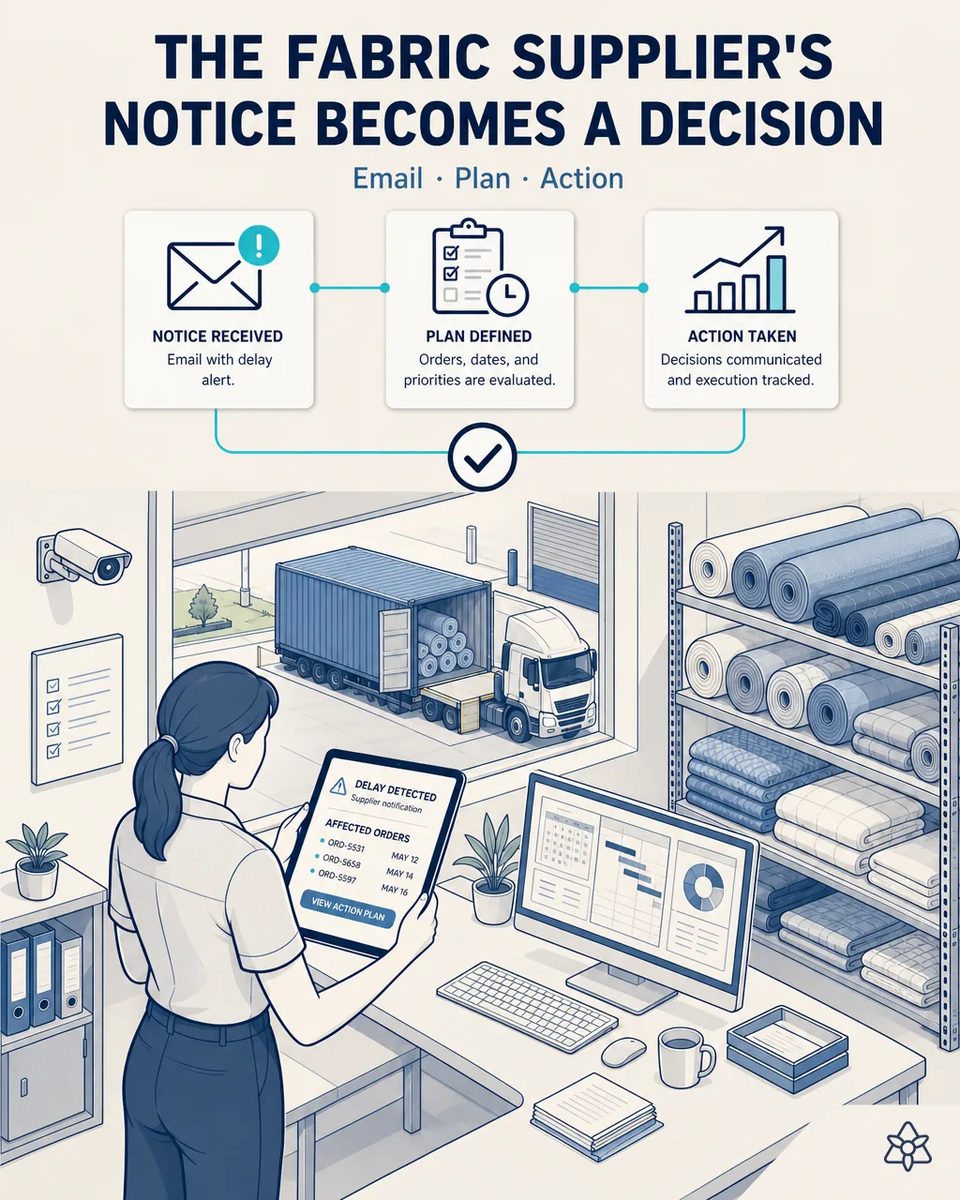
The notice that changes the season plan is read in the afternoon.
Critical supply notices arrive by email and messaging to specific people in purchasing. Hours or days pass before planning hears about them, and by then orders have been spread that cannot be finished. In catalog sales, the advertised product has to be available while the catalog is live. A fabric delay spotted late turns into stock-outs of a best-selling style in peak season, canceled orders and urgent freight that eats the margin.
- A bedding plant buys greige fabric, printed fabric and fiberfill from domestic and overseas suppliers, with transit times of weeks.
- Critical notices, a container held at port, a reduced quantity, a changed construction, arrive by email or messaging to one buyer, who may be in a negotiation and read them hours later.
- By the time planning hears about it, orders have been spread that cannot be finished for lack of fabric or fiberfill. Cut panels wait in the sewing area for weeks, occupying space and tying up money, while another style that could have been produced with the fabric in stock sits unplanned.
- In catalog sales the advertised product must be available while the catalog is live: a delay spotted late becomes a stock-out of a best-selling style in peak season, cancelled orders and urgent freight that eats the margin. The consultants who sold the style hear about it from their customers first.
Connect on supply email — a copied mailbox that returns an action, not a forward.
Connect in chaotic-sources mode: a mailbox copied around the clock. The LLM extracts intent (delay, quantity change, specification change) and entities (supplier, purchase order, material, dates) and matches them against the ERP. It returns a proposed action to the right role, not a simple forward. Step-by-step flow:
The value is not reading the email faster. It is that purchasing and planning receive, together, the purchase order affected, the catalog styles at risk and the alternative fabric in stock, while there is still room to reschedule. In catalog sales, those hours are the difference between moving a sequence and losing a best-selling style for the season.
- The supplier or forwarder writes as usual, with the iLEAN mailbox in copy.
- iLEAN identifies purchase order, material and new date, and matches them against the production plan.
- Purchasing and planning receive the impact: affected orders and styles, alternative stock.
- People decide: reschedule, substitute fabric or expedite the shipment.
The forwarder's email today versus the notice matched with the plan
| Aspect | Today | With iLEAN Connect |
|---|---|---|
| Container held at port | Read when the buyer is free | Detected as it arrives |
| Who hears about the held container | One buyer, then a chain of messages | Purchasing and planning at once |
| Catalog styles affected | Worked out by hand, if at all | Listed with the orders at risk |
| Alternative greige or printed fabric | Someone checks the warehouse | Stock shown with the notice |
| Replanning cutting and sewing | Once the fabric is already missing | While there is still room to act |
| Peak-season stock-out | Discovered at fulfillment | Visible from the supplier's notice |
From hours or days of human latency to minutes. Replanning once the fabric is already missing becomes replanning while there is still room to act.
Impact estimate — to be validated with your supply incidents per season.
The block below is an estimate to be validated against your plant's actual data. We put it forward so the committee has an order of magnitude; we refine it during the assessment.
- Estimated payback 3-7 months, depending on how often supply incidents hit the plan.
- Fewer in-season stock-outs of advertised styles, which are sales that do not come back once the catalog expires.
- Fewer urgent freights paid to rescue a late fabric or fiberfill delivery, which today eat the margin of the very style they are meant to save.
- Human latency drops from hours or days to minutes, so replanning happens before the spread, not after.
Estimated payback of 3 to 7 months depending on how often supply incidents occur; fewer in-season stock-outs and fewer urgent freights. Estimate to be validated.
And the fair question from the production manager
“What if it reads a new arrival date wrong and we replan for nothing?” — extracting the supplier, purchase order, material and date from a notice is an anchored task, where the best models drop below 1.5% error [1]. The original email travels with the proposal, and purchasing and planning decide whether to reschedule, substitute fabric or expedite.
[1] OpenAI paper "Why Language Models Hallucinate", 2025 — on the reliability of AI in anchored tasks.
What people ask about fabric and fiberfill supply notices
Do our fabric suppliers and forwarders have to change how they write?
No. They keep writing as usual with the iLEAN mailbox in copy. Notices in free text, in other languages or with attached schedules are read as they come. The original message is always kept next to the extracted data, so nobody has to trust a summary blindly.
Does it read the buyers' personal inboxes?
No. It only sees what is sent or copied to the dedicated mailbox, which is the channel the plant decides to open. Suppliers and forwarders simply add one address to the copy line.
How does it know which catalog styles a microfiber delay affects?
It matches the material on the notice with open purchase orders and with the production orders that consume it, so the styles at risk come out of your own plan. If a style has an alternative fabric approved, that stock is shown in the same alert.
Does it decide to move orders on its own?
No. It proposes the impact and the options; purchasing and planning decide whether to reschedule, substitute fabric or expedite the shipment. Their decision is recorded with the notice, so the next similar delay starts from what was done last time.
Does it cover quantity and specification changes, not only delays?
Yes. A shorter quantity or a change in construction or finish is extracted as its own intent and routed to whoever must act on it. A change in thread count or finish, for example, goes to quality as well as purchasing.
More cases from this series
- What the catalog showed is what arrives homeFour verification rings, from fabric received to parcel, so the product delivered is the one in the…
- Every lot's file, ready for auditEvery fabric lot generates its own file: lab results, validated start-up, photos and signatures, sorted…
- The cutting order reaches the system with a photoPhotograph the cutting order and traveler sheet: rolls, dye lot and meters reach the system in seconds,…
- The textile lab spreadsheet reaches the ERP by itselfiLEAN reads the textile lab spreadsheet when saved and, after human validation, posts it to the ERP.…
- Marker and cutter, stitched to the ERPiLEAN stitches marker CAD and the automatic cutter to the ERP: orders flow down and real fabric…
- Fabric roll receiving with a photoPhotograph the packing list and each roll label: lot, meters, width and shade enter the ERP validated…
Tell us how many fabric delays reached planning too late this season.
We work on your plant's real data, not ours. Assessment with no commitment.
Request estimated ROI within 48h ‹ See all cases of bedding See apparel