The cutting order reaches the system with a photo
In a plant making comforters, bedspreads and sheets, every order starts at the spreading table with a paper cutting order on which the spreader notes the rolls used, the plies laid and the fabric left over. A traveler sheet then follows each bundle. Those two papers are the only proof of which dye lot went into which comforter, and today they sit in a folder until someone keys them in. With iLEAN Connect, the spreader takes two photos and the order exists in the central system, with its rolls and shade lot, without changing the routine.
The only proof of which dye lot went into which comforter sits in a folder.
The cutting order is printed from the ERP and completed by hand: actual rolls, plies, splices, remnant. The traveler sheet collects signatures operation by operation. Both take between a shift and several days to be keyed in; meanwhile nobody knows real fabric consumption or which roll went into which order. When a shade difference appears between the sham and the comforter of the same set, finding out which rolls were mixed means searching folders. And real fabric consumption, the largest cost in the product, is known late, so spreading losses are discussed with last week's data.
- The cutting order prints from the ERP but is finished by hand at the spreading table: actual rolls used, plies laid, splices and the remnant left on the last roll.
- The traveler sheet then follows each bundle through quilting, sewing and packing, collecting signatures station by station. Both papers take between a shift and several days to be keyed in.
- When the sham and the comforter of the same set come out in slightly different shades, finding which rolls were mixed in that spread means opening folders one by one, usually with a customer complaint already open.
- Real fabric consumption, the largest cost in the product, is known late, so spreading losses get discussed with last week's numbers instead of today's. The marker may be fine; the losses are in splices and remnants nobody recorded.
Connect in photo mode — the spreader keeps writing on the cutting order.
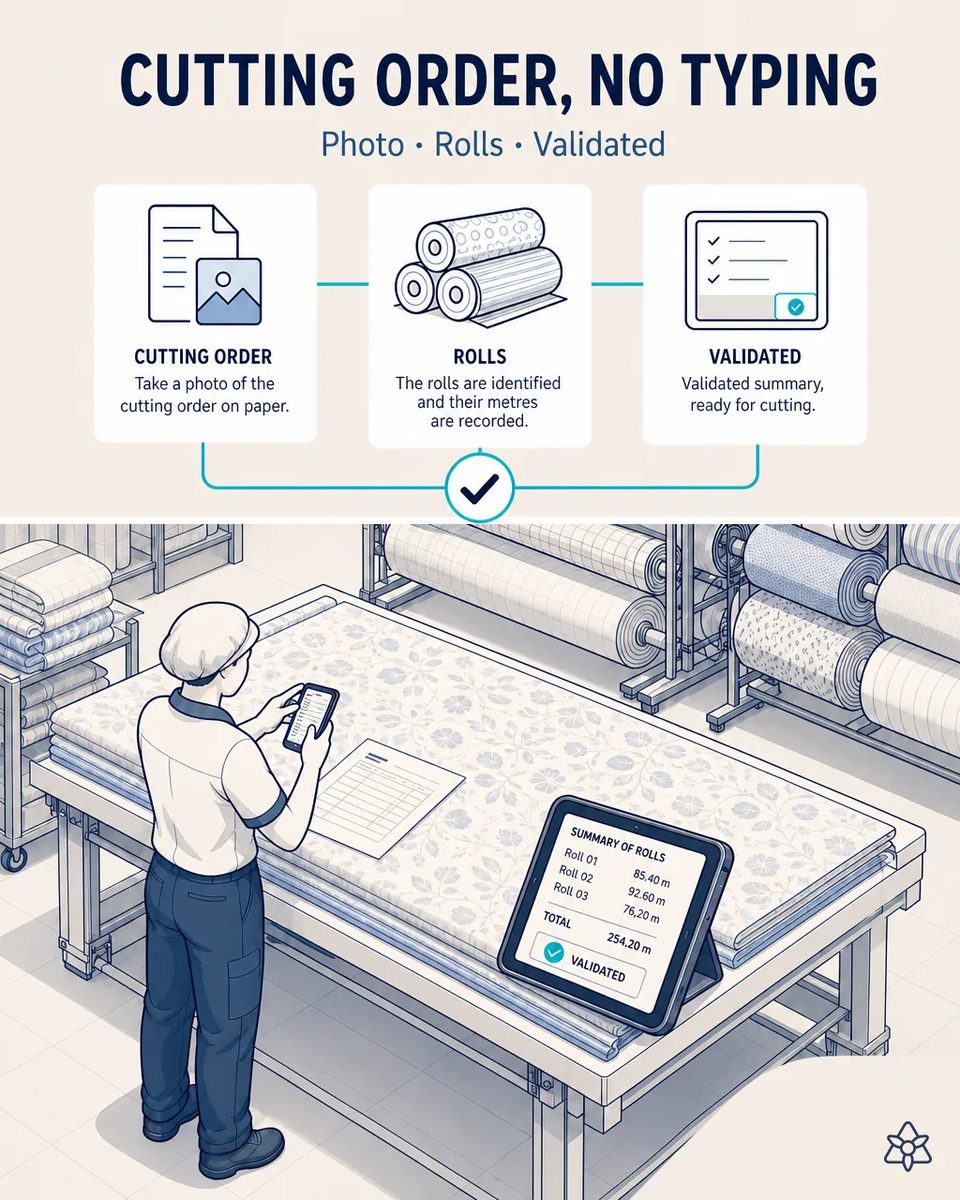
Connect in photo mode. A grounded LLM extracts structured fields (order, style, bed size, rolls, dye lot, plies, meters, remnant, signatures) and links them to the production order. Zero change of habit: the spreader keeps writing on paper. Step-by-step flow:
Nothing changes at the spreading table except one photo at the end of the spread. That is why it is usually the first case approved in a bedding plant: it creates no friction on the floor and it puts a dye lot behind every bundle from day one. Every later case in the matrix, from shade validation to the lot file, rests on that link between roll and order.
- The spreader finishes spreading and photographs the cutting order with a phone or the table tablet.
- iLEAN reads the handwriting, structures rolls, dye lot, plies and meters, and links them to the order.
- The summary appears on screen so the person in charge confirms it with two taps.
- The validated data sits in central memory, available to the ERP, quality and costing.
The handwritten cutting order versus the photographed cutting order
| Aspect | Today | With iLEAN Connect |
|---|---|---|
| Rolls and plies per spread | Keyed in a shift or days later | In the system at second zero |
| Dye lot behind each bundle | On paper, in a folder | Linked to the order and the bundle |
| Sham and comforter shade mismatch | Folder search after the complaint | One query by order or dye lot |
| Remnant left on the last roll | Often never recorded | Captured with its meters |
| Real fabric consumption | Known with last week's data | Visible the same day |
| The spreader's routine | Paper and pen | Paper, pen and one photo |
From a shift to several days of latency to second zero. Roll-to-order-to-product tracing by searching folders becomes an instant query by order or dye lot.
Impact estimate — to be validated with your cutting orders per day.
The block below is an estimate to be validated against your plant's actual data. We put it forward so the committee has an order of magnitude; we refine it during the assessment.
- Estimated payback 4-9 months, depending on how many cutting orders the plant spreads per day.
- Data-entry hours recovered in the cutting room and in production control, where someone retypes cutting orders and traveler sheets today, often at the end of the shift.
- Real fabric consumption visible the same day, so spreading losses are discussed while the order is still on the table.
- Roll-to-order-to-product tracing goes from searching folders to an instant query by order or dye lot.
Estimated payback of 4 to 9 months depending on cutting orders per day; data-entry time recovered and real fabric consumption visible the same day. Estimate to be validated.
And the fair question from the production manager
“What if it misreads the spreader's handwriting on the roll numbers?” — reading fields from a cutting order with a known layout is an anchored task, where the best models drop below 1.5% error [1]. And there is a second net: the summary of rolls, dye lot, plies and meters appears on the table tablet and the person in charge confirms or corrects it with two taps before anything reaches the ERP.
[1] OpenAI paper "Why Language Models Hallucinate", 2025 — on the reliability of AI in anchored tasks.
What people ask about photographing the cutting order and traveler sheet
Do we have to redesign the cutting order we print from the ERP?
No. Vision reads the layout you already print, including the handwritten notes in the margins, which is where the real roll numbers, splices and remnant usually end up. If a field is illegible, it is flagged for the person in charge instead of being guessed.
Does it capture the traveler sheet signatures as well as the cutting order?
Yes. Each station signature on the traveler sheet is stored as an event tied to the bundle, so you can see when a set left quilting, sewing and packing. A bundle that stalls between stations becomes visible the same day, not at the weekly review.
Can we find which rolls went into a specific set of shams, sheets and comforter?
That is the main use. Once the cutting order is captured, the dye lot of every roll is linked to the order, and a shade complaint becomes a query instead of a folder search. That is also what lets quality decide quickly whether the rest of the set can still ship.
How long does the photo take at the end of a spread?
A few seconds with a phone or the table tablet. The spreader keeps the paper as the working document; the photo just stops it from dying in a folder. Spreaders usually adopt it within the first week because it removes the end-of-shift paperwork run to the office.
Do we need ERP integration before we start capturing cutting orders?
No. The case runs from the first spread against iLEAN's central memory, and the push into the ERP is connected later, once the value is visible to production and costing. Many plants run several weeks on central memory alone before deciding how to connect the ERP.
More cases from this series
- What the catalog showed is what arrives homeFour verification rings, from fabric received to parcel, so the product delivered is the one in the…
- Every lot's file, ready for auditEvery fabric lot generates its own file: lab results, validated start-up, photos and signatures, sorted…
- The fabric supplier's notice becomes a decisioniLEAN reads the fabric supplier's notice, matches it against the production plan and proposes which…
- The textile lab spreadsheet reaches the ERP by itselfiLEAN reads the textile lab spreadsheet when saved and, after human validation, posts it to the ERP.…
- Marker and cutter, stitched to the ERPiLEAN stitches marker CAD and the automatic cutter to the ERP: orders flow down and real fabric…
- Fabric roll receiving with a photoPhotograph the packing list and each roll label: lot, meters, width and shade enter the ERP validated…
Tell us how many cutting orders your spreading tables close per day and when they reach the system.
We work on your plant's real data, not ours. Assessment with no commitment.
Request estimated ROI within 48h ‹ See all cases of bedding See apparel