Marker and cutter, stitched to the ERP
In the cutting room of a bedding plant, two modern systems live side by side without talking. The ERP knows which order to cut and how much fabric it should use. The marker CAD and the automatic cutter know how much fabric was actually used and with what utilization. Between them, one person types the order into the CAD in the morning and another keys consumption into the ERP in the afternoon. With iLEAN Connect the two are stitched together: the released order reaches the CAD with style, sizes and quantities, and the cutter report returns to the ERP with real meters and marker utilization, with no typing in between.
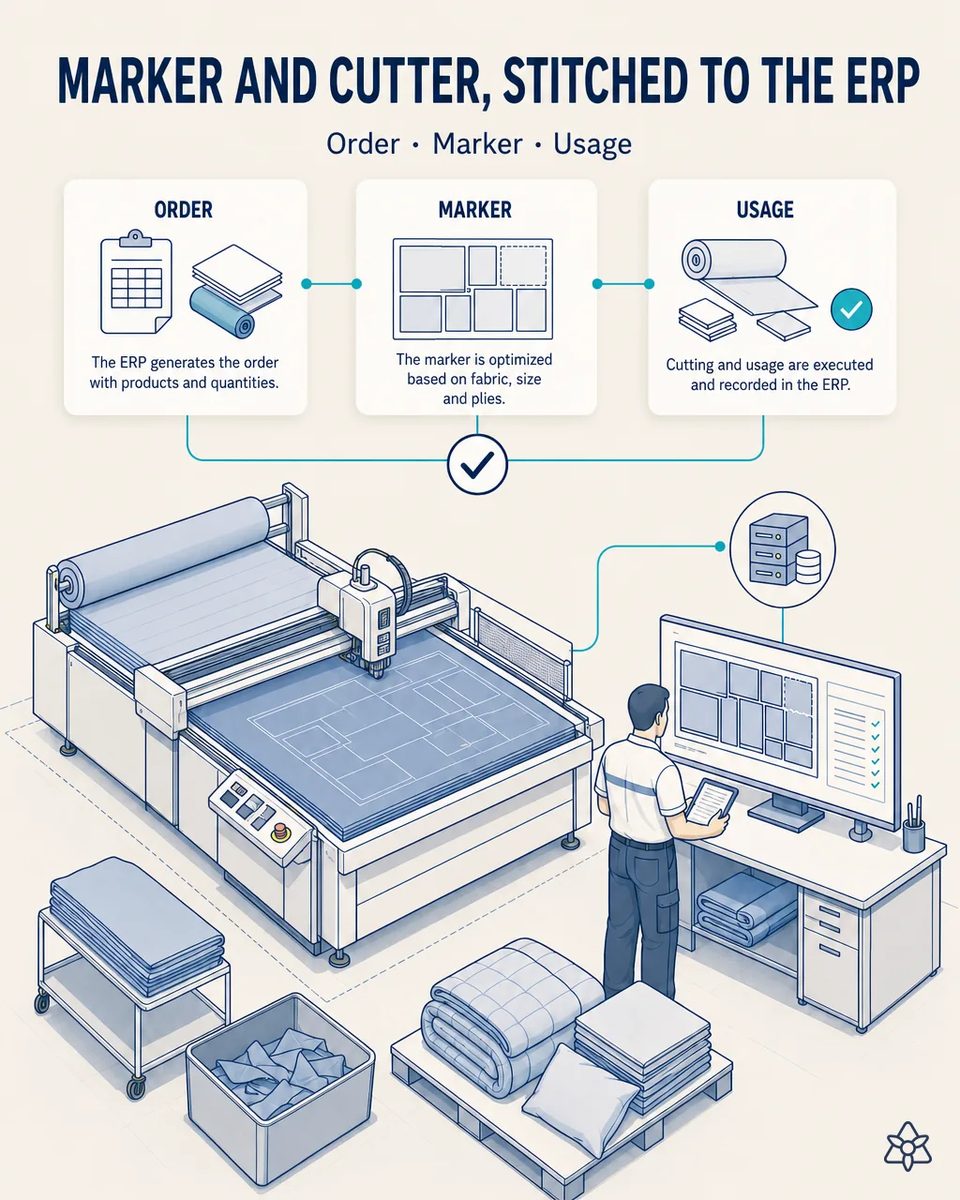
Real fabric usage sits in the cutter report, and the ERP keeps working with the standard.
Fabric is the largest cost in the product and its real consumption sits in the cutter report, yet the ERP works with standard consumption. Double entry introduces quantity and size errors, and the gap between standard and real is known at month end. A typing error in bed size or quantity is cut through hundreds of plies before anyone notices. And the real cost per style, which purchasing needs to negotiate and finance needs to set catalog prices, arrives late.
- The ERP knows which order to cut and how much fabric it should use. The marker CAD and the automatic cutter know how much was actually used, and with what utilization.
- Between them, one person types the order into the CAD in the morning and another keys consumption into the ERP in the afternoon. Two people spend part of every day copying data between two systems that both already have it.
- A typing error in bed size or quantity is cut through hundreds of plies before anyone notices, and the cut panels for a king set cannot become a queen.
- The gap between standard and real consumption is known at month end, so the real cost per style that purchasing needs to negotiate and finance needs for catalog pricing arrives late. By then, the next catalog has already been priced on standard consumption.
Connect stitches ERP, marker CAD and cutter — neither replaced, no typing between them.
Connect stitches two existing systems through their interfaces: API where there is one, exchange files where there is not. What happens in one is reflected in the other. Neither is replaced, and the cutting lead still decides the marker. Step-by-step flow:
Fabric is the largest cost in a comforter or a sheet set. Knowing real consumption per order the same day, instead of at month end, is what turns a marker discussion into a decision. One point of fabric utilization recovered already pays for the integration. And the cutting lead keeps full control of the marker; what disappears is the typing on both sides of it.
- Planning releases the order in the ERP as usual.
- iLEAN delivers it to the marker CAD with style, sizes and quantities.
- When cutting ends, iLEAN collects the cutter report.
- Real consumption and utilization sit in the ERP, linked to the order.
The typed cutting room versus the stitched cutting room
| Aspect | Today | With iLEAN Connect |
|---|---|---|
| Order into the marker CAD | Typed every morning | Delivered with style, bed sizes and quantities |
| Bed size or quantity error | Cut through hundreds of plies | No retyping, no transcription error |
| Real meters per order | Keyed in the afternoon, if at all | Collected from the cutter report |
| Marker utilization | Seen only in the CAD | Stored in the ERP per order |
| Standard versus real consumption | Known at month end | Known per order, the same day |
| Who decides the marker | The cutting lead | Still the cutting lead |
Error-prone double entry becomes zero typing in between. Real fabric consumption known at month end becomes known per order, the same day.
Impact estimate — to be validated with your marker utilization figures.
The block below is an estimate to be validated against your plant's actual data. We put it forward so the committee has an order of magnitude; we refine it during the assessment.
- Estimated payback 3-6 months.
- One recovered point of fabric utilization already justifies the integration, given that fabric is the largest cost in the product.
- Zero double entry between ERP and marker CAD, and with it the bed size and quantity errors that are cut through a whole spread. A king panel cut as a queen is fabric that cannot be recovered, so every avoided error counts at full fabric cost.
- Real cost per style available to purchasing and finance per order, not at month end, which is what catalog pricing for next season depends on.
Estimated payback of 3 to 6 months; one recovered point of fabric utilization already justifies the integration. Estimate to be validated.
And the fair question from the production manager
“What if the integration sends the wrong bed size to the CAD and we cut a whole spread?” — the order is passed field by field from the ERP, not reinterpreted, and reading the cutter report is an anchored task, where the best models drop below 1.5% error [1]. The cutting lead still reviews and decides the marker before cutting, exactly as today. Removing the retyping removes the main source of size errors.
[1] OpenAI paper "Why Language Models Hallucinate", 2025 — on the reliability of AI in anchored tasks.
What people ask about connecting the marker CAD and cutter to the ERP
Do we have to replace the marker CAD or the automatic cutter?
No. Connect works through the interfaces they already have: API where there is one, exchange files where there is not. Each vendor keeps its own system and its own support.
What exactly reaches the marker CAD from the ERP?
The released order with style, bed sizes, quantities and fabric reference, so the cutting lead starts the marker without retyping anything. The marker itself, nesting and ply height, remains the cutting lead's decision.
What returns to the ERP after cutting?
Real meters used, plies, marker utilization and remnant, linked to the order, so standard and real consumption can be compared the same day. Remnants become visible inventory instead of rolls forgotten under the table.
What happens if planning changes a quantity after the marker is made?
The change is reflected in the CAD as a new version and the cutting lead sees it before cutting, instead of finding it after the spread is cut. Every version is recorded, so nobody argues later about which quantity was valid.
Does it help set catalog prices for next season?
Yes. Real fabric cost per style, built from cutter reports, is what finance needs to price the next catalog with real numbers. Purchasing also gets the consumption per style it needs to negotiate fabric volumes.
More cases from this series
- What the catalog showed is what arrives homeFour verification rings, from fabric received to parcel, so the product delivered is the one in the…
- Every lot's file, ready for auditEvery fabric lot generates its own file: lab results, validated start-up, photos and signatures, sorted…
- The cutting order reaches the system with a photoPhotograph the cutting order and traveler sheet: rolls, dye lot and meters reach the system in seconds,…
- The fabric supplier's notice becomes a decisioniLEAN reads the fabric supplier's notice, matches it against the production plan and proposes which…
- The textile lab spreadsheet reaches the ERP by itselfiLEAN reads the textile lab spreadsheet when saved and, after human validation, posts it to the ERP.…
- Fabric roll receiving with a photoPhotograph the packing list and each roll label: lot, meters, width and shade enter the ERP validated…
Tell us how many orders a day are typed twice between your ERP and the marker CAD.
We work on your plant's real data, not ours. Assessment with no commitment.
Request estimated ROI within 48h ‹ See all cases of bedding See apparel