What the catalog showed is what arrives home
The core pain of a bedding plant selling through seasonal catalogs is twofold and it is the same: that the advertised product is available while the catalog is live, and that what arrives at the customer's home is exactly what she saw in the photo, same shade, same design, no defect. Every return costs freight both ways, the product and the trust of the consultant who sold it. Every stock-out is a sale that does not come back. iLEAN Agents coordinates the previous eleven pieces into four cross-checking verification rings: the fabric coming in, the process that gives it color, the fabric being cut and the product being packed. If one ring does not match the previous one, the lot is held before moving on, and people decide.
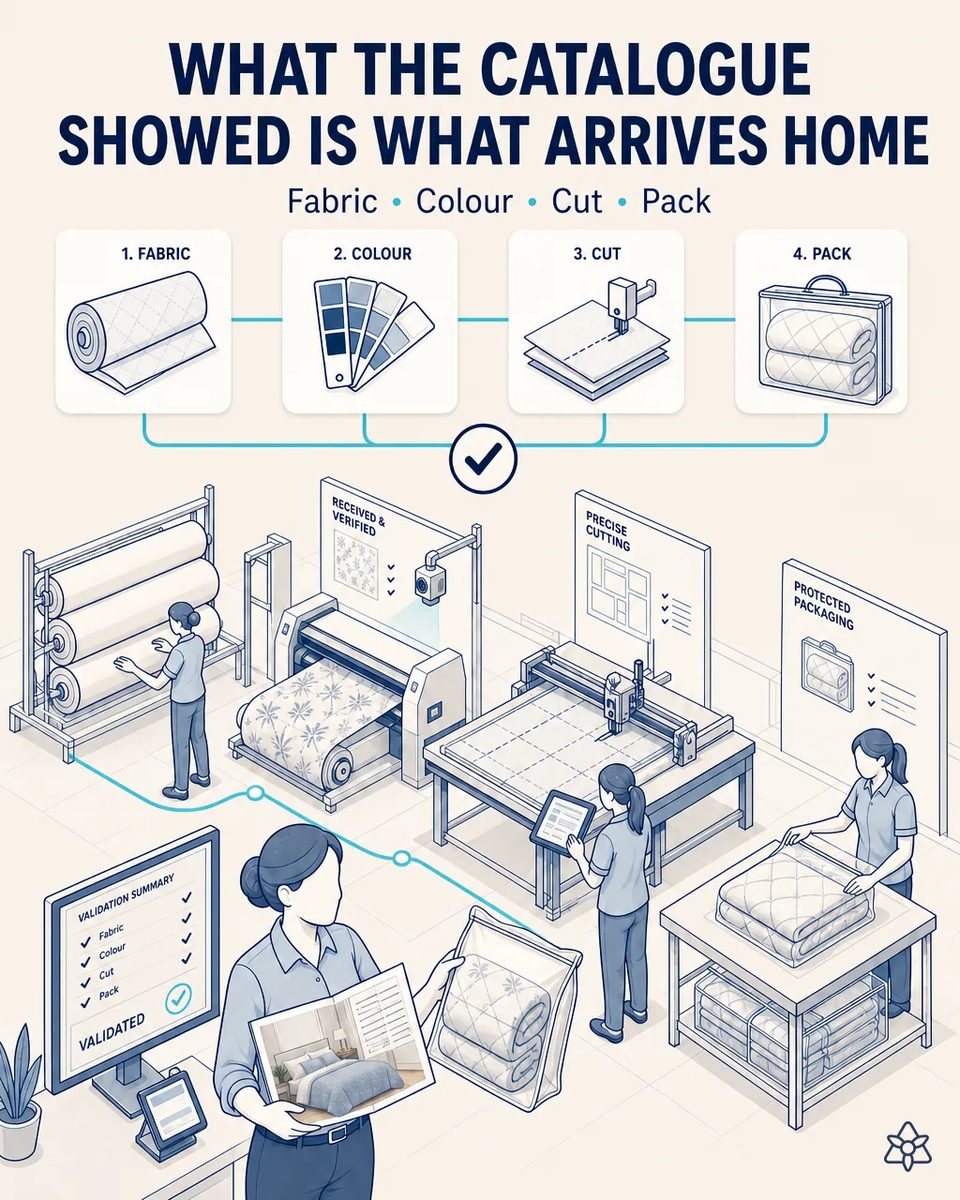
Every link works with its own paper, and the deviation shows up at the customer's door.
Perceived quality and availability depend on a long chain, fabric purchasing, dyeing and printing, finishing, cutting, sewing, packing, fulfillment, where each link works with its own paper and its own spreadsheet. Deviations are detected at the end, or in the customer's home. In direct sales, a return is not just a logistics cost: it affects the independent consultant who stood in front of her customer. And a catalog has a commercial expiry date: the run that must be repeated or the fabric that arrives late no longer make the season.
- The core pain of a bedding plant selling through seasonal catalogs is twofold: the advertised product must be available while the catalog is live, and what arrives home must be exactly what the customer saw in the photo.
- Perceived quality depends on a long chain, fabric purchasing, dyeing and printing, finishing, cutting, sewing, packing and fulfillment, where each link works with its own paper and spreadsheet.
- Deviations are detected at the end, or in the customer's home, and every return costs freight both ways, the product and the trust of the consultant who sold it.
- A catalog has a commercial expiry date: the run that must be repeated or the fabric that arrives late no longer make the season, and a stock-out is a sale that does not come back. Next season's catalog starts with that lost trust.
Agents coordinates four rings — fabric in, color, cut and pack, cross-checked.
Four coordinated rings. Ring 1, fabric coming in: every roll enters with lot, shade and meters; the lab releases it with evidence; supply delays are known in minutes. Ring 2, the process that gives color: finishing curve per lot and design changeover validated against the standard before the run. Ring 3, fabric being cut: roll defect map, shade lot confirmed at spreading, real consumption tied to the order. Ring 4, product being packed: a file per lot joining the previous three rings, available when a complaint arrives. Agents cross-checks the rings, flags what does not match and proposes the action; JIDOKA AI holds the lot on a deviation; SMED AI shortens changeovers so verification does not cost capacity. People decide at every point. Step-by-step flow:
No ring solves the problem on its own: each control already exists in some form and the mismatched set still reaches the customer. The strength is in the cross-check, because if one ring does not agree with the previous one, the lot is held before moving on and people decide. JIDOKA AI holds the lot, SMED AI keeps changeovers short, and quality has the last word.
- Ring 1: fabric enters with validated lot, shade and meters, and the lab releases it with evidence.
- Ring 2: dyeing, printing and finishing are compared against the approved standard.
- Ring 3: cutting uses the defect map and confirms the shade lot at every spread.
- Ring 4: the packed product keeps its file; agents cross-check the four rings and flag what does not match.
Catalog quality today versus four cross-checking rings
| Aspect | Today | With iLEAN Agents |
|---|---|---|
| Ring 1 · Fabric coming in | Totals, no shade per roll | Lot, shade and meters per roll, lab release with evidence |
| Ring 2 · The process that gives color | Approved by eye and memory | Stenter curve and changeover against the standard |
| Ring 3 · Fabric being cut | Shade lots mixed unknowingly | Defect map and shade lot confirmed at every spread |
| Ring 4 · Product being packed | Evidence scattered | A file per lot joining the three rings |
| Where a deviation is detected | At the end or in the customer's home | In the ring where it starts |
| In-season stock-out risk | Discovered at fulfillment | Visible from the supplier's notice |
Deviations detected at the end of the chain or in the customer's home are detected in the ring where they start. Stock-outs discovered at fulfillment become a stock-out risk visible from the supplier's notice.
Impact estimate — to be validated with quality, purchasing and management.
The block below is an estimate to be validated against your plant's actual data. We put it forward so the committee has an order of magnitude; we refine it during the assessment.
- A reduction of 30% or more in returns for shade and defects.
- Estimated payback 6-12 months for the whole system, built in layers where each case pays on its own.
- Fewer in-season stock-outs, because a fabric delay is visible from the supplier's notice, not at fulfillment, while the catalog is still live.
- Protection of the consultant's relationship with her customer, which in direct sales is worth more than the freight of a return.
A reduction of 30% or more in returns for shade and defects and fewer in-season stock-outs; estimated payback of 6 to 12 months for the whole. Estimate to be validated with quality, purchasing and management.
And the fair question from the production manager
“Do we have to deploy all twelve cases before we see anything?” — no, and framing it that way would be the surest way never to start. The rings are built in layers and each case pays on its own. Where a ring relies on reading documents or panels, it is an anchored task, where the best models drop below 1.5% error [1], and JIDOKA AI holds a lot only on a verifiable mismatch between rings, never on model doubt.
[1] OpenAI paper "Why Language Models Hallucinate", 2025 — on the reliability of AI in anchored tasks.
What people ask about the four rings against catalog returns
Where does a bedding plant usually start with the four rings?
With the cases that have fewest dependencies, normally the cutting order photo and roll receiving, which already build most of ring 1 and part of ring 3. Each layer pays on its own, so the plant never waits for the whole system to see a return.
What does the cross-check catch that each bedding control misses on its own?
The combination: a roll from a slightly different shade lot passes receiving, a spread passes cutting, and the set that joins them comes out mismatched. Rings that disagree reveal it. That is the return that no single control can prevent.
What happens when two rings do not agree on a lot?
The lot is held before moving to the next stage, Agents proposes the action, and quality or production decide whether to release, rework or reassign it. The hold is visible to planning so the catalog commitment is managed, not discovered.
Does it replace our ERP or planning system?
No. It cross-checks the systems you already have against each other and against what actually happens at the stenter, the printer and the spreading table. Your ERP stays the system of record.
Can the return reduction be estimated before committing?
Yes: with your returns by cause, stock-outs last season and changeovers per catalog, the return per layer is estimated before deciding the order of deployment. The estimate is shared with quality, purchasing and management before anything is committed.
More cases from this series
- Every lot's file, ready for auditEvery fabric lot generates its own file: lab results, validated start-up, photos and signatures, sorted…
- The cutting order reaches the system with a photoPhotograph the cutting order and traveler sheet: rolls, dye lot and meters reach the system in seconds,…
- The fabric supplier's notice becomes a decisioniLEAN reads the fabric supplier's notice, matches it against the production plan and proposes which…
- The textile lab spreadsheet reaches the ERP by itselfiLEAN reads the textile lab spreadsheet when saved and, after human validation, posts it to the ERP.…
- Marker and cutter, stitched to the ERPiLEAN stitches marker CAD and the automatic cutter to the ERP: orders flow down and real fabric…
- Fabric roll receiving with a photoPhotograph the packing list and each roll label: lot, meters, width and shade enter the ERP validated…
Tell us what share of last season's returns came from shade or print defects.
We work on your plant's real data, not ours. Assessment with no commitment.
Request estimated ROI within 48h ‹ See all cases of bedding See apparel