Every lot's file, ready for audit
A bedding plant with its own printing and dyeing answers to many eyes: textile labeling rules, harmful-substance certifications such as OEKO-TEX, the quality system, the environmental authority for wastewater discharge and audits by corporate customers. Each asks for different evidence about the same lot. Today, before each audit, several people spend days gathering lab results, logbooks and signatures. With iLEAN, every lot generates its file automatically: what Connect captured and what Edge saw, with signatures and timestamps. Agents sorts it by standard and answers questions like 'show me all lots of this design and their fastness tests'.
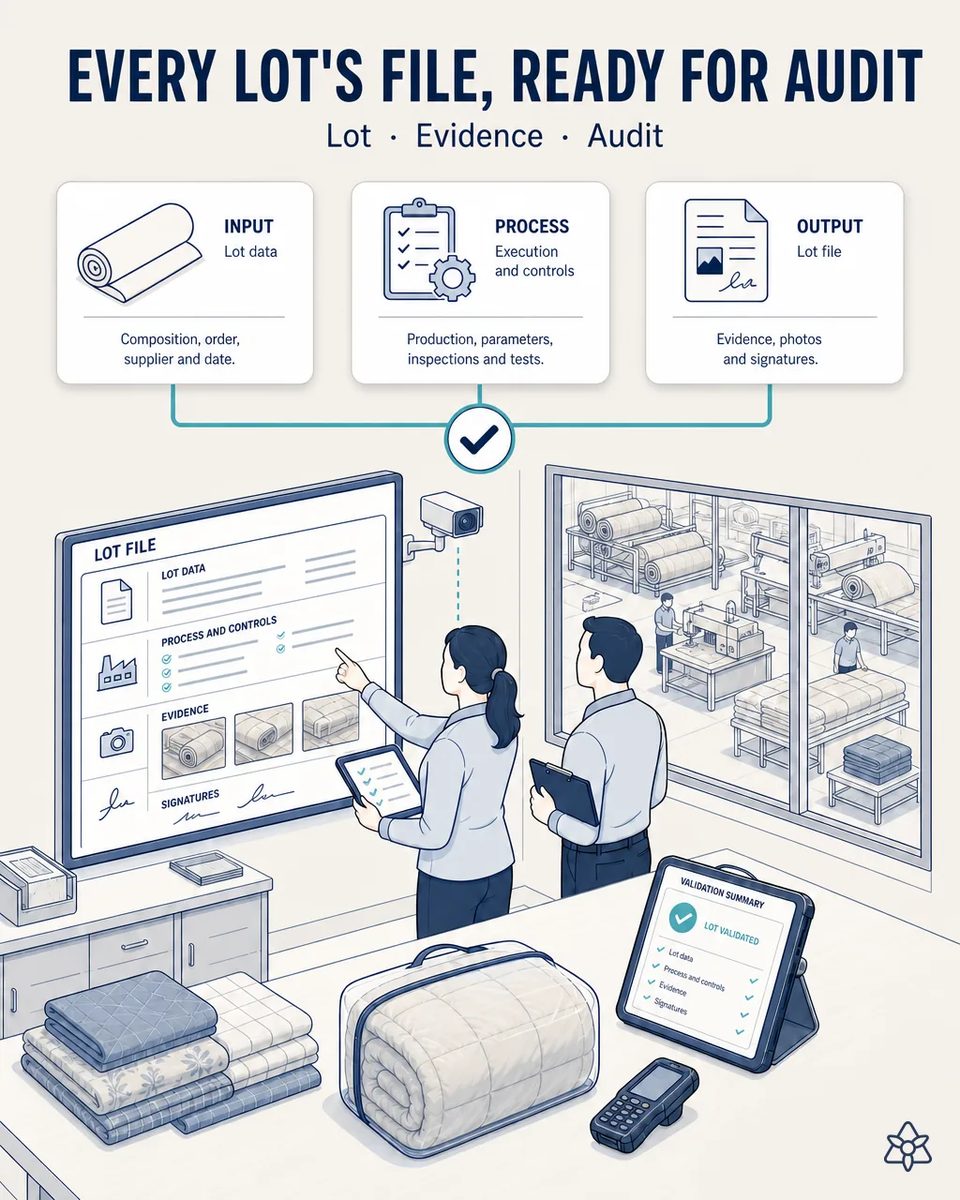
Fastness tests, logbooks and signatures exist, scattered across four places.
The evidence exists, but it is spread across the lab spreadsheet, paper logbooks, emails and people's memory. Gathering it before every audit takes days of key staff, and documentary gaps turn into non-conformities. The same happens with a complaint: proving that a lot was compliant when it left the plant requires an investigation. And a corporate customer asking for composition and test evidence expects an answer in hours, not weeks.
- A bedding plant with its own printing and dyeing answers to many eyes: textile labeling rules, harmful-substance certifications such as OEKO-TEX, the quality system, the wastewater discharge authority and corporate customer audits.
- Each one asks for different evidence about the same lot, and that evidence is spread across the lab spreadsheet, paper logbooks, emails and people's memory. The person who knows where everything is becomes the bottleneck of every audit and every complaint.
- Gathering it before every audit takes days of key staff, and documentary gaps turn into non-conformities.
- The same happens with a complaint: proving that a lot was compliant when it left the plant requires an investigation, while a corporate customer asking for composition and test evidence expects an answer in hours. Weeks of silence on a simple evidence request cost more trust than any non-conformity.
Connect and Edge capture at source; Agents files it by lot and by standard.
Edge and Connect provide the evidence at source, already validated by people. Agents organizes it by lot, design and standard, drafts the file and answers natural-language queries citing the source. Quality reviews and signs the file before it is handed over. Step-by-step flow:
The file is not rebuilt before the audit: it closes as the lot moves through the plant, with what Connect captured and what Edge saw, already validated by people. Agents only reorganizes it for whichever standard or customer is asking. Quality still reviews and signs, but it starts from a complete file instead of an empty folder.
- Every validated capture is linked to its lot in central memory.
- Agents builds the lot file and sorts it by standard.
- Quality reviews, completes if needed, and signs.
- The auditor or customer receives the file for the period or lot requested.
Audit preparation today versus the lot file built as you go
| Aspect | Today | With iLEAN Agents |
|---|---|---|
| Preparing for an OEKO-TEX or customer audit | Days of key staff | File available on demand |
| Composition and test evidence for a customer | Weeks | Hours |
| Fastness tests for all lots of one design | Files opened one by one | One natural-language question |
| Validated start-up and stenter curve | In separate places | In the same lot file |
| Missing lab test or signature in a lot file | Found by the auditor | Visible the day it should have been recorded |
| Who signs before handing it over | — | Quality, as always |
Days of preparation before each audit become a file available on demand. A reply to a corporate customer in weeks becomes a reply in hours.
Impact estimate — to be validated with your audits and corporate customers per year.
The block below is an estimate to be validated against your plant's actual data. We put it forward so the committee has an order of magnitude; we refine it during the assessment.
- Estimated payback 6-12 months, depending on the number of audits and corporate customers that ask for evidence each year.
- Fewer documentary non-conformities, because gaps are visible when they occur, not on audit day, while the people involved still remember what happened.
- Days of key staff before each audit become hours of review of a file that already exists, and those people go back to running the lab and the dye house.
- A corporate customer's request for composition and test evidence answered in hours instead of weeks. That speed is what corporate buyers remember when they decide who keeps the program next season, and it costs the plant nothing extra once the files exist.
Estimated payback of 6 to 12 months depending on the number of audits and corporate customers; fewer documentary non-conformities. Estimate to be validated.
And the fair question from the production manager
“What if the agent cites a test that does not exist?” — every answer cites its source, and the file only contains captures already validated by people. Retrieving and sorting recorded evidence by lot and standard is an anchored task, where the best models drop below 1.5% error [1]. And quality reviews, completes and signs the file before any auditor or customer receives it. Nothing leaves the plant without that signature.
[1] OpenAI paper "Why Language Models Hallucinate", 2025 — on the reliability of AI in anchored tasks.
What people ask about audit-ready files per fabric lot
Does the same lot file serve OEKO-TEX, labeling rules and customer audits?
Yes. The evidence is the same; what changes is the standard it is sorted against, which is exactly the work repeated today for each auditor. A new customer standard is a new view, not a new collection exercise.
What goes into a lot file?
Lab results, the stenter curve, the validated design changeover, the roll defect map, cutting and receiving data, photos and signatures with timestamps. Each item points back to the original capture.
Can we ask questions in plain language?
Yes, for example: show me all lots of this design and their fastness tests. The answer cites the source of each data point, so quality can verify it before sharing anything.
Does the textile auditor get access to our lab files and ERP?
No. They receive the file for the lot or period requested, reviewed and signed by quality, or a view limited to that scope. Nothing outside the requested lots or period is exposed.
Does it cover wastewater discharge evidence from the dye house?
If those readings are captured through Connect, yes: they are filed by period alongside the lots, ready for the environmental authority. If they are not captured yet, adding them is a Connect case like any other.
More cases from this series
- What the catalog showed is what arrives homeFour verification rings, from fabric received to parcel, so the product delivered is the one in the…
- The cutting order reaches the system with a photoPhotograph the cutting order and traveler sheet: rolls, dye lot and meters reach the system in seconds,…
- The fabric supplier's notice becomes a decisioniLEAN reads the fabric supplier's notice, matches it against the production plan and proposes which…
- The textile lab spreadsheet reaches the ERP by itselfiLEAN reads the textile lab spreadsheet when saved and, after human validation, posts it to the ERP.…
- Marker and cutter, stitched to the ERPiLEAN stitches marker CAD and the automatic cutter to the ERP: orders flow down and real fabric…
- Fabric roll receiving with a photoPhotograph the packing list and each roll label: lot, meters, width and shade enter the ERP validated…
Tell us how many days your team spends gathering evidence before each audit.
We work on your plant's real data, not ours. Assessment with no commitment.
Request estimated ROI within 48h ‹ See all cases of bedding See apparel