Fabric roll receiving with a photo
A container arrives with three hundred fabric rolls. The receiving lead has a multi-page packing list and roll after roll with its label: roll number, dye lot, meters, width and shade. For the ERP to know what is there, someone has to key in every roll, or the receipt is booked as a total and lot detail is lost. With iLEAN Connect, the operator photographs the packing list and each label while unloading; the system checks receipts against the purchase order, flags differences in meters or lot and, after one validation tap, posts the receipt to the ERP with roll-level detail.
Three hundred roll labels, and the ERP only learns the total.
Keying in a container roll by roll takes hours, so receipts are booked as totals. Dye lot and shade per roll never reach the ERP, and differences in meters against the invoice are discovered, if at all, weeks later. For purchasing, that means claiming from the supplier without evidence and out of time. For production, it means mixing rolls from different shade lots in the same spread without knowing. And the carrier waits at the dock while the paperwork is reconciled.
- A container arrives with three hundred fabric rolls, a multi-page packing list and a label on every roll: roll number, dye lot, meters, width and shade.
- Keying it roll by roll takes hours, so the receipt is booked as a total and dye lot and shade per roll never reach the ERP. From that moment the plant knows how many meters it has, but not which of them can be spread together.
- Differences in meters against the invoice are discovered weeks later, if at all, so purchasing claims from the supplier without evidence and out of time.
- In production, rolls from different shade lots end up in the same spread without anyone knowing. And the carrier waits at the dock while the paperwork is reconciled, often charging for the waiting time.
Connect in photo mode at the dock — the supplier's packing list read as it comes.
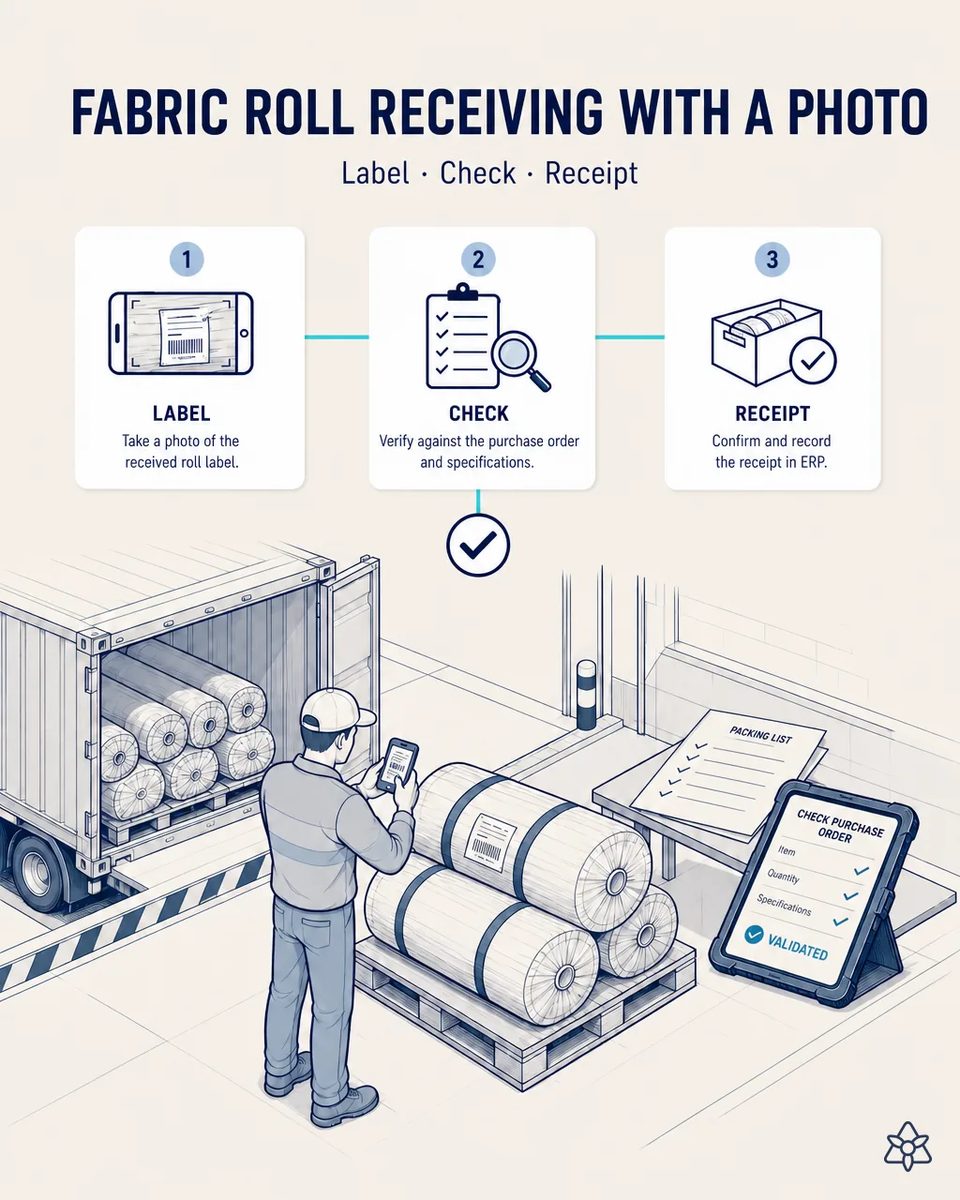
Connect in photo mode. Vision recognizes each supplier's packing-list layout without asking them to change it, and reads labels by barcode, QR or plain text. Automatic check against the purchase order; one-tap validation on a tablet; receipt posted to the ERP via API. CFO angle: the receiving and warehouse module usually needs two or three active licenses; with Connect, dock staff capture by photo and only the lead validates, from three to one. A typical 50-70% reduction in receiving-module licenses, plus supplier claims made with evidence and on time. Step-by-step flow:
The receiving lead stops typing and starts deciding: the system has already compared every roll with the purchase order and only the differences need attention, usually a handful of rolls out of three hundred. The shade lot captured at the dock is what later lets the spreading table avoid mixing lots.
- The operator photographs the packing list when the container is opened.
- As each roll comes off, they photograph its label; iLEAN reads lot, meters, width and shade.
- The system checks against the purchase order and flags the differences.
- The lead validates with one tap and the receipt is in the ERP, roll by roll.
Receiving by totals versus receiving roll by roll
| Aspect | Today | With iLEAN Connect |
|---|---|---|
| Level of detail in the ERP | One total per container | Every roll with lot, meters and width |
| Shade per roll | Lost at the dock | Recorded for the spreading table |
| Meter differences against the invoice | Found weeks later | Flagged while the truck is at the dock |
| Claim to the fabric supplier | Late and without evidence | On time, with the label photo |
| ERP licenses used at the fabric dock | Two or three active users | One validator |
| Each supplier's packing-list layout | Retyped as it comes | Read as it comes |
Receipt by totals and hours of typing becomes roll-level receipt within unloading time. Differences found weeks later are flagged while the truck is still at the dock.
Impact estimate — to be validated with your containers and rolls per month.
The block below is an estimate to be validated against your plant's actual data. We put it forward so the committee has an order of magnitude; we refine it during the assessment.
- Estimated payback 3-8 months, depending on containers and rolls received per month.
- Plus a typical recurring saving of 50-70% in receiving-module ERP licenses: from three active users to one validator.
- Recovery of invoice differences in meters, claimed from the fabric supplier with the label photo as evidence while the claim window is still open.
- A roll-level receipt within unloading time instead of hours of typing, and fewer mixed shade lots downstream. The dock stops being the place where lot detail is lost and becomes the place where the shade traceability of every set begins.
Estimated payback of 3 to 8 months, plus a typical recurring saving of 50-70% in receiving-module ERP licenses and recovery of invoice differences. Estimate to be validated.
And the fair question from the production manager
“What if it misreads the meters on a smudged roll label?” — reading roll number, dye lot and meters from a label by barcode, QR or printed text is an anchored task, where the best models drop below 1.5% error [1]. On top of that, every roll is checked against the purchase order and the packing list, and the receiving lead confirms the differences before the receipt is posted. The label photo stays attached to the roll as evidence.
[1] OpenAI paper "Why Language Models Hallucinate", 2025 — on the reliability of AI in anchored tasks.
What people ask about receiving fabric rolls with a photo
Does each fabric supplier have to change its packing list?
No. Vision learns each supplier's layout as it is, whether it lists rolls by bale, by lot or by piece number. A new supplier only needs one example document to be added.
What if a roll label has no barcode or QR?
It is read as printed text. Barcode or QR, when present, simply makes the reading faster and is cross-checked with the text. Handwritten corrections on a label are read too and flagged if they contradict the print.
Does it compare received meters with the invoice as well as the purchase order?
Yes. Differences in meters, width or lot against the purchase order and the supplier's invoice are flagged roll by roll for the lead to confirm. The label photo becomes the evidence attached to any claim.
How does the shade lot captured at the dock help the cutting room?
It travels with the roll in the ERP, so the spreading table knows which rolls share a shade lot and can avoid mixing them in one set. That is the link that later protects the sham, sheet and comforter of the same set from shade differences.
How long does it add to unloading a container?
One photo per roll as it comes off, which fits within unloading time. The packing list is photographed once when the container is opened. The carrier leaves when unloading ends, not when the paperwork is reconciled.
More cases from this series
- What the catalog showed is what arrives homeFour verification rings, from fabric received to parcel, so the product delivered is the one in the…
- Every lot's file, ready for auditEvery fabric lot generates its own file: lab results, validated start-up, photos and signatures, sorted…
- The cutting order reaches the system with a photoPhotograph the cutting order and traveler sheet: rolls, dye lot and meters reach the system in seconds,…
- The fabric supplier's notice becomes a decisioniLEAN reads the fabric supplier's notice, matches it against the production plan and proposes which…
- The textile lab spreadsheet reaches the ERP by itselfiLEAN reads the textile lab spreadsheet when saved and, after human validation, posts it to the ERP.…
- Marker and cutter, stitched to the ERPiLEAN stitches marker CAD and the automatic cutter to the ERP: orders flow down and real fabric…
Tell us how long it takes to receive a container of fabric rolls today.
We work on your plant's real data, not ours. Assessment with no commitment.
Request estimated ROI within 48h ‹ See all cases of bedding See apparel