Design changeover validated before the run
Every catalog collection brings dozens of designs, each in several colorways. On the printing machine that means constant changeovers: new screens or settings, a new color kitchen, registration adjustment. Today start-up is approved by comparing the first meters with a swatch by eye, under shop lighting and under pressure. If the shade drifts or a color was mounted in the wrong position, it is found thousands of meters later. With iLEAN Edge, cameras compare the first meters with the approved standard, and the run does not start at production speed until the comparison is right and the person in charge signs off with that evidence in front of them.
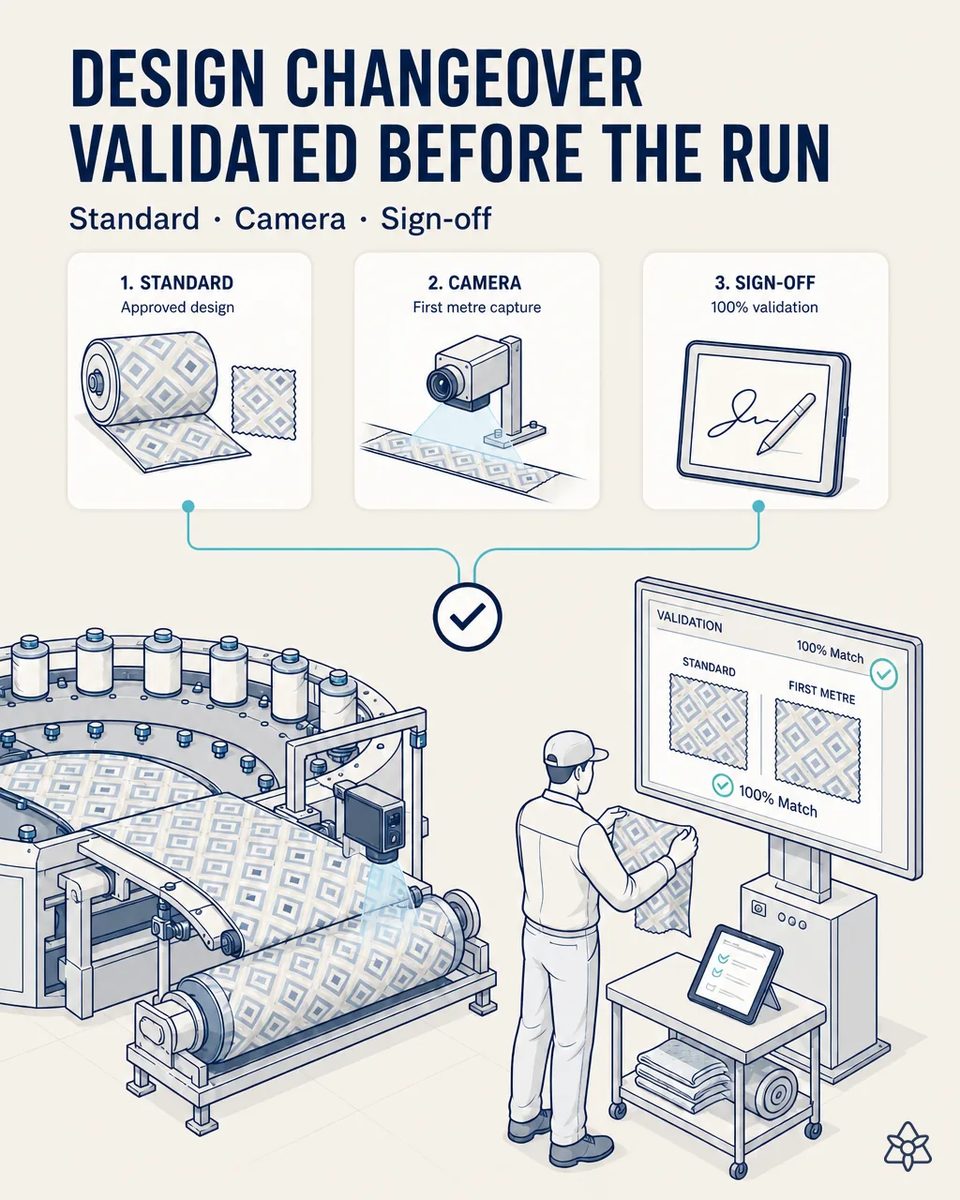
The riskiest moment in printing is approved under shop lighting, in a hurry.
The design changeover is the riskiest moment in printing. Start-up approval depends on one person's eye, the light at that moment and the hurry. An undetected color error turns a whole run into seconds. In catalog sales, the printed color has to match the photo the customer saw. A run with a shade deviation cannot be sold as first quality, and repeating it uses up the season window.
- Every catalog collection brings dozens of designs, each in several colorways. On the printer that means constant changeovers: new screens or settings, a new color kitchen, registration adjustment.
- Today start-up is approved by comparing the first meters with a swatch by eye, under shop lighting and with the next order waiting. Two people can look at the same swatch and disagree, and nothing records what was compared or who approved it.
- If the shade drifts or a color is mounted in the wrong position, it is found thousands of meters later, and the whole run becomes seconds.
- In catalog sales the printed color has to match the photo the customer saw. A run with a shade deviation cannot be sold as first quality, and repeating it uses up the season window. The fabric, ink and printer time of the rejected run are lost either way.
Edge with JIDOKA AI — the run reaches speed only with conformity and sign-off.
Edge plus JIDOKA AI. Cameras under standardized light compare the first meters against the digital standard of the design. The system shows registration and shade differences and holds the move to production speed until there is conformity and sign-off. SMED AI guides the changeover sequence to shorten it. Step-by-step flow:
The camera does not approve the run on its own. It shows registration and shade differences against the approved standard under controlled light, and the person in charge signs off with that evidence in front of them. What changes is not who decides, but what they decide on, and that evidence stays with the lot for any later complaint.
- The team carries out the design change following the guided sequence.
- The first meters are printed at set-up speed.
- Cameras compare them with the approved standard and show the differences.
- With the comparison conforming, the person in charge signs off and the run starts.
Start-up approval by swatch versus approval against the digital standard
| Aspect | Today | With iLEAN Edge |
|---|---|---|
| Shade check after a design change | Swatch by eye under shop light | Camera under standardized light |
| Color mounted in the wrong station | Found thousands of meters later | Caught in the first meters |
| Registration of the new design | Adjusted by feel | Difference shown against the standard |
| Move to production speed | When it looks right | With conformity and a signature |
| Changeover sequence | Depends on the crew | Guided step by step by SMED AI |
| Run rejected for shade | Reprinted, eating the season | Prevented before the run |
Approval by eye under shop lighting becomes approval with objective evidence against the standard. An error found thousands of meters later is caught in the first meters.
Impact estimate — to be validated with your design changeovers per shift.
The block below is an estimate to be validated against your plant's actual data. We put it forward so the committee has an order of magnitude; we refine it during the assessment.
- Estimated payback 6-12 months, depending on the number of design changeovers per shift.
- Fewer start-up meters printed before the design is right. With dozens of designs and several colorways per catalog, those meters add up to whole rolls of fabric every week, and to printer hours that could have gone to first-quality production.
- Fewer runs rejected for shade, each of which would otherwise consume fabric, ink, printer time and part of the season window before the catalog closes.
- A shorter changeover, guided by SMED AI, so verification does not cost printing capacity.
Estimated payback of 6 to 12 months depending on changeovers per shift; fewer start-up meters and fewer runs rejected for shade. Estimate to be validated.
And the fair question from the production manager
“Won't the camera hold the printer every time the light changes?” — that is why the comparison runs under standardized light against the digital standard of that design and colorway. Checking registration and shade against a fixed reference is an anchored task, where the best models drop below 1.5% error [1]. When there is doubt it does not block silently: it shows the difference and the person in charge decides. It stops on a measurable difference, not on model uncertainty.
[1] OpenAI paper "Why Language Models Hallucinate", 2025 — on the reliability of AI in anchored tasks.
What people ask about validating print design changeovers
What is the first-meter comparison made against?
Against the approved digital standard of the design and colorway, captured under the same standardized light as the cameras at the printer. The standard is stored once per colorway and reused every time it is printed.
Does it slow down the changeover?
The comparison takes seconds at set-up speed. SMED AI guides the changeover sequence, so the total time usually goes down, not up. Fewer start-up meters also mean less fabric thrown away per changeover.
Does it detect a color mounted in the wrong screen position?
Yes. A swapped color shows as a clear difference against the standard in the first meters, before thousands of meters are printed. The screen shows which color is out of place, so the correction is quick.
Can the run be started without conformity if we are in a hurry?
An exception can be signed by the person in charge and it is recorded as such. What cannot happen is a start-up with no trace of who approved it. Exceptions are reviewed weekly with quality.
Does it help with many colorways of the same design?
That is where it shows most: each colorway has its own standard, and more changeovers per catalog no longer mean more exposure. The same check applies to every colorway, from the first changeover of the week to the last.
More cases from this series
- What the catalog showed is what arrives homeFour verification rings, from fabric received to parcel, so the product delivered is the one in the…
- Every lot's file, ready for auditEvery fabric lot generates its own file: lab results, validated start-up, photos and signatures, sorted…
- The cutting order reaches the system with a photoPhotograph the cutting order and traveler sheet: rolls, dye lot and meters reach the system in seconds,…
- The fabric supplier's notice becomes a decisioniLEAN reads the fabric supplier's notice, matches it against the production plan and proposes which…
- The textile lab spreadsheet reaches the ERP by itselfiLEAN reads the textile lab spreadsheet when saved and, after human validation, posts it to the ERP.…
- Marker and cutter, stitched to the ERPiLEAN stitches marker CAD and the automatic cutter to the ERP: orders flow down and real fabric…
Tell us how many meters you print at each design changeover before the run is approved.
We work on your plant's real data, not ours. Assessment with no commitment.
Request estimated ROI within 48h ‹ See all cases of bedding See apparel