Two taps before data enters the system
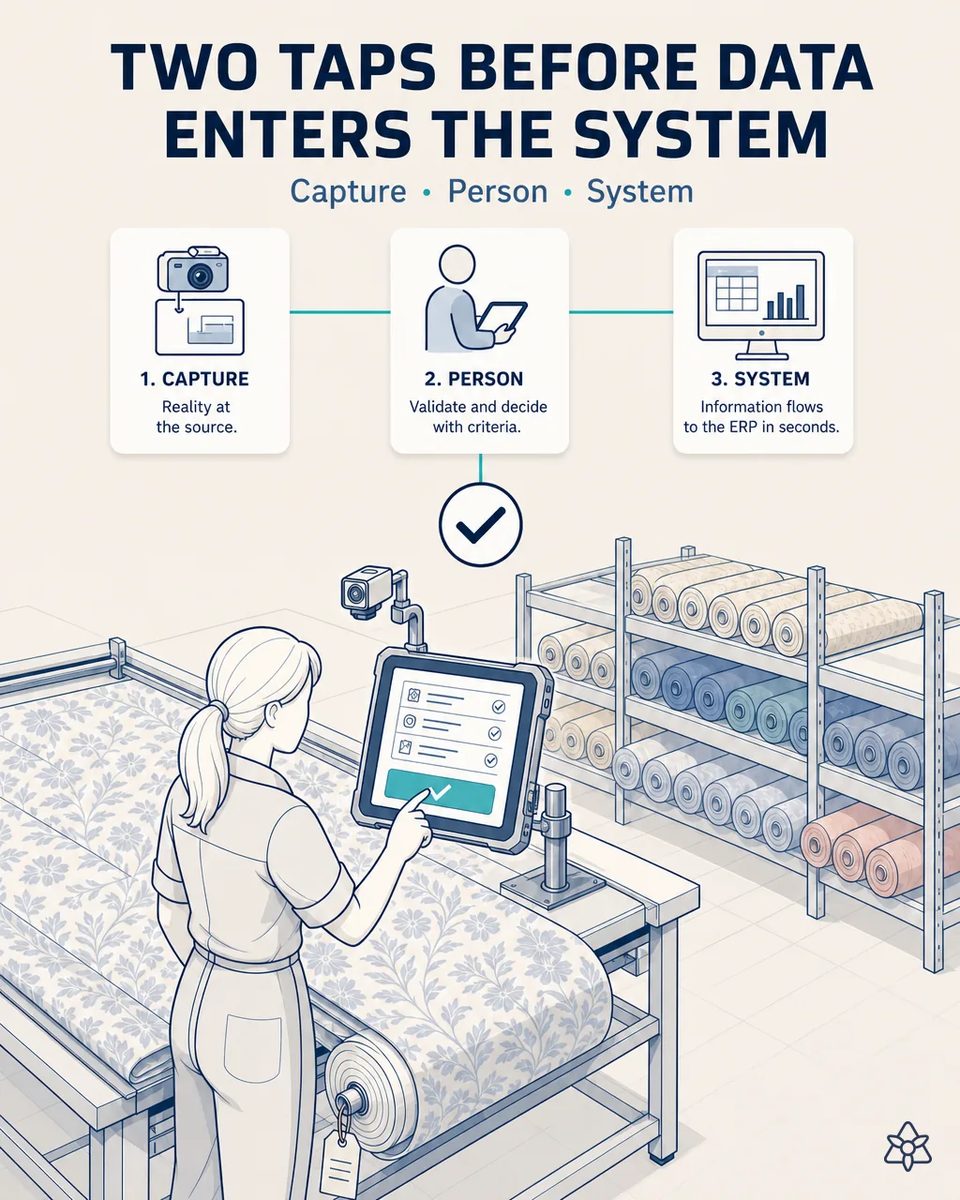
What sets iLEAN apart from an autonomous agent writing data on its own is this: nothing captured enters the central system before a person has seen it. In a bedding plant, the data that needs it most is the shade lot of each roll and the meters actually used, because they decide whether the sham, sheet and comforter of one set match. The industrial tablet by the spreading table shows in two seconds what iLEAN read from the cutting order or the roll label; the person in charge confirms with a tap or corrects it before it crosses. No long training, no typing.
A wrong shade lot is invisible in the ERP and obvious in the customer's bedroom.
The cultural brake on digitizing the plant is the fear that AI will pollute the ERP with unchecked data. At the same time, shop-floor staff do not want to, and should not, become data-entry clerks. A wrongly assigned shade lot is not noticed in the system: it is noticed weeks later, when a customer opens the parcel and the sham does not match the comforter. That is why the data must be validated on the spot by whoever has the fabric in front of them.
- The cultural brake on digitizing a bedding plant is the fear that AI will fill the ERP with unchecked shade lots and meters.
- At the same time, spreaders and cutters do not want to become data-entry clerks, and they should not.
- A wrongly assigned shade lot is not noticed in the system. It is noticed weeks later, when a customer opens the parcel and the sham does not match the comforter.
- That is why the shade lot and the meters used must be confirmed on the spot, by the person who has the roll and its label in front of them. Nobody else can tell a sateen white from an off-white at a glance.
Connect with early human verification — a two-second summary and one tap.
Connect in early human verification mode. Every capture goes through the tablet with a visual summary before crossing into the central system. The interface is designed for validating in seconds, not for entering data. A record is kept of who confirmed what and when. Step-by-step flow:
It is the piece that keeps the master clean and puts a name behind every shade lot. Without it, the other eleven cases do not get approved: no plant manager signs off on AI writing roll data into the ERP that decides whether a set matches. With a name behind each record, the ERP becomes something production trusts instead of something it works around.
- iLEAN captures the data by photo, voice, email or panel reading.
- The workstation tablet shows a clear summary: order, roll, shade lot, meters.
- The person confirms with one tap or corrects the field that does not add up.
- Only confirmed data crosses into the ERP, signed by whoever validated it.
Shade lot entry today versus shade lot confirmed at the table
| Aspect | Today | With iLEAN |
|---|---|---|
| Shade lot of each roll | Typed later by someone who never saw it | Confirmed by whoever holds the roll |
| Meters actually used | Estimated or left blank | Read and confirmed in seconds |
| Data captured out of distrust | Never captured | Captured and signed |
| Spreader's effort | Typing at a terminal | One tap on the tablet |
| Who wrote this to the ERP | Unknown | A name and a timestamp |
| Sham and comforter from different lots | Found in the customer's home | Stopped at the spreading table |
Unvalidated data, or data never captured out of distrust, becomes data captured and confirmed in seconds by whoever has the fabric in front of them; a clean master.
An enabling piece for the bedding matrix — no payback figure of its own.
The block below is an estimate to be validated against your plant's actual data. We put it forward so the committee has an order of magnitude; we refine it during the assessment.
- No standalone payback: it is the enabling piece of the whole matrix, and we do not put a number on it because its value shows up in the other eleven cases.
- Without early human verification, the capture, vision and agent cases do not get approved by production or IT, so the value of the matrix depends on this piece.
- A clean master: shade lots and meters confirmed by whoever has the fabric in front of them, with a record of who confirmed what and when.
- Data that today is never captured, out of distrust, starts being captured because a person stands behind each record.
The enabling piece of the whole matrix: without early human verification the others do not get approved. Strategic value, not directly monetizable; estimate to be validated.
And the fair question from the production manager
“If someone confirms everything anyway, what is the AI actually saving?” — the effort is in assembling, not in deciding. Reading a roll label or a cutting order is an anchored task, where the best models drop below 1.5% error [1], so the summary arrives already filled in and the spreader only confirms or fixes one field. Every correction is stored with its author, so extraction improves exactly where it failed.
[1] OpenAI paper "Why Language Models Hallucinate", 2025 — on the reliability of AI in anchored tasks.
What people ask about confirming shade lots on the spreading table tablet
How long does confirming a roll take at the spreading table?
About two seconds: the tablet shows order, roll, shade lot and meters already filled in, and the person confirms with one tap or corrects the field that does not add up. There is nothing to type and no menu to learn.
Can iLEAN post a shade lot to the ERP without anyone confirming it?
No. That is the architecture, not a setting: captured data only crosses into the ERP after human confirmation. IT and production can rely on that rule when they approve the rest of the cases.
Which captures go through the tablet in a bedding plant?
All of them: cutting order photos, roll labels at receiving, stenter readings, supplier notices and supervisor dictations. Each one waits for confirmation before it crosses. The summary is adapted to each source, so a roll label shows lot and meters while a supplier notice shows order and date.
What is recorded when a spreader corrects a value?
The summary shown, who confirmed or corrected it, when, and the old and new value. It serves as an audit trail and as feedback for the model. Fields that get corrected often are the ones the model is retrained on first.
Why does shade lot validation carry no payback figure of its own?
Because on its own it does not save fabric or hours. It is what makes the cases that do save them approvable, so we count its value there. Saying it plainly avoids double counting when the business case is built.
More cases from this series
- What the catalog showed is what arrives homeFour verification rings, from fabric received to parcel, so the product delivered is the one in the…
- Every lot's file, ready for auditEvery fabric lot generates its own file: lab results, validated start-up, photos and signatures, sorted…
- The cutting order reaches the system with a photoPhotograph the cutting order and traveler sheet: rolls, dye lot and meters reach the system in seconds,…
- The fabric supplier's notice becomes a decisioniLEAN reads the fabric supplier's notice, matches it against the production plan and proposes which…
- The textile lab spreadsheet reaches the ERP by itselfiLEAN reads the textile lab spreadsheet when saved and, after human validation, posts it to the ERP.…
- Marker and cutter, stitched to the ERPiLEAN stitches marker CAD and the automatic cutter to the ERP: orders flow down and real fabric…
Tell us who types the shade lot of each roll into your ERP today.
We work on your plant's real data, not ours. Assessment with no commitment.
Request estimated ROI within 48h ‹ See all cases of bedding See apparel