The sewing supervisor dictates while walking
The sewing supervisor in a comforter and sheet plant spends the shift walking between multi-needle quilting machines, sewing cells, turning and packing, hands busy. Everything they see, a quilter breaking thread since the wadding lot changed, a cell behind because of an absence, binding arriving short, stays in their head and is lost at shift end. With iLEAN Connect in voice mode they dictate it while walking. iLEAN structures it as an incident tied to the machine and the active order, notifies maintenance or quality, and answers in the earpiece within seconds.
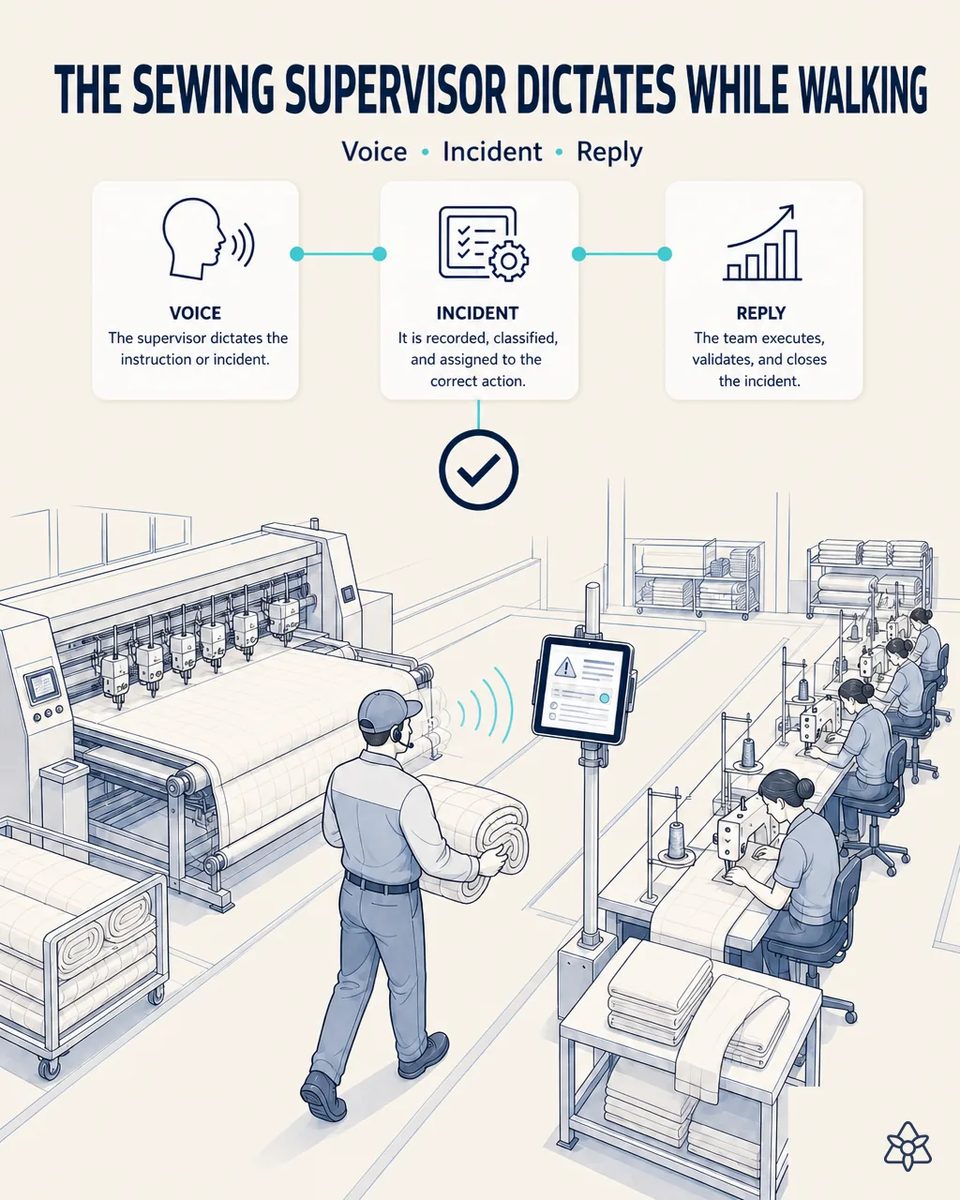
The quilting floor's best observer has both hands full.
The most valuable operational knowledge in sewing lives in supervisors' heads. It is not recorded because typing means stopping, and what is not recorded cannot be analyzed or handed over to the next shift. Production meetings discuss a late order without knowing that the cause was seen mid-morning. Short stops on quilting machines, thread breaks and missing trims repeat because they never get written down.
- The sewing supervisor spends the shift walking between multi-needle quilting machines, sewing cells, turning and packing, with fabric or a quilt in hand.
- What they see, a quilter breaking thread since the wadding lot changed, a cell behind because of an absence, binding arriving short, stays in their head.
- It is not recorded because typing means stopping, and what is not recorded cannot be analyzed or handed over to the next shift. The incoming supervisor starts each shift rediscovering what the previous one already knew.
- So production meetings discuss a late comforter order without knowing the cause was seen mid-morning, and short stops on the quilters repeat because they never get written down. The same quilter fails on Tuesday and Thursday, and nobody connects the two.
Connect in voice mode — a wake word, and the supervisor keeps doing the round.
Connect in voice mode with a wake word. The LLM structures the dictation as an incident linked to machine, cell, order and shift, and routes it to the role that must act. The reply comes by voice or as a tablet alert. It listens to the conversation the supervisor starts, nothing else. Step-by-step flow:
It listens to the supervisor when they choose to speak, and to nothing else. That limit is what keeps the case alive after the first month: the floor sees a tool that saves the supervisor from remembering, not a microphone over the sewing cells. And every incident recorded on the spot is one less problem solved from scratch on the next shift.
- The supervisor activates the earpiece and dictates what they observe, without stopping.
- iLEAN turns it into an incident linked to the machine and the active order.
- The alert reaches maintenance, quality or planning, as appropriate.
- The supervisor hears the reply and carries on with the round.
The quilting floor round today versus the round dictated by voice
| Aspect | Today | With iLEAN Connect |
|---|---|---|
| Thread breaks on a quilter | Remembered, maybe | An incident tied to machine and wadding lot |
| Binding or trims arriving short | Mentioned at the next meeting | Routed to planning on the spot |
| Cell behind on a comforter order | Cause unknown at the review | Cause recorded when it was seen |
| Shift handover in sewing | From memory | With the list of incidents |
| Answer back to the sewing supervisor | Walk to the office and ask | In the earpiece within seconds |
| Conversation between sewing operators | — | Never recorded |
Observations lost at shift end become records made on the spot, tied to machine and order. Handover from memory becomes handover with an incident list.
Impact estimate — to be validated with the sewing production manager.
The block below is an estimate to be validated against your plant's actual data. We put it forward so the committee has an order of magnitude; we refine it during the assessment.
- Estimated payback 6-12 months, which is harder to fix upfront than in the capture cases and has to be checked with the production manager.
- Fewer repeated short stops on quilters and sewing cells, because the second occurrence is already on record and maintenance can act before the third.
- Continuous improvement in sewing gets data to work with: incidents per machine, per wadding lot and per shift. The weekly review stops arguing about impressions and starts from a list of what actually stopped the quilters, ranked by how often it happened.
- The shift handover stops depending on memory and starts from a written list of what was seen, tied to each quilter and sewing cell.
Hard to quantify upfront; it enables continuous improvement in sewing and reduces repeated short stops. Estimated payback of 6 to 12 months, to be validated with the production manager.
And the fair question from the production manager
“Is this a way to keep tabs on the sewing operators?” — no. iLEAN needs the wake word and only hears what the supervisor dictates; there is no continuous listening. Structuring a dictation into machine, order and symptom is an anchored task, where the best models drop below 1.5% error [1], and the supervisor hears the summary back and corrects it if anything is off. Ordinary talk between sewing operators is never recorded.
[1] OpenAI paper "Why Language Models Hallucinate", 2025 — on the reliability of AI in anchored tasks.
What people ask about voice capture on the quilting and sewing floor
Does recognition work with multi-needle quilters running?
That is the design condition. The headset is built for industrial noise and recognition is tuned to trade words such as wadding, binding, piping or flange. It works alongside hearing protection where the floor requires it.
Does the supervisor have to learn fixed commands?
No. After the wake word they speak as they would to a colleague, and iLEAN structures it into machine, cell, order, symptom and shift. If something is missing, such as which quilter, iLEAN asks back in the earpiece.
Who receives what the supervisor dictates?
The role that must act: maintenance for a quilter fault, quality for a seam or shade issue, planning for missing binding or trims. The supervisor hears the reply and does not have to chase anyone on the floor.
Can it link thread breaks to a wadding or thread lot?
Yes, because each incident is tied to the active order and its materials. When the same symptom repeats with the same lot, it shows as a pattern. That is the evidence purchasing needs to talk to the wadding or thread supplier with data instead of impressions.
Why is the payback range wider in this case?
Because its value comes from fewer repeated stops and better handovers, which depend on how the floor works today. That is why we validate it with your production manager before committing to a number, using your stop history if you have one.
More cases from this series
- What the catalog showed is what arrives homeFour verification rings, from fabric received to parcel, so the product delivered is the one in the…
- Every lot's file, ready for auditEvery fabric lot generates its own file: lab results, validated start-up, photos and signatures, sorted…
- The cutting order reaches the system with a photoPhotograph the cutting order and traveler sheet: rolls, dye lot and meters reach the system in seconds,…
- The fabric supplier's notice becomes a decisioniLEAN reads the fabric supplier's notice, matches it against the production plan and proposes which…
- The textile lab spreadsheet reaches the ERP by itselfiLEAN reads the textile lab spreadsheet when saved and, after human validation, posts it to the ERP.…
- Marker and cutter, stitched to the ERPiLEAN stitches marker CAD and the automatic cutter to the ERP: orders flow down and real fabric…
Tell us how many quilter stops last week never made it into any record.
We work on your plant's real data, not ours. Assessment with no commitment.
Request estimated ROI within 48h ‹ See all cases of bedding See apparel