The stenter starts to talk, without replacing it
In the finishing area of a printing and dyeing plant, the stenter sets fabric width, hand feel and shrinkage. It is often fifteen to twenty-five years old, with a proprietary panel and no network. Replacing it is a seven-figure investment and weeks of downtime. With iLEAN Connect an external camera pointed at the panel is enough: the machine stays the same, but every fabric lot now has its real process curve stored in central memory, without touching the original controls.
The stenter decides width and shrinkage, and forgets every parameter once the lot is out.
The stenter and the dyeing machines decide shade, width and shrinkage, but their real parameters are only visible on screen while the fabric runs. The operator notes a few values in a logbook; the rest is lost. When a lot comes out narrow, shrinks too much in washing or does not match the previous lot, nobody can compare its curve with a good one. The adjustment depends on the most senior operator, and every reprocess consumes water, gas and machine hours.
- The stenter and the dyeing machines set shade, width, hand feel and shrinkage, but their real parameters are only visible on the panel while the fabric runs.
- Many stenters are fifteen to twenty-five years old, with a proprietary panel and no network. The operator notes a few values in a logbook and the rest is lost, including the overfeed and chamber setpoints that explain why a percale lot came out right last month.
- When a lot comes out narrow, shrinks too much after washing or does not match the previous lot of the same design, there is no good curve to compare it with.
- The correction depends on the most senior finishing operator, and every reprocess burns water, gas and stenter hours that the season plan did not include. When that operator is on vacation, the plant simply reprocesses more.
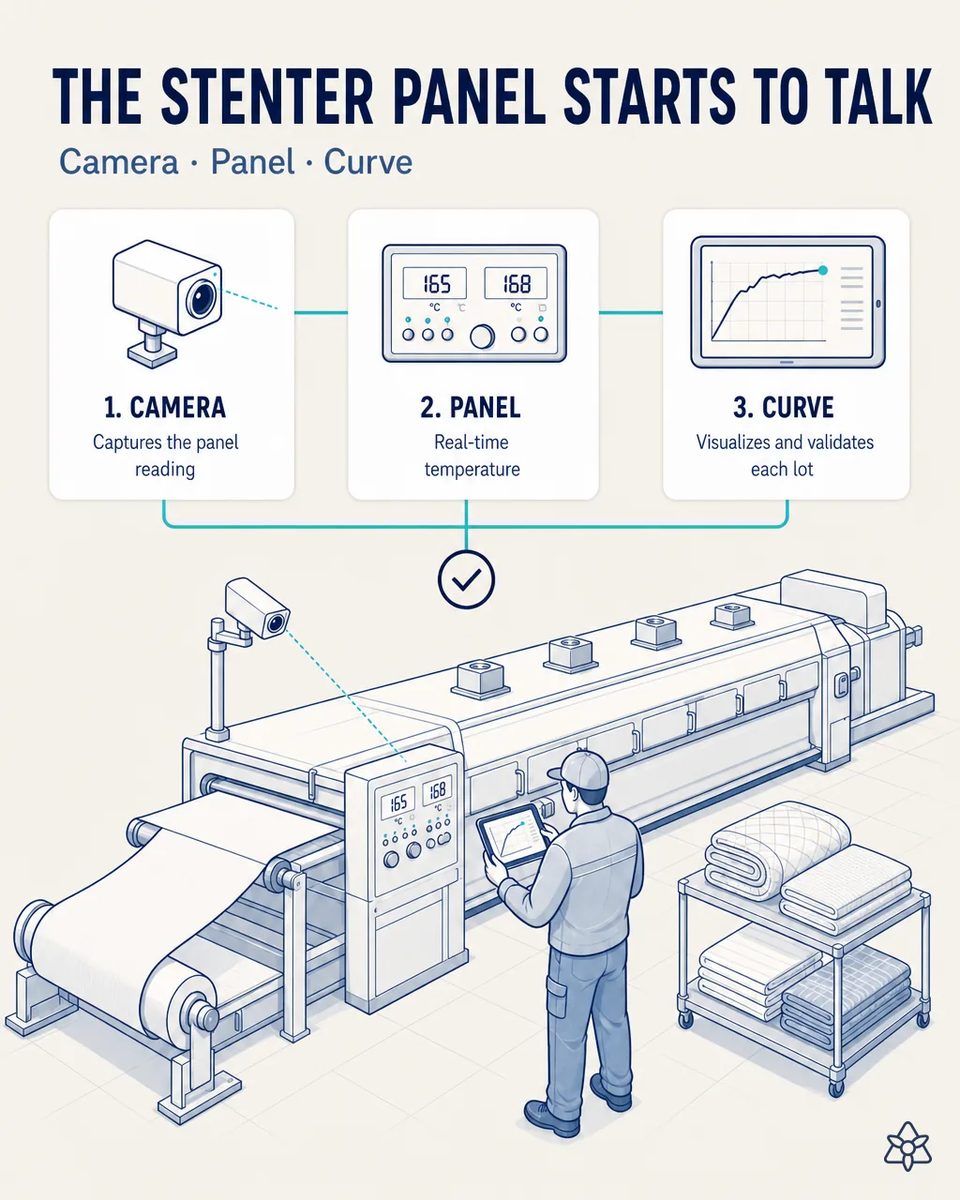
Connect reading the stenter panel — a camera outside, the machine untouched.
Connect in photo mode over a panel. A fixed industrial camera in front of the screen, read every few seconds with OCR and a grounded LLM, producing a time series per lot matched to the order on the machine. The PLC and wiring are left untouched. Step-by-step flow:
Replacing a stenter is a seven-figure investment and weeks without finishing capacity. Reading its panel from outside costs a camera and keeps the machine exactly as it is, while every lot starts leaving a curve that can be compared with a good one. The senior operator's know-how stops living only in their head and starts living in the curves.
- A fixed camera is installed in front of the stenter panel, with no intervention on the machine.
- iLEAN reads temperature per chamber, speed and width every few seconds.
- Each reading is linked to the lot and order on the machine at that moment.
- The finishing manager compares the lot curve with the standard and decides the adjustments.
The silent stenter versus the stenter being read
| Aspect | Today | With iLEAN Connect |
|---|---|---|
| Chamber temperatures and speed | Seen on the panel, then gone | A time series per fabric lot |
| Width at the stenter exit | A logbook entry, sometimes | Recorded every few seconds |
| Lot that shrinks after washing | Adjusted by the senior operator | Compared with a good lot's curve |
| Root cause of a narrow lot | Intuition | Bad-lot versus good-lot comparison in minutes |
| PLC, wiring and controls | — | Untouched |
| Stenter replacement | On the capex list | Deferrable |
Parameters that die on the screen become a full curve per lot. Root cause by intuition becomes a bad-lot versus good-lot comparison in minutes.
Impact estimate — to be validated with your finishing reprocess history.
The block below is an estimate to be validated against your plant's actual data. We put it forward so the committee has an order of magnitude; we refine it during the assessment.
- Estimated payback 5-10 months.
- Fewer finishing and dyeing reprocesses, each of which costs water, gas and stenter hours, and pushes back the next lot in the finishing queue.
- Stenter replacement can be deferred, because the machine stops being a black box and its real behavior per lot is finally on record.
- Root cause of a narrow or shrinking lot goes from intuition to a curve comparison in minutes, without depending on one operator's memory. That matters most on the night shift, when the senior finishing operator is not on the floor and the lot still has to leave the stenter within tolerance.
Estimated payback of 5 to 10 months; fewer finishing and dyeing reprocesses, and machine replacement can be deferred. Estimate to be validated.
And the fair question from the production manager
“Can a camera reading a screen really be trusted for chamber temperatures?” — here the task is anchored: a fixed panel, values in known positions and expected physical ranges per chamber, where the best models drop below 1.5% error [1]. A reading outside the possible range is discarded instead of stored, and the finishing manager still decides every adjustment. The camera adds memory to the stenter; it does not take control of it.
[1] OpenAI paper "Why Language Models Hallucinate", 2025 — on the reliability of AI in anchored tasks.
What people ask about reading the stenter panel in a bedding plant
Does the stenter manufacturer have to be involved?
No. Nothing is installed on the machine and no port is opened. The camera reads the panel the operator already looks at, so warranties and settings stay as they are. Installation takes hours and does not require stopping the finishing line.
Which stenter values does it read?
Temperature per chamber, fabric speed and width, plus any overfeed or setpoint the panel shows. What gets read is defined at commissioning with your finishing team. If the panel cycles through several screens, each one is mapped once.
How does each reading know which fabric lot was on the stenter?
Each reading is linked to the lot and order loaded on the machine at that moment, so a curve always belongs to a specific lot and design. That is what makes it possible to say which settings produced the last good lot of a sateen or a percale.
Does it work on the dyeing machines too?
Yes, the pattern is the same for any panel without a network. Most plants start with the stenter because width and shrinkage complaints trace back to it. Dyeing machine curves can be added later on the same central memory.
Will it tell the operator what to change on the stenter?
It shows the lot curve next to the standard and the difference. The adjustment remains the finishing manager's decision. Over time the plant builds a library of good curves per fabric and design that new operators can learn from.
More cases from this series
- What the catalog showed is what arrives homeFour verification rings, from fabric received to parcel, so the product delivered is the one in the…
- Every lot's file, ready for auditEvery fabric lot generates its own file: lab results, validated start-up, photos and signatures, sorted…
- The cutting order reaches the system with a photoPhotograph the cutting order and traveler sheet: rolls, dye lot and meters reach the system in seconds,…
- The fabric supplier's notice becomes a decisioniLEAN reads the fabric supplier's notice, matches it against the production plan and proposes which…
- The textile lab spreadsheet reaches the ERP by itselfiLEAN reads the textile lab spreadsheet when saved and, after human validation, posts it to the ERP.…
- Marker and cutter, stitched to the ERPiLEAN stitches marker CAD and the automatic cutter to the ERP: orders flow down and real fabric…
Tell us how many fabric lots went back through the stenter last month.
We work on your plant's real data, not ours. Assessment with no commitment.
Request estimated ROI within 48h ‹ See all cases of bedding See apparel