The par-baked bread recipe lives in the manager's spreadsheet — and nobody downstream knows it.
In most frozen par-baked bread plants, the recipe and the oven curve live in a local spreadsheet that the bakery manager updates every week with the incoming flour batch. iLEAN Connect reads that sheet wherever it is and turns it into live MES data — without forcing anyone to change tools. The manager stays in charge; the system stops being blind.
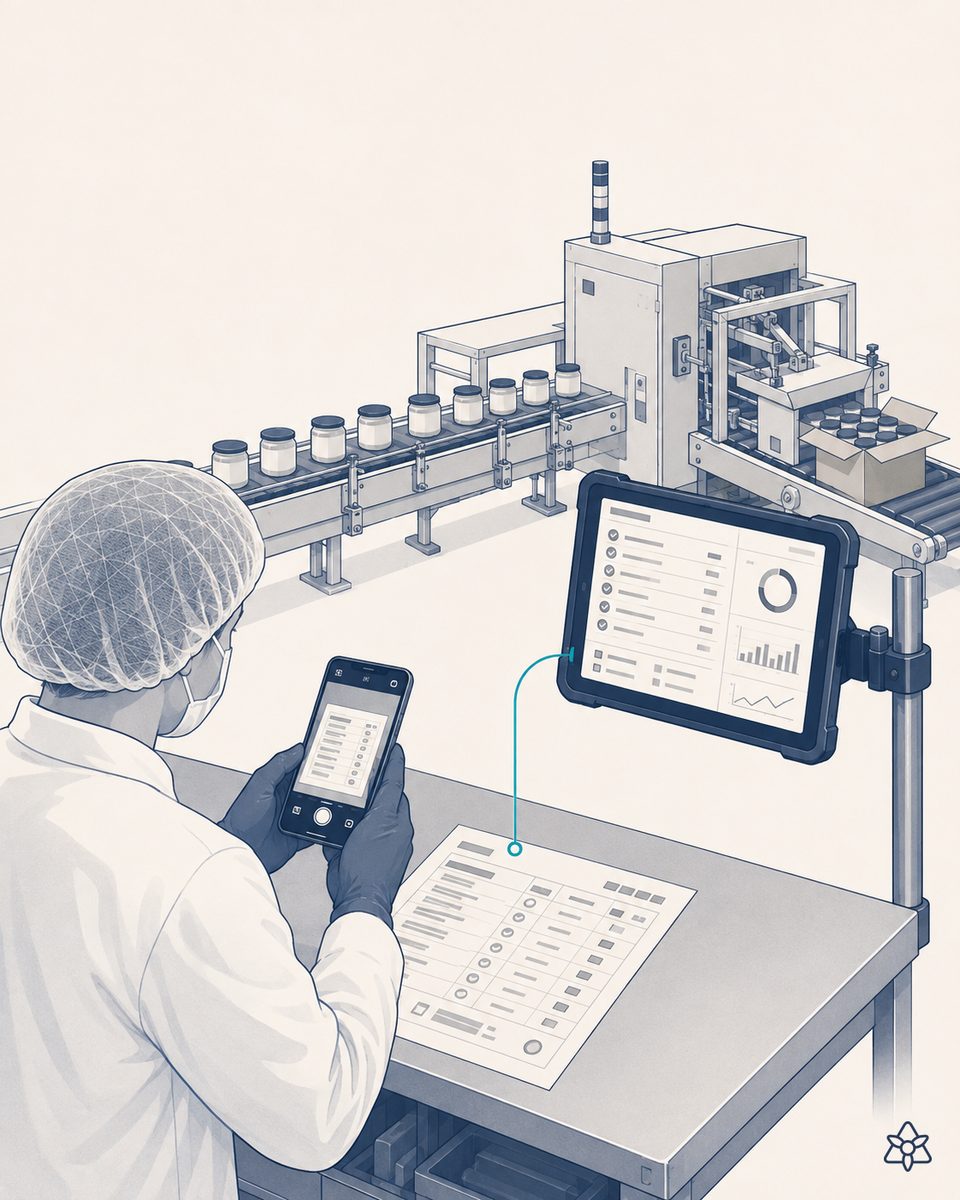
The oven recipe is not in the MES — it is on the manager's laptop.
Frozen par-baked bread is a product that gets adjusted every week to the flour batch, the ambient humidity, the customer order and the shift on duty. The person who owns that adjustment on the shop floor is the bakery manager, and the tool where it is written down is neither the MES nor the ERP — it is a local spreadsheet with tabs per oven, per SKU and per season.
Why this happens:
- The MES never learned the recipe. The settings of a rotary oven (ramp-up curve, steam in the first minutes, crown time, hearth time, ramp-down) are far too fine-grained to fit into a standard recipe module that does not understand the craft.
- The spreadsheet solved the problem. It was flexible, fast and the team understood it. It could be adjusted on the fly and it worked. That it never reached downstream was the price to pay.
- The price shows up when something changes. When the freezing tunnel runs at its limit, when a customer complains about a batch, when the auditor asks for traceability, when the manager goes on holiday — the sheet stops talking to the rest of the plant and starts costing money.
This is not a management failure, it is what happens in every industrial bakery. The manager's spreadsheet is the universal patch that holds the operation together. The change is not to retire the sheet: it is to read it where it already lives.
iLEAN Connect — the sealant that closes the gap between the spreadsheet and the MES.
This is not a cutting-edge technology problem: it is information living on an island that, at the critical moment, never reaches the person deciding. iLEAN acts as the sealant covering the dead zone that the ERP and the MES left exposed in par-baked bread. We do not ask you to change the oven, the tunnel or the bakery manager.
Connect reads the spreadsheet wherever it is. The agents cross it with the MES, the freezing tunnel and the order. The person signs — never the other way around.
What comes into play in a frozen par-baked bread plant:
- Connect (graduated capture). If the sheet sits in the manager's shared folder, Connect reads it there. If it sits on an isolated laptop, the graduated capture system comes in through whichever door fits — reading a synced folder, voice dictation, or an assistant in the manager's earpiece. The rule is: we never force the person who knows to change their tool.
- Connect (outward facing). The flour supplier sends the analysis by email with the new W and P/L of the batch. Connect captures it at second zero and puts it into the system, without the manager having to forward anything. The week's recipe is crossed with the week's flour, automatically.
- Baking agent. It cross-checks the batch recipe, the oven curve, the freezing tunnel, the chamber humidity and the order. If it detects that the tunnel is running at its limit or that the manager's recipe clashes with the planned SKU, it alerts through whichever channel the shift manager uses. It does not touch the oven: it proposes, the person decides.
- Three rings. The spreadsheet and the oven data live in ring 1 (OT, sacred). Connect reads from outside the ring, leaves a signed envelope in the mailbox, and ring 1 picks it up when it wants. The PLC receives nothing new, no port is opened.
Recipe in a local spreadsheet vs. recipe in the system with iLEAN Connect
| Aspect | Bakery manager's spreadsheet | With iLEAN Connect + Agent |
|---|---|---|
| Where the recipe lives | Manager's laptop or folder | Same sheet + the system reads and replicates it |
| Recipe change | Only the person in front of it knows | MES, quality and planning know at second zero |
| Batch traceability | Rebuilt by hand if the customer complains | Per-batch file, automatic |
| IFS/BRC audit | Days spent hunting for the right version | Full version history of the sheet, automatic |
| Veteran's retirement | The knowledge leaves with them | The judgement stays captured as a pattern |
| Decision about the oven | A person, with no safety net | A person, with the agent saying "careful, today's flour needs a longer crown time" |
Impact estimate for your plant — to be validated with your numbers.
The block below is an estimate to be validated with the actual data of your plant. It is an order of magnitude so the committee can size it; we refine it during the diagnostic.
- Mid-sized frozen par-baked bread plant, 2-3 rotary ovens, a shared freezing tunnel, 8-12 SKUs (baguette, ciabatta, par-baked sandwich loaf, specialities). The manager's recipe in a spreadsheet with tabs per oven and SKU.
- Connect pilot reading the spreadsheet + emitting to the MES + an agent alerting the shift manager. First value expected within a few weeks (the sheet starts travelling to the system).
- Indicative payback between 4 and 9 months. There are three hard levers: reduction of scrap from out-of-range batches (defensible floor ≥30%), recovery of the cost of a withdrawn or reprocessed batch, and capture of the manager's knowledge for the next generation.
- Rollout to other plants in the group done by the customer with their own trained people — without us.
And IT's reasonable doubt
"What if the AI misreads the spreadsheet and pushes a made-up recipe into the MES?" — hallucination is a problem of free generation, not of anchored tasks. Reading a spreadsheet and emitting the data to a system is the anchored task par excellence: the best models brought the error below 1.5% [1]. And even then, the data passes through ring 2 (validation) before touching ring 1: the system allows it because the architecture allows it, not because of blind trust.
[1] OpenAI paper "Why Language Models Hallucinate", 2025 — on the reliability of AI in anchored tasks.
What people ask about the forgotten par-baked bread recipe spreadsheet
Why does the par-baked bread recipe usually live in the bakery manager's spreadsheet?
Because the oven, the sourdough, the proofing chamber and the freezing tunnel went through decades of fine-tuning on the shop floor — temperatures, times, hydration, proofing percentage, par-baking curve — and nobody wanted to push that recipe into an MES that would take two years to learn it. The bakery manager's spreadsheet was the fastest solution and the only one that could be adjusted every week to the flour batch that arrived. It was not carelessness, it was the only reasonable thing at the time. What changed is that now that sheet can be read and left exactly where it is — without forcing the manager to change tools.
How does iLEAN Connect read a local spreadsheet without touching the oven's OT network?
Connect connects to the folder where the bakery manager keeps the sheet — shared folder, synced cloud drive, local NAS — and reads it at whatever cadence is configured: every change, every shift, every hour. The data crosses into the system inside ring 2 (validation), not ring 1 (the oven's critical OT). The oven PLC receives nothing new and no port is opened on its network. Connect is the sealant that fills the gap between the sheet and the MES, without demolishing anything that already works.
What happens if the bakery manager changes the recipe without telling anyone?
That is exactly what this solves. Today the recipe change stays in the sheet and nobody downstream finds out until the batch comes out odd. With Connect, the change is detected the moment the sheet is saved: the agents cross it with the production order and the history, and alert quality and planning at second zero. If the change is one of those that requires readjusting the freezing tunnel, the agent says so — but it does not touch the oven. A person validates and signs; the line does not restart on its own.
What exactly do you gain by digitizing the forgotten spreadsheet?
Three things. One: batch traceability — which exact recipe, which oven settings, which flour, which chamber, how long in the freezing tunnel. When the customer complains or the IFS/BRC auditor asks for the file, it comes out automatically. Two: capturing the veteran's knowledge — the day the bakery manager retires, their judgement does not leave with them. Three: OEE — when the oven or the tunnel drift out of range, the agents see it and warn before the batch ends up in the bin.
How long does this take to be up and running in a par-baked bread plant?
Connect reading a local spreadsheet and emitting the data to the MES is one of the fastest first-value wins in the iLEAN catalogue: within a few weeks there is flow. The full pilot (spreadsheet + MES integration + alert rules for the shift manager) fits into a quarter. And the rollout to the other lines or the other plant is done by the customer with their own trained people — the success of a good pilot is that they stop needing you. Ask for the estimated ROI and we will send it within 48h, with your plant's numbers.
More cases in ilean connect
- Transport notice email parser — at 8:00 the truck is not leaving; at 8:01 production already has a plan.iLEAN Connect reads the carrier email when the truck will not leave and the Agents replan production at…
- The campaign recipe lives in the veteran's spreadsheet — and nobody downstream knows it.How iLEAN Connect captures the veteran's polymer campaign recipe spreadsheet and Agents detect blend…
- The dispenser viscosity lives in a spreadsheet — and the lump lives in the oven.How iLEAN Connect reads the viscosity spreadsheet of the powder coating dispenser and crosses it with…
- From image to Excel, handwriting too. And the next sheet does itself.Convert a photo of a handwritten sheet to Excel with an AI agent. If it's a form you use every day, it…
- Your paper inspection checklists, tallied and watched by AI agents.Free printable daily equipment inspection checklist and defect check sheet. Check them off by hand, snap…
- Your paper maintenance log, read by AI agents.Free printable equipment maintenance log template. Techs fill it in by hand, snap a photo, and an AI…
Tell us your case and within 48h we will send you the estimated ROI of this AI project for your par-baked bread plant.
We work on your plant's real data, not ours. Diagnostic with no commitment.
Request estimated ROI within 48h See iLEAN Connect