Transport notice email parser — at 8:00 the truck is not leaving; at 8:01 production already has a plan.
The transport supplier writes at 8:00 to say the truck is not leaving. In the classic flow, the notice goes through the sales rep, reaches production by mid-morning and the plant replans too late. iLEAN Connect reads the email at second zero, the Agents propose a revised plan within a minute and the planning manager signs it off. No forwarding chains. No meeting. No day lost.
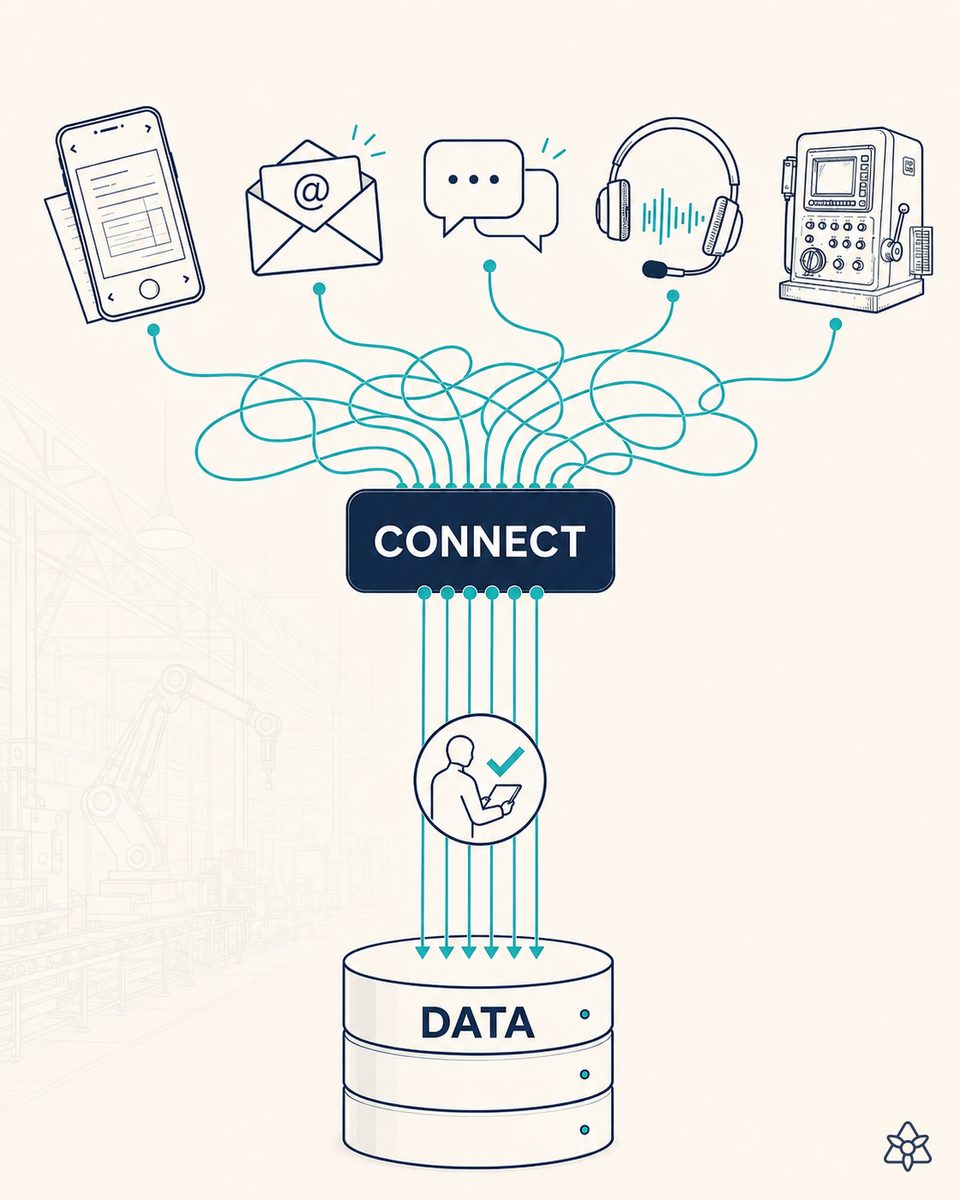
The critical information in a plant almost never comes in through a sensor — it comes in through an email.
The production planning system works well with the predictable: orders in the ERP, raw material in the MES, capacity in the SCADA. Where it breaks is with the unforeseen that arrives through a people channel: an email from the carrier at 8:00 saying the truck is not leaving because of a breakdown, a driver calling in sick or a border check.
What happens in a plant without Connect is the same script over and over:
- The supplier writes to the sales rep — because that is their contact.
- The sales rep opens the email when they get back from a customer visit.
- The sales rep forwards it to logistics, copying production.
- Production checks whether there is alternative raw material, whether another order can be moved.
- They call a quick meeting — which is almost never quick.
- By mid-afternoon a decision is made and the plan is adjusted. The day is lost.
The cost is not only the truck that did not leave. It is the whole chain reacting late: the line that stops because there was no way to know in time, the customer who gets the warning after the committee meeting, the sales rep who spends the morning relaying messages instead of selling. Transport volatility — from the 2021 peaks to the recent overcapacity [3] — only amplifies this dependence on email as the plant's on/off switch.
iLEAN Connect — the supplier email enters the system at second zero, not in the 11 a.m. forward.
The problem is not the email — the supplier will keep sending it by email. The problem is the forwarding chain between the email and the person who decides. iLEAN Connect is the filler for that gap: the external capture from the manifesto, «the critical information of a factory almost never comes in through a sensor; it comes in through a supplier email, a customer message, a phone call». It does not ask you to change the ERP, or the MES, or the way the supplier writes — it simply deposits the data into the system when it arrives, not when someone finds it.
Connect reads the email at second zero. The Agents propose a revised plan. The planning manager signs — production does not move on its own.
The iLEAN pieces applied to the transport notice:
- Connect — listens to the company mailbox (sales, logistics, planning) and recognizes the carrier notice the moment it lands. It recontextualizes the body of the email as a structured event: supplier, affected order, original date, new date or no-show, reason. It recognizes template and dialect variations without asking the supplier to change the way they write.
- Agents — cross the event with the ERP/MES/SCADA: which order depends on that material, which other order can be pulled forward, which customer ends up with less stock, which alternative transport fits the budget. They prepare a replanning proposal with scenarios and costs and put it on the planner's desk within a minute.
- Connect (again, outbound) — once the person signs the new date off, the Agents prepare the reply to the carrier through the same channel the notice arrived on. The reply goes out with the manager's signature — Connect carries, the Agents propose, the person signs.
Autonomy is graded by ring: ring 3 processes the email at full speed; ring 2 validates that the order and the supplier exist as stated; ring 1 (the OT network, the shop-floor orders) never executes changes without a human signature. That is the safety line iLEAN holds even when everything is moving fast.
Manual forwarding of the notice vs. email parsed with iLEAN Connect
| Aspect | Email → forwards → meeting | With iLEAN Connect + Agents |
|---|---|---|
| Arrival of the notice at production | When the sales rep forwards it | At second zero, deposited into the system |
| Supplier language or template | Someone has to read it carefully | Any format, recontextualized |
| Replanning proposal | Quick meeting that takes a while to convene | Revised plan on the planner's desk within a minute |
| Visibility for the end customer | Arrives late and through a person | Notice prepared for signature in the same flow |
| Opportunity cost of the day | Day lost, or half a day | Day reorganized while the coffee goes cold |
| Traceability of the decision | Crossed email threads | Event + proposal + signature, all attached to the order |
Impact estimate for your plant — to be validated with your numbers.
The block below is an estimate to be validated with the actual data of your plant. We put it forward so the committee has an order of magnitude; we refine it during the diagnostic.
- Plant with 20-80 shipments/day, several carriers, no-show or delay notices by email between 1 and 5 a day.
- Connect connected to the shared logistics/sales mailbox. First expected value within a few weeks: the first notice parsed and replanned before the coffee break.
- Reduction of the average reaction time to a notice ≥ 30% — the hard lever is the production day rescued for every incident that is handled well.
- Indicative payback between 4 and 9 months, depending on the number of notices/month, the cost of a day of stopped line and the average cost of a customer stock-out avoided.
And the fair question from the planning manager
«What if the agent misreads the email and replans the wrong order?» — hallucination is a problem of free generation, not of anchored tasks. Pulling the fields «supplier, order, date, reason» out of an email is exactly a task anchored to its source: the best models brought the error below 1.5% [1]. And even so, the plan does not move on its own: the agent proposes, the planning manager signs. That is the boundary of the three rings — and in logistics it is exactly the one that holds up the contract with the customer.
[1] OpenAI paper «Why Language Models Hallucinate», 2025 — on the reliability of AI in anchored tasks.
[3] Recent volatility in container shipping — the 2021 peaks, the Red Sea rebound and the subsequent fall driven by overcapacity.
What people ask about the transport notice email parser
Why does a truck no-show notice take so long to reach production?
Because it comes in through the wrong channel for production: it arrives as an email from the carrier to the sales rep or to logistics, who opens it when they can, reads it, understands it, forwards it to production, and production decides what to do. Between the supplier's morning email and the plant replanning, two or three hours have easily gone — and that day is lost. The problem is not that information is missing: it is that the data does not reach the person who decides in time.
What does an email need to have for iLEAN Connect to understand it?
Nothing special. Connect reads the supplier email exactly as it was written — ambiguous subject line, optional attachment, shop-floor Spanish or the carrier's English — and recontextualizes the content as a structured event: which supplier, which order is affected, which original date, which new date or whether it is a full no-show, which reason. You do not ask the supplier to change their format; that is precisely what makes the system scale to every supplier you already have.
What do the Agents replan within the minute and what stays with the person?
The Agents propose a revised plan — which order slips, which order is pulled forward because raw material is available, which customer ends up with one day less of stock, which alternative transport could be sourced — and put it on the planning manager's desk within a minute. The final replanning is signed off by a person; the system does not move production orders on its own. That boundary is the one drawn by the three iLEAN safety rings.
What if the sales rep owns the supplier relationship and does not want to lose control?
It is not about taking the relationship away — it is about not using it as a bottleneck for an operational data point. Connect deposits the notice in the system and alerts the sales rep through their own channel; it does not take the conversation away. The sales rep keeps talking to the supplier; what changes is that production no longer waits for the forward in order to react. Everyone gains clock time, and the sales rep gains time to sell instead of relaying messages.
Does Connect also reply to the carrier, or does it only listen?
Connect is bidirectional: it listens outward and it also speaks outward. Once the person signs the replanning off, the Agents can prepare the reply to the supplier (confirmation of the new date or a request for an alternative) through the same channel the notice arrived on. The reply never goes out without a human signature — that is the contract with iLEAN: Connect carries, the Agents propose, the person signs.
More cases in ilean connect
- The supplier SDS arrives in German and sits in an inbox until someone translates it.iLEAN Connect intercepts the supplier SDS in German or Italian, recontextualises it into English and…
- Raw milk delivery note email parser — the data arrives before the tanker.iLEAN Connect reads the raw milk delivery note PDF in the carrier's email and extracts batch, farm, pH…
- Your tier-2 supplier emails the forecast — and your MES expects EDIFACT.How iLEAN Connect normalizes a non-EDI supplier forecast (email + spreadsheet) into EDIFACT and feeds it…
- The campaign recipe lives in the veteran's spreadsheet — and nobody downstream knows it.How iLEAN Connect captures the veteran's polymer campaign recipe spreadsheet and Agents detect blend…
- The dispenser viscosity lives in a spreadsheet — and the lump lives in the oven.How iLEAN Connect reads the viscosity spreadsheet of the powder coating dispenser and crosses it with…
- The par-baked bread recipe lives in the manager's spreadsheet — and nobody downstream knows it.How iLEAN Connect reads the bakery manager's spreadsheet with oven settings and par-baked bread recipes…
Tell us about your case and within 48h we will send you the estimated ROI of this AI project for your supply chain.
We work on the real data of your plant, not on ours. Diagnostic with no commitment.
Request estimated ROI in 48h See Connect