Raw milk delivery note email parser — the data arrives before the tanker.
The raw milk delivery note arrives as a PDF attached to the carrier's email, fifteen minutes ahead of the tanker. iLEAN Connect extracts it — batch, farm, pH, temperature — and drops the data into the goods-receiving system before the truck reaches the dock. The person on the dock signs off the unloading; nothing enters without validation.
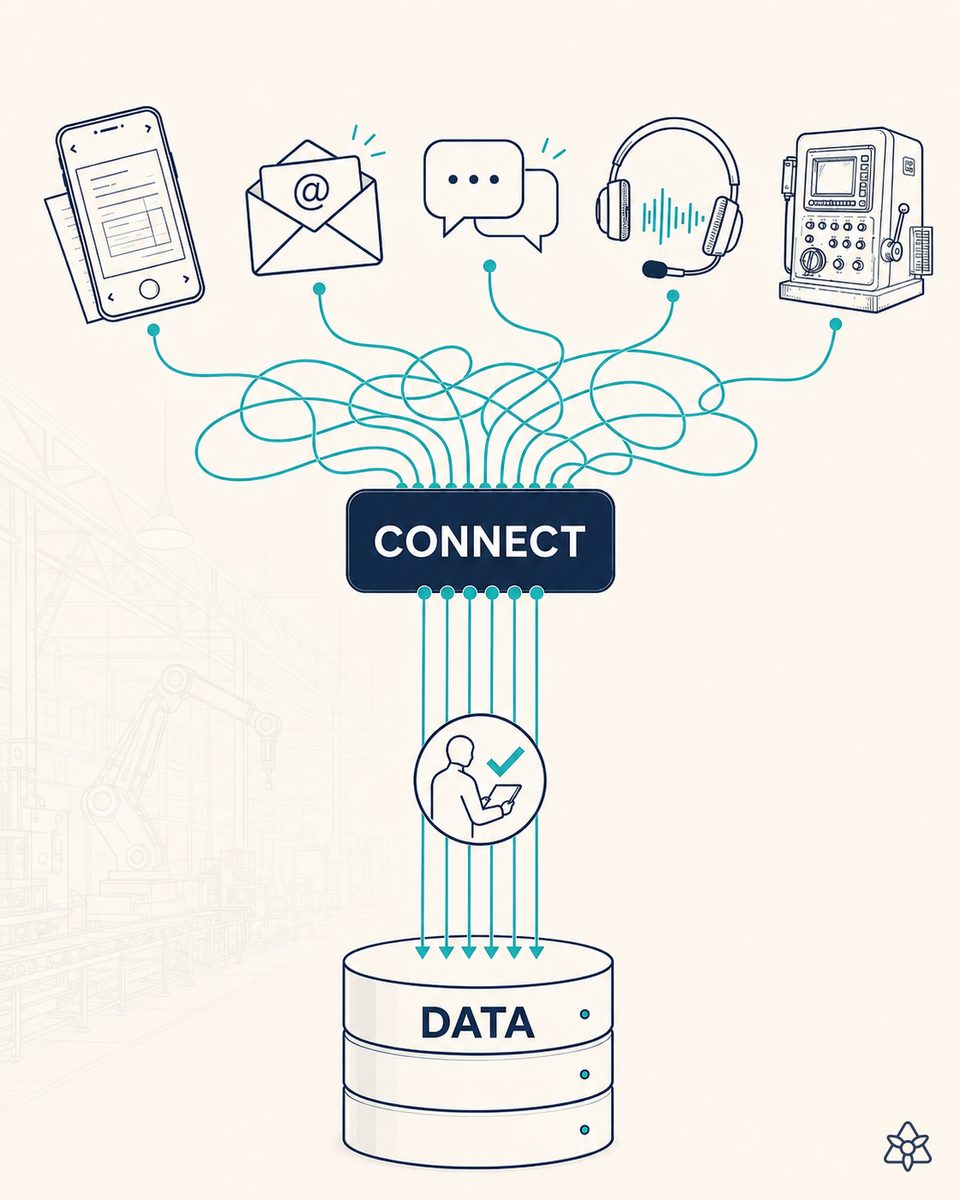
The data already exists — and gets typed in when it is already too late.
In a dairy handling several tankers a day, goods receiving usually works like this: the carrier pulls up at the dock with a delivery note in PDF (printed or on their tablet), the receiving supervisor types it into the system, the laboratory takes samples, and the batch goes in. The problem is not that the data is missing — the cooperative measured it at origin and emailed it fifteen or twenty minutes earlier. The problem is that this email sits in an inbox nobody opens before the unloading.
Three consequences that hurt at month-end close:
- Dock time spent typing in a delivery note that was already digital at origin. Three minutes per tanker, every single day.
- Late decisions on batches with pH or temperature out of range: by the time the laboratory confirms, the truck has already unloaded.
- Incomplete traceability: the original delivery note stays in an email folder and never attaches to the batch file the auditor will ask for.
This is not clumsiness on the receiving supervisor's part. It is that pulling heterogeneous data together used to cost a fortune, so nobody did it. That has just changed.
iLEAN does not add a fourth system — it seals the crack between the email and the ERP.
A plant's critical information almost never comes in through a sensor — it comes in through a supplier's email, a customer's WhatsApp message, a phone call. Connect is the piece that captures all those channels and puts them into the system at second zero. It is the filler covering the dead zones that ERP, MES and SCADA left exposed, whether the data comes from outside or from within.
Connect reads the PDF in the email. The Agents validate it against the HACCP plan. The dock sees the batch before it arrives. The person signs — the truck does not unload on its own.
The iLEAN pieces applied to the raw milk delivery note:
- Connect (listening outward) — reads the goods-receiving inbox, identifies the carriers' PDF attachments, extracts batch, farm, volume, pH and temperature. It learns each template from a couple of examples; it does not demand that the supplier change their format.
- Middle ring (validation) — raw data enters the outer ring fast; a pool of Agents verifies that the carrier is on the approved list, that the farm exists, and that the values fall within the client's HACCP ranges. If it passes, the signed data is deposited for the ERP to pick up. If it does not, the dock gets the alert before the truck arrives.
- Agents — build the batch file from second zero: original delivery note as evidence, extracted reading as structured data, timestamp and the dock supervisor's signature when unloading closes. The file for the IFS/BRC auditor rebuilds itself.
Typed-in goods receiving vs. pre-read goods receiving with iLEAN
| Aspect | Delivery note typed in at the dock | With iLEAN Connect + Agents |
|---|---|---|
| When the data is known | When the truck is already there | 15-20 min earlier, when the email arrives |
| Decision on an out-of-range batch | After unloading | Before the dock barrier opens |
| Supplier format | Every cooperative, its own PDF | Connect learns each template |
| Dock time per tanker | 3-5 min typing + checking | 30 s of visual validation and signature |
| Original delivery note attached to the batch | In an email folder | Attaches to the batch file automatically |
| Traceability for the auditor | Rebuild email → ERP by hand | Per-batch dossier with original PDF + reading |
Impact estimate for your plant — to be validated with your numbers.
The block below is an estimate to be validated with the specific data of your plant. We put it forward so the committee has an order of magnitude; we refine it during the diagnostic.
- Dairy with 10-20 tankers/day, 3-6 cooperatives each with their own delivery note template, goods receiving typed into the ERP by the dock supervisor.
- Connect pilot (email parser + integration with the goods-receiving ERP + advance HACCP alert). First value expected within a few weeks.
- Indicative payback between 4 and 9 months, depending on tanker volume and the cost of one deviant batch unloaded by oversight.
- Reduction in dock time per tanker ≥ 30%. A single out-of-range unloading avoided pays for a good part of the pilot.
And the quality manager's reasonable doubt
"What if the AI gets a PDF wrong and puts an incorrect value into the system?" — hallucination is a problem of free generation, not of anchored tasks. Reading a "pH" field from a PDF in a known template and depositing it into an ERP field is exactly what AI does best; the leading models brought the error rate below 1.5%[1] on this type of task. And even so, the middle ring validates before the data enters the critical ring, and the person on the dock signs off the unloading.
[1] OpenAI paper "Why Language Models Hallucinate", 2025 — on the reliability of AI in anchored tasks.
What people ask about the raw milk delivery note email parser
What data does Connect extract from the raw milk delivery note PDF?
Batch, farm of origin, volume, pH at the farm tank outlet, temperature recorded by the carrier's probe, collection time, carrier code. Those are the ones the goods-receiving system needs to validate the unloading; the rest of the PDF stays attached to the batch as evidence.
What if every cooperative sends the delivery note in a different format?
That is exactly where AI changes the rules. Recontextualising a value (from a PDF in template A into a field in the system) is an anchored task, not a creative one, and that is why reliability is very high. Connect learns each new template from a couple of examples given by the quality manager; there is no need to ask the supplier to change their format.
What happens if the pH or temperature on the delivery note is outside HACCP limits?
The system holds the unloading before the tanker reaches the dock. The quality manager receives the alert with the original delivery note, the out-of-range value and the batch affected. The person decides — return, segregate or unload with an observation — and signs. The gate does not open on its own.
Does this replace the goods-receiving laboratory?
No. The goods-receiving laboratory measures on site — Connect only brings forward the data the supplier already measured. What you gain is time: the dock knows what is coming fifteen minutes ahead, and the laboratory focuses on confirming and resolving deviations rather than typing in the delivery note.
How long does it take to integrate with the dairy's ERP?
Connect plugs in as one more source — email, SFTP folder, API if the supplier has one — and drops the data into the ERP/MES through whichever channel the client already uses. The fast part is the reading; the part that takes real work is deciding with quality which thresholds trigger a hold. We do that together with you during the immersion.
More cases in ilean connect
- The aerospace OEM's CSR arrives as a 200-page Word file — and the plant reads it as a per-batch verifiable checklist.iLEAN Connect reads the aerospace OEM's Word CSR and turns it into a per-batch verifiable checklist on…
- API CoA email parser — from the supplier PDF to the batch record without retyping.iLEAN Connect captures the API CoA PDF arriving by email, extracts the specs and posts them to the…
- The supplier SDS arrives in German and sits in an inbox until someone translates it.iLEAN Connect intercepts the supplier SDS in German or Italian, recontextualises it into English and…
- Your tier-2 supplier emails the forecast — and your MES expects EDIFACT.How iLEAN Connect normalizes a non-EDI supplier forecast (email + spreadsheet) into EDIFACT and feeds it…
- Transport notice email parser — at 8:00 the truck is not leaving; at 8:01 production already has a plan.iLEAN Connect reads the carrier email when the truck will not leave and the Agents replan production at…
- The campaign recipe lives in the veteran's spreadsheet — and nobody downstream knows it.How iLEAN Connect captures the veteran's polymer campaign recipe spreadsheet and Agents detect blend…
Tell us about your case and within 48h we'll send you the estimated ROI of this AI project for your goods receiving.
We work on your plant's real data, not ours. Diagnostic with no commitment.
Request estimated ROI within 48h See iLEAN Connect