The aerospace OEM's CSR arrives as a 200-page Word file — and the plant reads it as a per-batch verifiable checklist.
The Customer Specific Requirements that Airbus, Boeing, Embraer or Bombardier send in Word are the real source of aerospace quality — but they live in a quality mailbox nobody has time to read. iLEAN Connect parses every CSR, the Agents turn it into a per-batch checklist with a reference to the source clause, and a person signs every close. No rewriting, no losing track of the live revision.
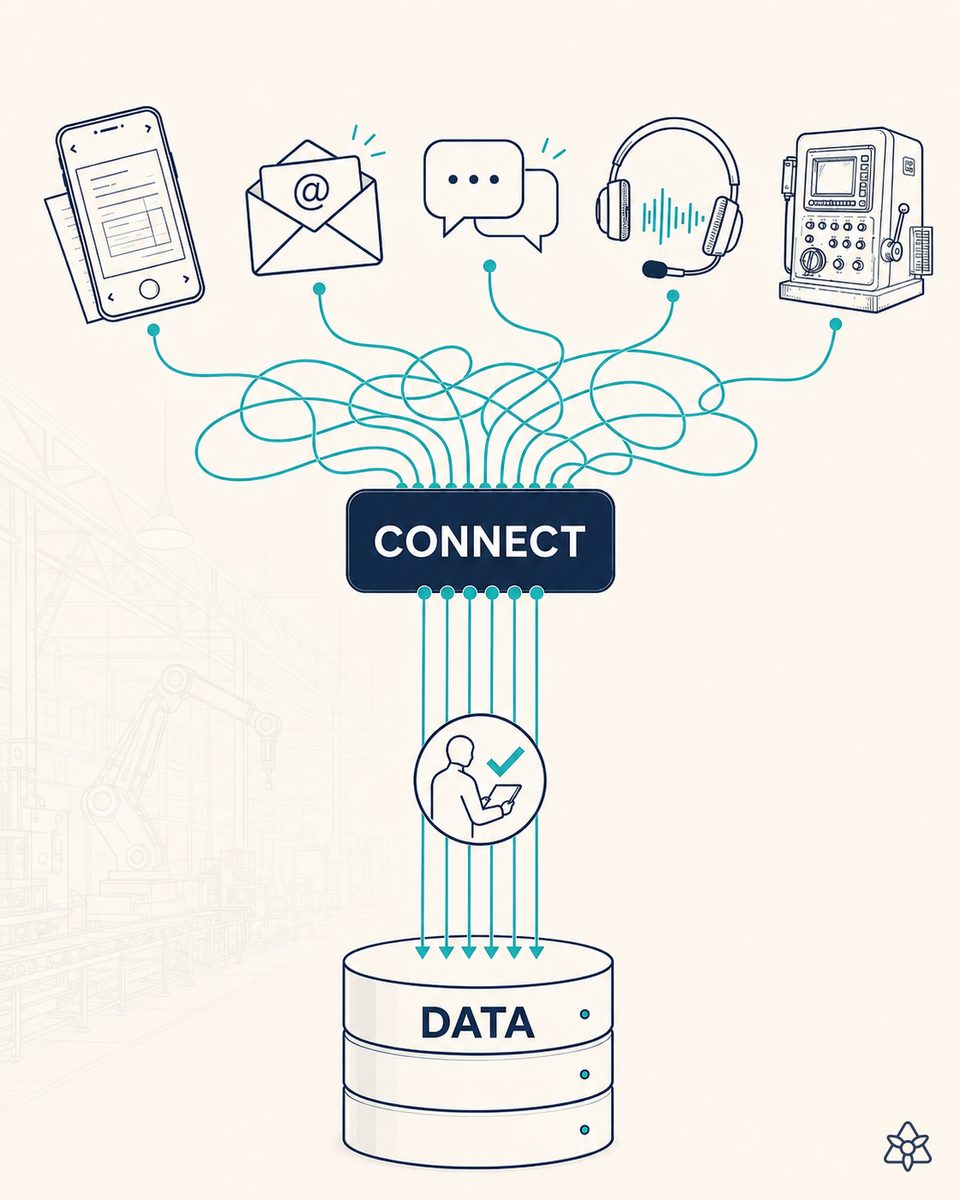
A 200-page CSR is the truth of the programme — and almost nobody on the floor has read it end to end.
In aerospace, AS9100 (or EN9100 in Europe) is the floor. On top of it comes the CSR: the document where the OEM adds its particular rules by programme, by alloy, by part family. It arrives as a Word file of tens or hundreds of pages, with nested indexes, annexes and cross-references to other customer specifications. And it changes by revision whenever the OEM adjusts a calculation, switches a raw material supplier or learns a lesson in service.
Day to day, the aerospace Tier 1 lives with three uncomfortable realities at once:
- The email lands in the quality mailbox — the manager downloads it, opens it, tries to read it, marks what looks relevant, and saves it to a network folder. On a quiet day.
- The shop floor manufactures against the last revision it remembers — because nobody has had time to compare, clause by clause, what changed between the previous revision and the new one.
- The audit arrives and asks for per-batch traceability — which version of the CSR governed each batch, which clause was verified, who signed. Rebuilding that by hand can take the quality team a week.
The classic system (Word file + folder + email + the veteran's memory) works almost always. The day it doesn't, the consequence is a major non-conformance, a programme stop-shipment, or the loss of preferred supplier status — in an industry where rebuilding the OEM's trust takes years.
Connect reads the customer's Word file — the Agents turn it into a per-batch checklist — the person signs.
The CSR is not a standards problem: it is a total integration problem. Critical information reaches the factory by email in a Word file, not through a sensor. And it almost never reaches the person deciding on the line in time. iLEAN acts as the filler that seals that crack between the quality mailbox and the shop floor, without replacing the ERP, the MES or the document management system you already have.
Connect captures the CSR where it already is. The Agents recontextualise it into a per-batch checklist. The person signs every close. If the OEM issues a revision, the difference is flagged and goes back through the signature. Nothing ever restarts on its own.
The three iLEAN pieces applied to the aerospace CSR:
- Connect — captures the CSR Word file straight from the quality or engineering mailbox, at second zero. It reads the attachment, identifies programme, revision and date, and makes it available to the swarm. No forwarding, no manual saving to a network folder.
- Agents — segment the CSR by chapter, extract the actionable requirements (the ones that generate a real verification on the floor), match them to the part family and the programme, and build the checklist per batch number. If a new revision arrives, they compare it clause by clause and propose the change.
- Three rings — the Word file enters ring 3 (power) fast. It is validated in ring 2 (does the revision exist? is the programme one of ours? does the change add up?). It only enters ring 1 (critical OT, closed document system) with a cryptographic seal and the signature of the responsible person. DO-326A was written for exactly this.
CSR read by hand vs. CSR parsed by iLEAN Connect
| Aspect | Manual CSR reading | With iLEAN Connect + Agents |
|---|---|---|
| Arrival of the Word file | Quality mailbox, manual download, saved to a folder | Captured at second zero, segmented and available |
| Detection of a new revision | The manager notices it — if they notice it | Automatic diff between revisions, changes flagged |
| Cascade down to the line | Quality manager's memory, internal sheet | Per-batch checklist with the CSR clause reference |
| Per-batch verification | Operator and a generic checklist | Items specific to the programme, alloy and family |
| Dossier for the OEM audit | Rebuilt by hand, days or weeks | Per-batch file with every clause resolved and signed |
| Human validation | Trust that somebody read it | Explicit signature per batch close, ring 1 |
Impact estimate for your plant — to be validated with your numbers.
The block below is an estimate to be validated with the concrete data of your plant. We put it forward so the committee has an order of magnitude; we refine it during the diagnostic.
- Tier 1 plant with 2-4 active OEM programmes, several hundred live CSRs and an average of several revisions published per programme per year.
- Connect pilot on one quality mailbox and one programme: Word capture + parsing + per-batch checklist generation + revision comparator. First value expected within a few weeks (one programme running against a generated checklist).
- Indicative payback between 4 and 9 months, depending on the current cost of quality hours spent reading and comparing CSRs, revision frequency and the historic average cost of an NC caused by an expired revision.
- Expected reduction in the time spent assembling the per-batch dossier for the OEM audit of ≥ 30%, once the checklist already closes with the CSR clause reference on every step.
- The hard lever is a single major NC avoided: one programme stop-shipment can pay for the pilot and two years of licence.
And the quality director's reasonable doubt
"What if the agent misreads a CSR clause and lets a part through against the wrong revision?" — hallucination is a problem of free generation, not of anchored tasks. Recontextualising a Word file into an actionable checklist, quoting the source clause, is precisely an anchored task: the best models brought the error below 1.5% [1]. And even so, nothing critical is decided alone: the checklist does not enter the closed document system until the responsible manager signs. The three rings exist precisely for this, and DO-326A formalises it for the sector.
[1] OpenAI paper "Why Language Models Hallucinate", 2025 — on the reliability of AI in anchored tasks.
What people ask about the aerospace CSR email parser
What is a CSR (Customer Specific Requirement) in aerospace and why does it change so often?
A CSR is the document where the aerospace OEM (Airbus, Boeing, Embraer, Bombardier) adds its particular rules on top of the general AS9100/EN9100 standard. It almost always arrives as a Word file of tens or hundreds of pages, organised by programme, by alloy, by part family, clause by sub-clause. It changes by revision whenever the OEM adjusts its design, its raw material supplier or a lesson learned in service. For the shop floor that means the version governing the batch entering today may not be the same one that governed last Thursday's batch.
How does iLEAN Connect extract the useful content from a 200-page CSR in Word?
Connect captures the Word file from the quality or engineering mailbox at second zero. The Agents segment it by chapter, identify the actionable requirements (the ones that translate into a verification on the floor), match them to the corresponding part family and programme, and turn them into checklist items per batch number. What used to be a document nobody read end to end becomes a sequence of verifications the operator runs on the tablet — with the CSR clause reference behind each one, in case the audit asks.
What happens when the OEM publishes a new revision of the CSR?
Connect detects the revision in the incoming email (the OEM usually changes the revision number in the Word file name). The Agents compare it clause by clause against the live revision, flag the changes — added, modified, removed — and propose the update to the per-batch checklist. Nothing changes in production until a quality manager signs. Three rings: the data reaches ring 3 fast, is validated in ring 2, and only enters ring 1 with a cryptographic seal and human validation.
How do you make sure the operator verifies the CSR clauses that apply to their batch?
The checklist is per batch, not generic. When a manufacturing order comes in, the agent takes the part family, the OEM programme and the alloy, and builds the list of verifications that apply to that specific batch. The operator walks through them on the tablet or phone, signs each step, and attaches a photo if the CSR requires it. When the batch closes, what remains is a file with every CSR clause resolved — the "boring, concrete agent": the batch dossier ready for the OEM auditor.
What risk does per-batch CSR revision traceability cover?
The classic risk is manufacturing against an expired revision — the OEM changed a torque value in the new revision, the customer received the email, but the change never reached the plant. A part manufactured against an obsolete revision can trigger a major non-conformance, a programme stop-shipment, and the loss of preferred supplier status in an industry where rebuilding trust takes years. Per-batch revision traceability is not a nice-to-have: it is the document that proves to the OEM that every part shipped against the correct version of the CSR.
More cases in ilean connect
- The chemical tank has a good pressure gauge — and its reading lives in a shift notebook.iLEAN Connect reads the analog pressure gauge of a chemical tank with a fixed camera and emits the…
- Analog panel capture on the pasteurizer — the CCP that lives on a needle, now in the system.iLEAN Connect reads the pasteurizer's analog panel from a photo — temperature and pressure needles — and…
- A ceramic tile that warps in the kiln is scrap — and the blame lies with the curve nobody cross-checked against the thermocouples.A fixed camera reads the analog panel of the Sacmi ceramic kiln; iLEAN Connect cross-checks…
- API CoA email parser — from the supplier PDF to the batch record without retyping.iLEAN Connect captures the API CoA PDF arriving by email, extracts the specs and posts them to the…
- The supplier SDS arrives in German and sits in an inbox until someone translates it.iLEAN Connect intercepts the supplier SDS in German or Italian, recontextualises it into English and…
- Raw milk delivery note email parser — the data arrives before the tanker.iLEAN Connect reads the raw milk delivery note PDF in the carrier's email and extracts batch, farm, pH…
Tell us about your case and within 48h we'll send you the estimated ROI of this AI project for your aerospace Tier 1.
We work on your plant's real data, not on ours. Diagnostic with no commitment.
Request estimated ROI in 48h See Connect