The GMP deviation is reported by phone first — and rewritten three hours later, from memory.
In a pharma plant the operator reaches for the phone before the form, because the equipment will not wait. iLEAN Connect transcribes the VoIP call in real time, opens the OOS with a signed timestamp and hands it to the supervisor to sign. The person validates — the report is not invented three hours later.
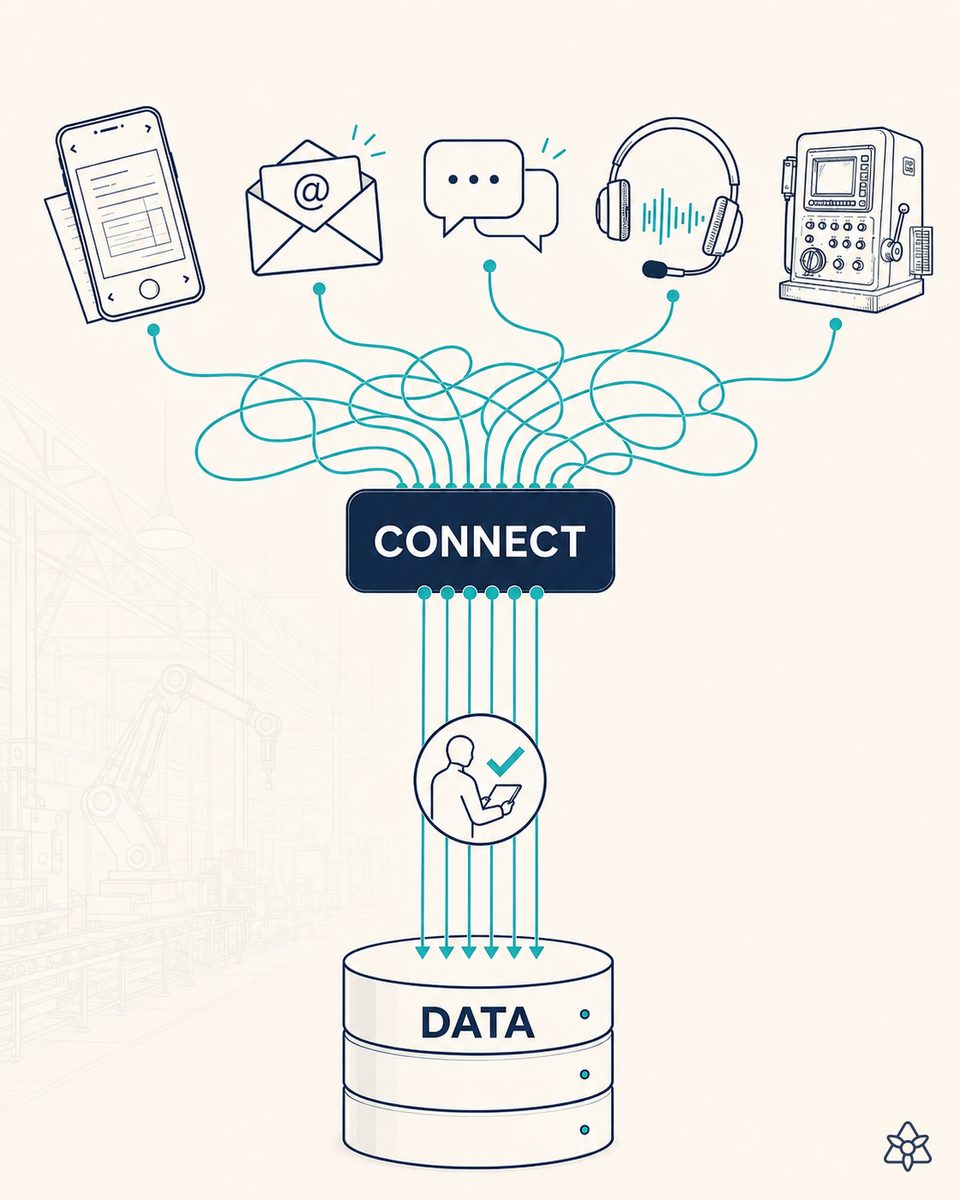
The exact minute of the event is lost between the call and the form.
GMP regulation is clear: every deviation is opened with the timestamp of the moment of the event, the identity of whoever observed it and a precise description. The reality of the plant is another story:
- The operator calls, they do not write. When the reactor drifts or the cleaning did not finish properly, the first reflex is to pick up the phone — because speaking runs at 150 words per minute and writing at 30, and the equipment will not wait.
- The supervisor takes a mental note. Or on paper, or in a document. The call lasts a minute; the formal report will be written after walking the line, talking to quality and checking the equipment.
- The OOS is rewritten hours later. The timestamp ends up being the moment of the report, not the moment of the event. Detail blurs. What the operator said raw is diluted into defensive wording.
The FDA, EMA or national inspector looks at the audit trail and sees an OOS opened at 13:47. The reality was that the reactor drifted at 10:12, the operator called at 10:13 and the information sat in a notebook until 13:30. Three hours of regulatory darkness that nobody wanted — but that the classic system had no way of avoiding.
iLEAN Connect carries the event; the agent prepares the draft; the supervisor signs.
The problem is not a lack of goodwill: it is that the reality of the plant does not arrive through a sensor, it arrives through a phone call. And classic quality systems do not listen to calls. iLEAN Connect is the filler that seals that crack between the operator's voice and the signed OOS, without asking you to change your quality system or your PBX.
Connect transcribes the VoIP call at second zero. The agent extracts batch, equipment and parameter. The OOS draft appears in the quality system before the supervisor hangs up. The person signs — never the other way around.
The iLEAN pieces applied to GMP deviation reporting over VoIP:
- Connect — capture over VoIP. It plugs into the plant PBX (Asterisk, Cisco, 3CX, Teams), records the call between operator and supervisor and transcribes it in real time with a model tuned to GMP vocabulary. The audio is cryptographically signed and archived. It is bidirectional: the supervisor can reply through the same channel with short instructions that are also recorded.
- Agents — the OOS draft. An agent listens to the transcript, identifies the deviation pattern (batch, equipment, parameter, area), locates the master record in the ERP/MES and pre-fills the OOS in the quality system (TrackWise, Veeva Vault QMS, MasterControl). The draft reaches the supervisor with the real timestamp, not the one of the late capture.
- The three safety rings. The transcript and the draft live in the outer ring, where AI has autonomy. They pass through the validation chamber (ring 2), which verifies that the batch exists and the equipment is in the catalogue. Only then is it filed in the quality system (ring 1), which never closes the OOS without a human signature. The supervisor signs — the line restarts.
OOS rewritten three hours later vs. OOS signed at second zero
| Aspect | Classic report after the call | With iLEAN Connect + Agent |
|---|---|---|
| OOS timestamp | Time when the supervisor writes the report | Real time of the event, extracted from the audio |
| Detail of what the operator said | Supervisor's memory, paraphrased | Literal transcript, audio archived |
| Identity of who observed it | Rewritten by the supervisor | Operator's voice, identified and signed |
| Latency to the quality system | Hours, sometimes the next day | Draft at second zero |
| Audit trail for FDA / EMA | Reconstructed by hand | Audio + transcript + electronic signature |
| Load on the supervisor | Writing from scratch after walking the line | Validate and sign — not rewrite |
Impact estimate for your plant — to be validated with your numbers.
The block below is an estimate to be validated with the concrete data of your plant. We lay it out so the committee has an order of magnitude; we refine it during the diagnostic.
- Sterile manufacturing plant, 1 VoIP PBX (Asterisk or 3CX are typical), 10-20 GMP deviations per month, quality system on TrackWise or Veeva. Initial capture over 2-3 critical areas (formulation, filtration, aseptic filling).
- Connect VoIP pilot + one OOS draft agent in a single area. First value expected within a few weeks — the first deviation that enters the quality system at second zero, with a real timestamp, archived audio and the supervisor's signature.
- Indicative payback between 4 and 9 months. The hard levers: writing hours returned to the supervisor, OOS records that are not rewritten from memory (less rework and fewer CAPAs caused by weak descriptions), and robustness under inspection (a complete audit trail avoids costly observations).
- Expected reduction of OOS opening time of ≥30% in the first quarter, conservatively — the real ceiling is set by the QMS integration.
And the quality director's reasonable doubt
"What if the AI invents a parameter in the transcript?" — hallucination is a problem of free generation, not of anchored tasks. In tasks where the AI is limited to transcribing and filling a field from one system into another (audio → transcript → OOS field), the best models brought the error below 1.5% [1]. And even so, the critical part is never decided alone: the agent proposes the draft, the supervisor validates it against the archived audio and signs. If they do not sign, the OOS is not closed. It is the three-ring pattern — the system allows critical operations to be executed only by a person.
[1] OpenAI paper "Why Language Models Hallucinate", 2025 — on the reliability of AI in anchored tasks.
What people ask about transcribed VoIP and the GMP OOS
What is a GMP deviation and why is it reported by phone first?
A GMP deviation is any event that falls outside the Good Manufacturing Practice standard: an out-of-range parameter, an incomplete cleaning, a questionable label, a piece of equipment behaving oddly. Regulation (EU GMP Annex 15, ICH Q10) requires opening an OOS with a timestamp and traceability of who observed what and when. But in the real plant the first thing that happens is that the operator picks up the phone and calls the supervisor, because talking is faster than writing and the equipment will not wait. The formal report is rewritten hours later, sometimes from memory — and that is where detail, context and the exact minute are lost.
How does iLEAN Connect transcribe the VoIP call in real time?
Connect plugs into the plant VoIP PBX (Asterisk, Cisco, 3CX, Teams) and captures the conversation between operator and supervisor as duplex audio. Transcription runs in real time with a speech-to-text model tuned for GMP terminology — batch number, equipment, out-of-range parameter, clean area. The transcript carries a start and end timestamp, the identity of the operator and the supervisor, and the signed audio is archived in case it has to be shown to an auditor.
How does it open the OOS automatically without the supervisor rewriting anything?
An iLEAN agent listens to the transcript and, as soon as it detects the pattern of a deviation (keywords + report structure), pre-fills a draft OOS in the quality system (TrackWise, Veeva, MasterControl, or whatever the plant runs). The draft reaches the supervisor with the extracted text, the original timestamp and the link to the audio. The supervisor reads it, corrects it if needed and signs. No rewriting — validation. The three rings guarantee that nothing is closed without a human signature.
Does it comply with 21 CFR Part 11 and EU GMP Annex 11?
Yes. The record generated carries the supervisor's electronic signature, an audit trail of every modification, the timestamp of the real moment of the event (not the moment of the late report), and the original audio archived with a cryptographic signature. That is exactly what 21 CFR Part 11 and EU GMP Annex 11 ask for: unambiguous identity, record integrity and traceability. The difference against the classic report is that the data enters the system at second zero of the event, not three hours later.
What if the model gets a critical parameter wrong in the transcript?
Hallucination is a problem of free generation, not of anchored tasks. In tasks where the AI is limited to transcribing and re-contextualising a specific data point (audio → text → OOS field), the best models brought the error below 1.5%. Even so, the critical part is never decided alone: the agent proposes the draft, the supervisor validates it against the archived audio and signs. The line does not restart until that signature. It is the pattern of iLEAN's three safety rings — the system allows critical operations to be executed only by a person.
More cases in ilean connect
- Multilingual voice in a pharma cleanroom — dictate in your own language, the EBR is filled in English without taking off the gloves.iLEAN Connect transcribes the pharma cleanroom operator's voice ES→EN, proposes the electronic batch…
- The operator drops the technical nuance in Romanian — and the supervisor only understands Spanish.How iLEAN Connect transcribes the Romanian operator in their language and delivers the technical nuance…
- The NDT inspector dictates the finding out loud — and the batch's NADCAP pack is already assembled when the part is set down.iLEAN Connect transcribes the aerospace NDT inspector's VoIP call and Agents build the NADCAP batch…
- WhatsApp andon in tier-1 automotive — the red light that does find the manager.iLEAN Connect pushes the tier-1 automotive andon over WhatsApp, escalates to the manager in a 5-minute…
- WhatsApp HACCP in an artisan PDO cheese dairy — the master reports as always; the system records underneath.iLEAN Connect captures the HACCP deviation the master cheesemaker sends by WhatsApp, links it to the…
- The operator's WhatsApp in the meat cutting room — the report already exists; what's missing is a system that reads it.iLEAN Connect transcribes the meat cutting operator's WhatsApp reports — line stoppages, yield loss,…
Tell us about your case and we'll send you, within 48h, the estimated ROI of this AI project for your pharma plant.
We work on the real data of your plant, not on ours. Diagnostic with no commitment.
Request estimated ROI in 48h See iLEAN Connect