The campaign recipe lives in the veteran's spreadsheet — and nobody downstream knows it.
In a polymer extrusion plant, the campaign recipe — percentages, temperatures per zone, screw speed, % of regrind — lives in a spreadsheet belonging to the extrusion supervisor that the MES never learned. iLEAN Connect captures that sheet wherever it is, and the Agents cross-reference the recipe with the extruder's actual parameters to detect drift before the blend goes out of range. The veteran stays in charge; the system stops being blind.
The recipe is not in the MES — it is on the extrusion supervisor's laptop.
A polymer campaign — compounding, masterbatch, profile extrusion, blown film, pipe — demands fine judgement that is built on the shop floor and adjusted every week to the raw material batch, the percentage of regrind, the ambient temperature, the blend of the day. The person carrying that judgement is the extrusion supervisor, and the tool where he writes it down is not the MES — it is a spreadsheet with tabs per extruder, per SKU and per blend.
Why it happens:
- The MES never learned the recipe. The parameters of a twin screw (temperature profile per zone, speed, back pressure, additive dosing, degassing profile) are far too fine-grained for a standard module that does not contemplate the craft of polymer.
- The sheet solved the problem. It was flexible, fast, the team understood it, it could be tuned on the fly and it worked. That it never reached downstream was the price to pay.
- The price shows up when something changes. When a regrind batch comes in with a different MFI, when the customer claims a part out of tolerance, when the auditor asks for campaign traceability, when the supervisor goes on holiday — the sheet stops talking to the rest of the plant and starts costing money.
This is not a management failure, it is what happened in every extrusion plant. The veteran's spreadsheet is the universal patch holding the operation together. The change is not to retire the sheet: it is to read it where it already is.
iLEAN Connect — the filler between the supervisor's spreadsheet and the real extruder.
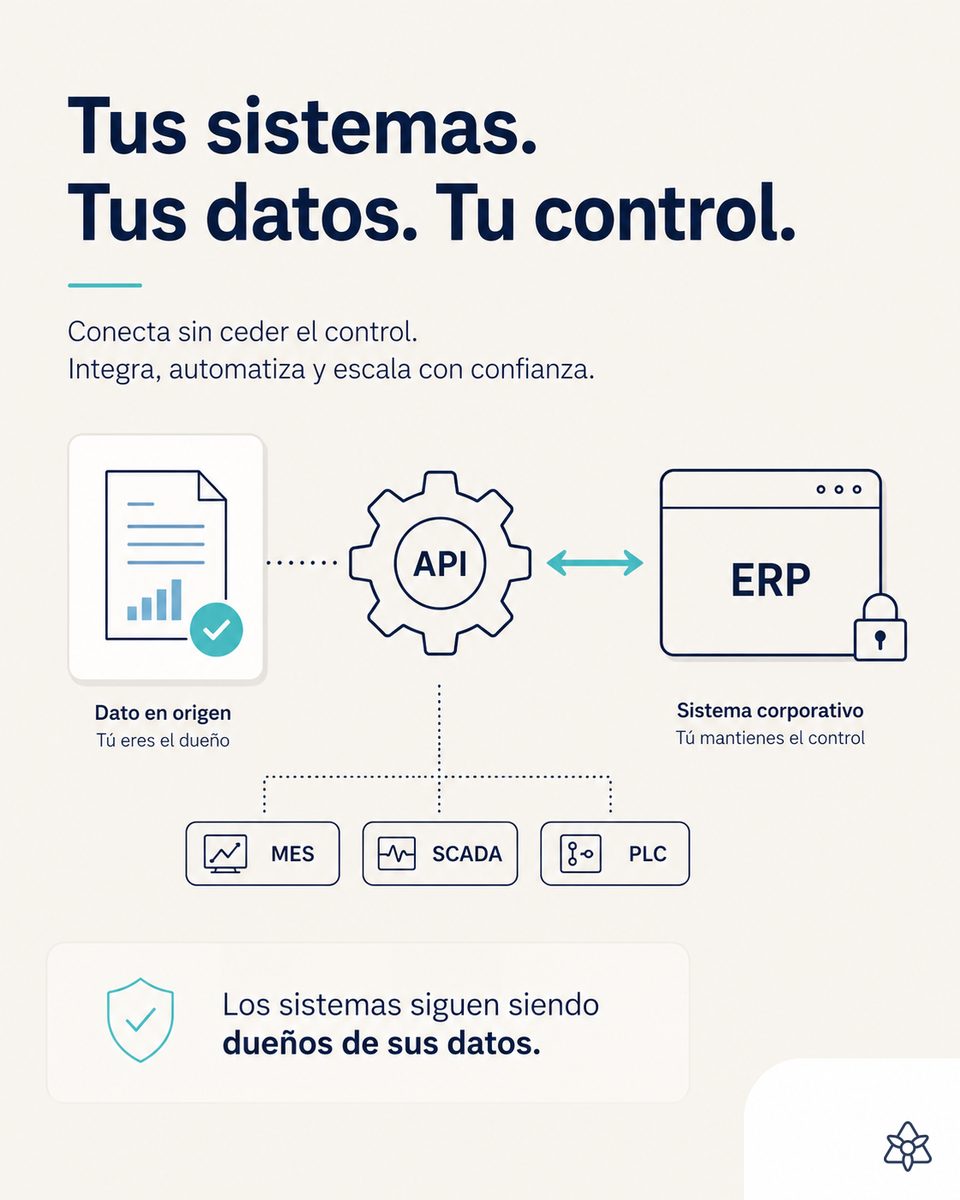
The classic gap was twofold: the data lived on islands (the spreadsheet and the extruder HMI) and, even if you joined them, there was nobody to operate them and detect drift in real time. iLEAN covers both: Connect homogenizes the spreadsheet and the HMI reading, the Agents cross-reference them, and the veteran decides. Filler, not demolition. The extruder, the PLC and the supervisor's sheet are left untouched.
Connect reads the spreadsheet wherever it is. The Agents cross-reference it with the extruder HMI. If the blend drifts, they notify the shift supervisor. The person decides — never the other way round.
What comes into play in a polymer extrusion plant:
- Connect (graduated capture). If the spreadsheet is in the shared folder, Connect reads it there. If it is on the supervisor's laptop, the graduated system comes in through whichever door fits — synced folder, voice dictation, or an assistant in his earpiece. The rule is: we do not force the person who knows to change tools.
- Connect (reading the old HMI). If the extruder has a modern HMI with OPC UA, direct integration. If it has an isolated local computer, Connect connects and extracts the value every minute. If it has neither, a fixed camera over the HMI reads it with a CNN. None of these options forces you to change the machine.
- Extrusion agent. It cross-references the campaign recipe (the supervisor's spreadsheet), the extruder's actual parameters (HMI), the raw material from the ERP/lab (batch MFI, % moisture, % regrind) and the campaign history. When it detects meaningful drift, it notifies the shift supervisor through the channel he uses. It does not touch the extruder. It proposes, the person decides.
- Three rings. The spreadsheet and the extruder HMI live in ring 1 (OT, sacred). Connect reads from outside, leaves a signed envelope in the mailbox, and ring 1 picks it up when it wants. The extruder PLC receives nothing new, no port is opened.
Recipe in a local spreadsheet vs. recipe captured by iLEAN Connect + Agents
| Aspect | Extrusion supervisor's spreadsheet | With iLEAN Connect + Agents |
|---|---|---|
| Where the recipe lives | Supervisor's laptop or folder | Same sheet + system reads and replicates it versioned |
| Recipe vs. actual parameters | By the operator's eye, if he notices | Continuous, agent raises a notice on deviation |
| Traceability per campaign | Rebuilt by hand if the customer claims | Campaign file, automatic |
| ISO 9001 / IATF audit | Days spent finding the right version | Full versioning, automatic |
| The veteran's retirement | The knowledge walks out with him | The judgement stays captured as a pattern |
| Decision on the blend | Operator, with no safety net | Operator, with an agent saying "today's regrind calls for 5 °C less in zone 4" |
Impact estimate for your plant — to be validated with your numbers.
The block below is an estimate to be validated with the actual data of your plant. It is an order of magnitude so the committee can size it; we refine it during the diagnostic.
- Compounding or polymer converting plant, 3-6 extruders (single or twin screw), campaign recipe in the extrusion supervisor's spreadsheet, variable % of regrind, 15-40 SKUs.
- Connect pilot reading the spreadsheet + reading the HMI of one extruder + drift detection agent. First value expected within a few weeks (the sheet starts travelling into the system).
- Indicative payback between 4 and 9 months. Hard levers: scrap reduction from out-of-range blends (defensible floor ≥30%), recovering the cost of one reprocessed campaign, capturing the veteran's knowledge for the next generation.
- Rollout to the remaining extruders and to the group's other plants done by the customer with their own trained people — without us.
And the fair question from the extrusion supervisor
“What if the AI reads the spreadsheet wrong and proposes a temperature that ruins the campaign?” — hallucination is a problem of free generation, not of anchored tasks. Reading a spreadsheet and comparing it with the HMI parameters is the anchored task par excellence: the best models brought the error below 1.5% [1]. And even so, the agent proposes — it does not touch the extruder. The person on shift validates and decides. The three rings exist for exactly this: the system lets the critical call be closed only by whoever has the craft.
[1] OpenAI paper “Why Language Models Hallucinate”, 2025 — on the reliability of AI in anchored tasks.
What people ask about the polymer extrusion recipe spreadsheet
Why does the polymer campaign recipe still live in the veteran's spreadsheet?
Because a polymer campaign (PE, PP, PVC, PA, masterbatch) is tuned with fine judgement — filler percentages, % of post-industrial regrind, additives, temperatures per extruder zone, screw speed, back pressure — and that judgement was built on the shop floor over years of craft. Putting it into an MES or an ERP called for a recipe module that took a long time to learn the nuance. The extrusion supervisor's spreadsheet was the fastest, most flexible and most reliable answer. It was not clumsiness, it was the only reasonable thing at the time. What changed: that spreadsheet can now be read where it already is, without forcing the veteran to change tools.
How does iLEAN Connect read the spreadsheet without touching the extruder?
Connect connects to the folder where the extrusion supervisor keeps the sheet — shared folder, cloud drive, local NAS, even his own synced laptop. The reading happens in ring 2 (validation), not in ring 1 where the extruder PLC lives. The line control system receives nothing new, no port is opened on its OT network. Connect is the filler that seals the gap between the sheet and the rest of the systems, without demolishing anything that already works in the plant.
What do the Agents do when the blend drifts from the recipe?
The agent cross-references the campaign recipe (what the veteran wrote down) with the actual parameters the extruder is delivering (temperature per zone, pressure, screw speed, motor torque) — capture can be through PLC integration, by reading the old HMI, or over OPC UA where it exists. When it detects meaningful drift (beyond a threshold the supervisor configures), it raises a notice through whatever channel the shift supervisor uses: earpiece, phone, tablet. It does not act on the extruder — it proposes, the person decides. Agents are the operator's safety net, not his replacement.
What do you gain by digitizing the veteran's spreadsheet?
Three things. One: traceability per batch and per campaign — which exact recipe, which temperatures, which raw material, what percentage of regrind. When the customer claims a part out of tolerance or the internal lab asks to repeat the blend, it comes out automatically. Two: capture of the veteran's knowledge — the day the supervisor retires, his judgement stays as a pattern anyone can consult, it does not walk out with him. Three: scrap reduction when the Agents detect drift before the blend goes out of range. The operator starts his shift with the bed already warm.
How long does this take to be running in an extrusion plant?
Connect reading a local spreadsheet and emitting the recipe into the system is one of the fastest first-value steps in the iLEAN catalogue: within a few weeks there is flow. The full pilot (spreadsheet + reading the extruder HMI + drift detection agent + MES/historian integration) fits in a quarter. Rolling it out to the remaining extruders or to the other plant is done by the customer with their own trained people — the success of a good pilot is that they stop needing us. Ask for the estimated ROI and we'll send it within 48h.
More cases in ilean connect
- Raw milk delivery note email parser — the data arrives before the tanker.iLEAN Connect reads the raw milk delivery note PDF in the carrier's email and extracts batch, farm, pH…
- Your tier-2 supplier emails the forecast — and your MES expects EDIFACT.How iLEAN Connect normalizes a non-EDI supplier forecast (email + spreadsheet) into EDIFACT and feeds it…
- Transport notice email parser — at 8:00 the truck is not leaving; at 8:01 production already has a plan.iLEAN Connect reads the carrier email when the truck will not leave and the Agents replan production at…
- The dispenser viscosity lives in a spreadsheet — and the lump lives in the oven.How iLEAN Connect reads the viscosity spreadsheet of the powder coating dispenser and crosses it with…
- The par-baked bread recipe lives in the manager's spreadsheet — and nobody downstream knows it.How iLEAN Connect reads the bakery manager's spreadsheet with oven settings and par-baked bread recipes…
- From image to Excel, handwriting too. And the next sheet does itself.Convert a photo of a handwritten sheet to Excel with an AI agent. If it's a form you use every day, it…
Tell us your case and within 48h we'll send you the estimated ROI of this AI project for your extrusion plant.
We work on your plant's real data, not on ours. Diagnostic with no commitment.
Request estimated ROI in 48h See iLEAN Connect