Multilingual voice in a pharma cleanroom — dictate in your own language, the EBR is filled in English without taking off the gloves.
In a pharma cleanroom every extra movement to type on a screen is potential contamination and lost time. iLEAN Connect lets the operator dictate through an earpiece in their own language, transcribes against the electronic batch record schema in English and proposes the line. The person signs — the system does not.
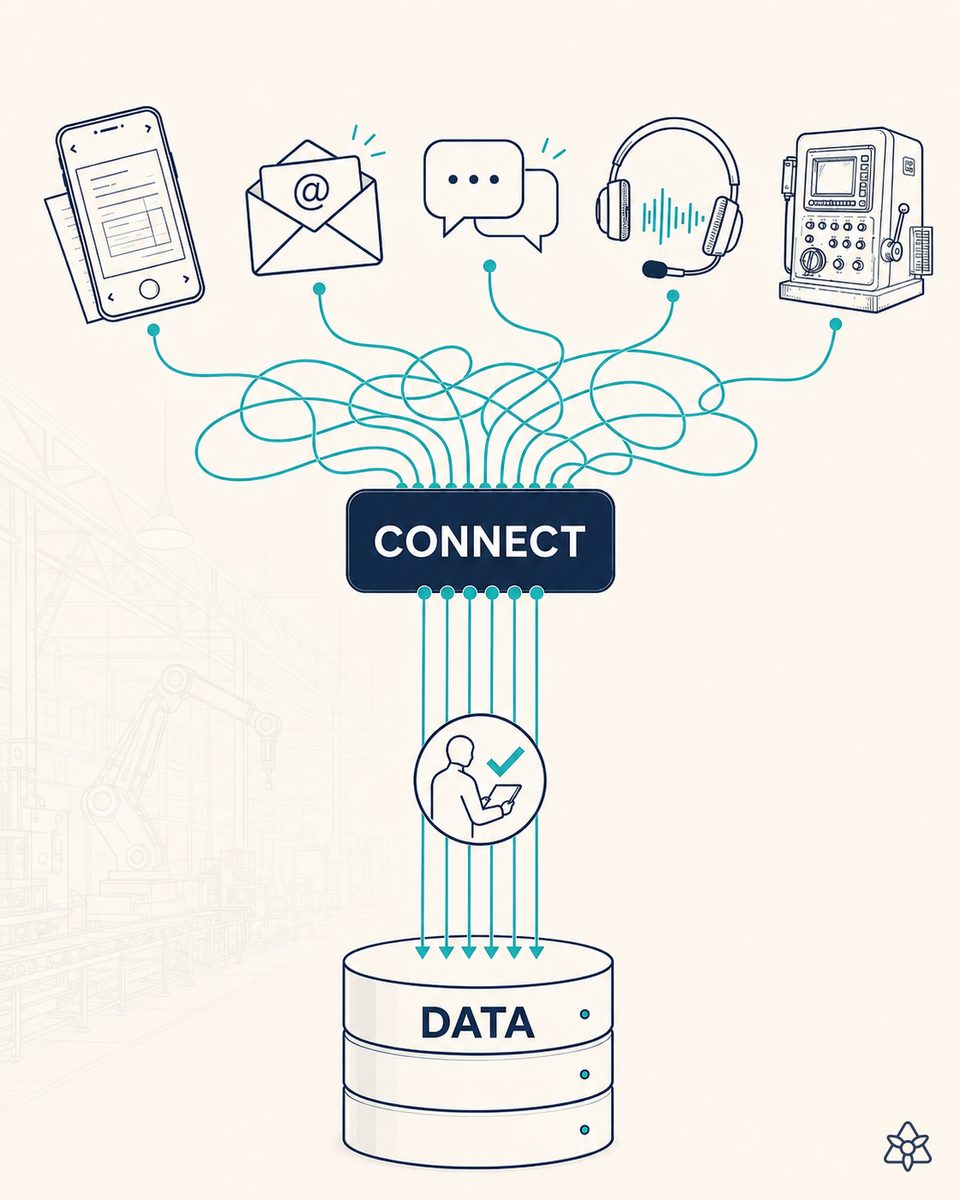
Every time the operator leaves the flow to type, the cleanroom pays for it.
The electronic batch record is designed in English so it can be global. The operator running the line almost always speaks another language. And the cleanroom is designed so that nothing interrupts the operator's flow — because every interruption means contamination, time and risk. Today those three realities collide at a trivial point:
- Recording the weight check, the recipe adjustment, the labelling verification, the non-routine event. Every entry forces a walk to a terminal.
- Changing gloves if you have to touch the keyboard. Or asking someone else to write down what you saw. Either option costs time and opens a small hole in traceability.
- Translating mentally from the operator's language into the system's English. Or writing in either one and letting QA reconcile it later. Whoever writes is not always whoever saw it.
The result is familiar to anyone who has set foot in a cleanroom: the operator either steps out of the flow (time, contamination) or writes on paper and somebody transcribes it afterwards (lag, error, broken audit trail). Either way it costs money and raises the risk of a deviation. This is one of the points where gap one from the book — data islands — is felt most physically.
iLEAN Connect — the filler between the operator's voice and the English EBR.
The IRIS system defines Connect as the ear and the voice of the plant. The basic form of inbound capture is exactly this: every person carries a phone or an earpiece on the line, full duplex, and whatever the operator says becomes usable data without having to change medium. iLEAN Connect fills the gap between the operator's natural speech and the corporate system, without throwing away the EBR, without throwing away the qualification, without taking off the gloves — the filler that covers the dead zone between the line and the quality system.
The operator dictates in their own language. The transcription proposes an EBR line in English. The person signs — never the other way round.
How Connect works applied to multilingual voice in a pharma cleanroom:
- PPE-compatible earpiece. A headset or microphone that comes in without breaking cleanroom qualification (validated models exist; failing that, a zoned ambient microphone). The operator speaks as they would to a colleague, in their own language.
- Streaming transcription with correction. Connect transcribes as the operator speaks, handles rephrasing (“240, sorry, 245”) and disambiguates units. If confidence is low for a critical field, nothing is signed — it flags it and asks for a repeat.
- Anchored to the EBR schema. This is not free dictation: the transcription is mapped against the fields the EBR already has defined (weight, batch, format, adjustment, event). If what the operator says does not fit any field, it stays as a shift note pending review, not as a signable line.
- Audio + transcription + diff stored as evidence. The EBR receives a proposed line. QA, or the operator themselves on leaving the cleanroom, reviews and signs. The electronic signature is the usual EBR one; the raw audio is kept with a hash and a timestamp for the auditor.
Connect carries the voice, the agent structures it against the EBR, the person signs. The EBR qualification is not broken — it is simply fed with less friction. That is the rule.
Manual EBR entry vs. multilingual dictation with later signature.
| Aspect | Operator walks out to type / writes on paper | With iLEAN Connect (multilingual voice in the cleanroom) |
|---|---|---|
| Flow interruptions | One per entry | Zero — speaks on the line |
| Input language | Whatever English the operator manages | The operator's natural language |
| Output language in the EBR | Variable, requires QA reconciliation | Normalised English, anchored to the EBR schema |
| Latency from entry to EBR | Hours (paper → transcription) | Seconds — proposed line ready to sign |
| Audit trail traceability | Whoever wrote it ≠ whoever saw it | Audio + transcription + signature of the operator who saw it |
| Glove changes just to record data | Recurring | Eliminated |
Impact estimate for your plant — to be validated with your numbers.
The block below is an estimate to be validated with the specific data from your cleanroom. We put it forward so the committee has an order of magnitude; we refine it during the diagnostic.
- Pharma cleanroom with operators whose natural language is Spanish (or another), an already qualified EBR in English, and entries that today force a walk to the terminal or a note on paper.
- Connect pilot in one cleanroom (validated earpiece / microphone + EBR integration + QA review flow). First expected value in a few weeks: the first category of entry (weight check, for example) is already dictated and lands as a proposed EBR line.
- Indicative payback between 4 and 9 months, depending on operator hours spent stepping out of the flow, rework from discrepant entries and the cost of investigating broken audit trails.
- Hard lever: a ≥ 30% reduction in operator time spent out of flow for data entry — plus capture of the event at second zero, without passing through anybody's memory.
And the quality director's reasonable doubt
“What if the voice transcription invents a critical value?” — hallucination is a problem of free generation, not of anchored tasks. A transcription anchored to the EBR schema (with per-field confidence, refreshing from the source when it drops) sits exactly in the regime where the best models brought error below 1.5% [1]. And even so, the electronic signature is still the one in the already qualified EBR, and the raw audio remains as evidence. The person signs. The three rings of safety are there precisely for this.
[1] OpenAI paper “Why Language Models Hallucinate”, 2025 — on the reliability of AI in anchored tasks.
What people ask about multilingual ES↔EN voice in a cleanroom
Why is typing the batch record inside a cleanroom a problem?
Because every time the operator has to type on a screen they are stepping out of their workflow: walking to a terminal, possibly changing gloves, breaking concentration or asking someone else to write it for them. In a pharma cleanroom every extra movement is potential contamination, lost operating time and risk of error. And if the corporate batch record is in English while the operator speaks Spanish, one more layer of friction appears: mental translation, ambiguity, hand transcription by someone who did not witness the event.
How does the iLEAN Connect multilingual voice earpiece work?
The operator wears an earpiece or microphone compatible with their cleanroom PPE. They speak in their natural language (Spanish, Portuguese, Romanian, whatever it is) and Connect transcribes in streaming, identifies the specific action (weight check, labelling verification, recipe adjustment) and proposes it to the electronic batch record in the system language (English, normally). The transcription is of the anchored kind: the proposed data goes against the EBR schema that already exists, it does not generate free fields.
Does it work for Annex 11 / 21 CFR Part 11 if the signature is made by voice?
Nothing is signed by voice — the voice is transcribed and a batch record line is proposed, but the electronic signature is still the one in the customer's already qualified EBR. The operator reviews the proposed line before closing it (visually or by voice: “confirmed” in their own language) and the signature is recorded like any other EBR signature. The raw audio, the transcription and the model used are stored as GMP evidence. The receiving system does not change its qualification — Connect simply feeds it faster.
What if the operator has a strong accent, speaks poorly or corrects themselves mid-sentence?
Transcription runs in streaming with correction. If the operator makes a mistake and rephrases (“the weight is 240 grams, sorry, 245 grams”) Connect proposes the final version. If transcription confidence is low for a critical field, nothing is signed: it flags the field in amber and asks the operator to repeat it or to type it on the way out of the cleanroom. The rule is the same as in the rest of the system: nothing critical is decided alone. The person signs.
Does this also help with audits and incident traceability?
Yes — that is perhaps where it shows most. When a non-routine event occurs (out of specification, equipment stoppage, suspected contamination), the operator dictates it on the spot, in their own language, without having to stop and look for a terminal. Connect leaves the audio, the transcription and the proposed EBR line linked to the batch and the workstation. In the later investigation, the quality team hears the operator's voice at second zero of the event — not a hand-built reconstruction hours afterwards.
More cases in ilean connect
- SMS HACCP CCP alert in a meat plant — alerting through the channel the shift lead actually carries.iLEAN Connect sends the HACCP CCP alert by SMS to the meat plant shift lead with no smartphone, with…
- The Seveso III event happens at 04:12 — and the notification chain depends on somebody remembering who is on call.iLEAN Connect escalates Seveso III events by SMS to the on-call manager, with a countdown and automatic…
- Arabic and French voice to text in a Maghreb plant — HQ reads the shift without losing the nuance.Maghreb subsidiary with a mixed Arabic-French shift: iLEAN Connect transcribes for HQ so the plant…
- The operator drops the technical nuance in Romanian — and the supervisor only understands Spanish.How iLEAN Connect transcribes the Romanian operator in their language and delivers the technical nuance…
- The NDT inspector dictates the finding out loud — and the batch's NADCAP pack is already assembled when the part is set down.iLEAN Connect transcribes the aerospace NDT inspector's VoIP call and Agents build the NADCAP batch…
- The GMP deviation is reported by phone first — and rewritten three hours later, from memory.iLEAN Connect transcribes the operator-to-supervisor VoIP call in pharma plants and opens the GMP OOS…
Tell us your case and within 48h we'll send you the estimated ROI of this AI project for your pharma cleanroom.
We work on the real data from your cleanroom, not on ours. Diagnostic with no strings attached.
Request estimated ROI in 48h See iLEAN Connect