The NDT inspector dictates the finding out loud — and the batch's NADCAP pack is already assembled when the part is set down.
The aerospace NDT inspector (penetrant testing, magnetic particle, ultrasonics, radiography) has both hands on the part and one eye on the indication: writing a long report live is not realistic. iLEAN Connect transcribes the dictation over VoIP or headset, Agents assemble the NADCAP batch pack with calibration, NAS 410 certification and procedure — and the inspector signs. The part does not move to the next step without that signature.
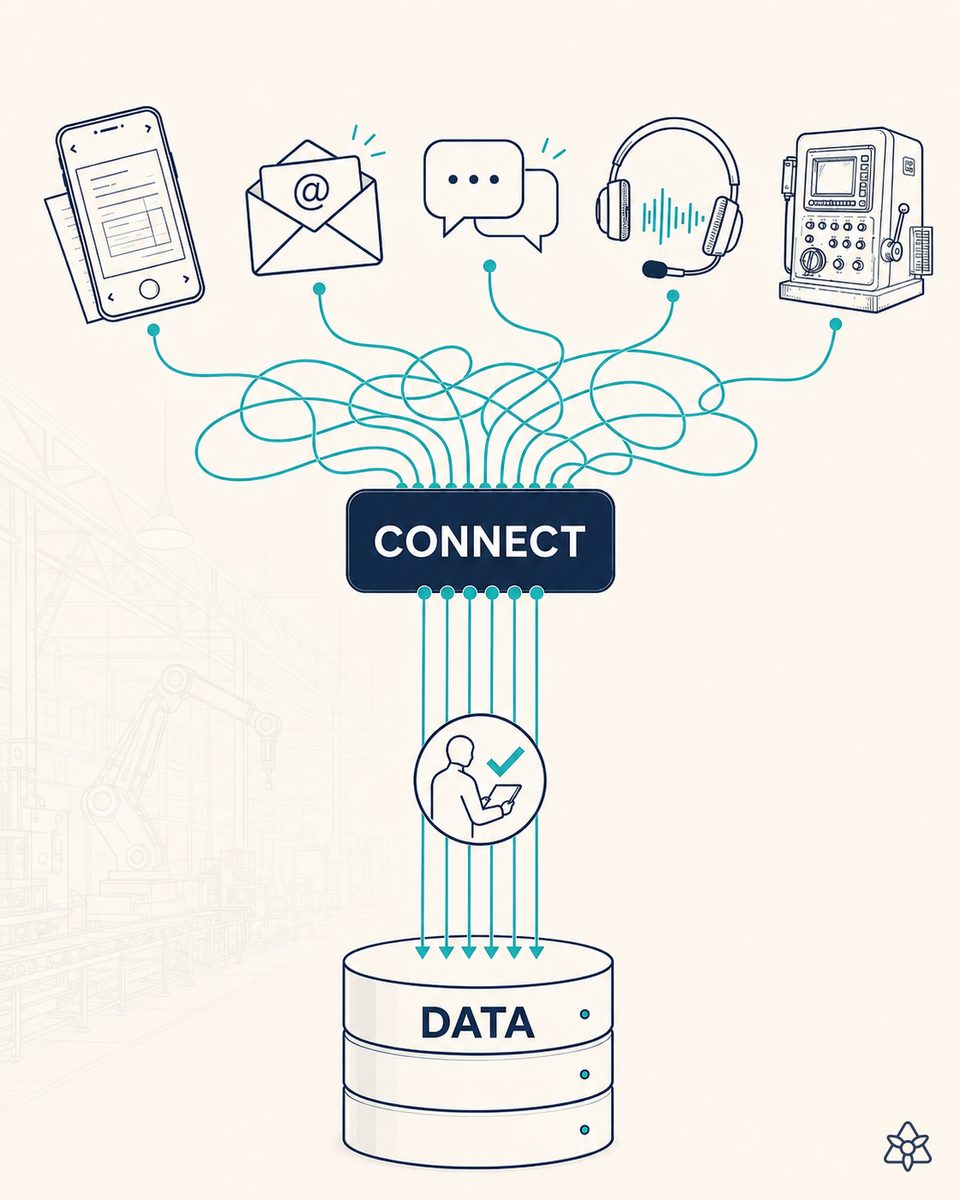
Inspecting and documenting are two jobs the inspector has to do at the same time.
In a serious aerospace NDT booth, the inspector with the UV lamp in one hand and the part in the other spots an indication that could be a crack, an inclusion or a false positive from the penetrant itself. A decision has to be made, and a record has to be left. Writing it live on a screen breaks the flow. Jotting it in a notebook means writing it up later — and that is where the nuances that were obvious with the part in front of you get lost.
And then, on top of that, there is NADCAP. Every inspected batch has to reach the auditor with:
- Who inspected — an inspector with a current NAS 410 certification, at the level appropriate to the technique.
- Under which procedure — the internal reference for the special process, at the current revision.
- With which equipment — current calibration, parameters applied.
- What was found — indications, dimensions, disposition.
- What was decided — accept, reject, re-inspect.
Reconstructing the pack after the fact, batch by batch, eats an enormous slice of the inspector's shift — and of the booth supervisor's when an audit is approaching. The classic system (notebook + word processor template + folder) works, but it turns a qualified inspector into a typist. That is not the best use of one of the most expensive certifications in the industry.
Connect captures the voice — Agents assemble the pack — the inspector signs.
The problem is not the standard, nor the inspector's willingness: it is capture. The critical information (what the inspector sees and says) enters the booth through their voice and their hands, not through a sensor. And it almost never reaches the quality system in digital form without an intermediate job of copying and formatting. iLEAN acts as the filler that seals that crack between the booth and the NADCAP pack, without replacing your quality system, your MES or the special process procedure.
Connect listens to the dictation. Agents cross-check calibration, certification and procedure. A person signs every closure. No rewriting, no transcribed notebook, no 7 p.m. Friday reconstructing the pack.
The three iLEAN pieces applied to aerospace NDT:
- Connect — captures the inspector's VoIP (or the in-line headset, full duplex), transcribes at second zero with NDT vocabulary (technique, parameters, indications), and ties the transcript to the part and the batch the inspector is looking at. Bidirectional: the agent can confirm by voice “received, part such-and-such, indication such-and-such in zone X”.
- Agents — take the transcript, cross it with the inspector's current NAS 410 certification, the equipment calibration and the special process procedure, and assemble the batch file in the format the NADCAP audit asks for. They flag doubts and confidence level point by point.
- Three rings — the transcript and the draft pack live in ring 3. They pass through validation in ring 2 (is calibration current? does the inspector hold the right level? is the procedure at the correct revision?). They only enter the closed document system (ring 1) with the signature of the inspector and/or the booth supervisor. DO-326A formalizes this for the sector.
NDT with notebook + template vs. NDT with VoIP transcribed by iLEAN
| Aspect | Classic NDT flow | With iLEAN Connect + Agents |
|---|---|---|
| Recording the finding | Notebook or dictaphone, transcribed later | VoIP transcribed at second zero, tied to the batch |
| NADCAP pack per batch | Word-processor template filled in by hand | Draft generated with calibration, certification and procedure |
| Verifying current calibration | Manual check on every batch | Cross-checked by the agent before closure is accepted |
| Inspector time spent documenting | 25-40% of the shift (estimate to be validated) | ≥ 30% reduction in documentation |
| Batch closure | When the report gets typed up | When the inspector signs the transcript and the pack |
| Arriving at the audit | Ad-hoc reconstruction beforehand | File already closed per batch, available instantly |
Impact estimate for your plant — to be validated with your numbers.
The block below is an estimate to be validated with the specific data from your booth. We lay it out so the committee has an order of magnitude; we refine it during the diagnostic.
- A booth with 2-5 NAS 410 Level 2 inspectors, a mix of PT/MT/UT, several dozen batches inspected per day, an active NADCAP program and periodic audits.
- Connect pilot on a single technique (PT or MT as a starting point): VoIP capture + transcription + generation of the draft pack. First expected value within a few weeks: one technique running with the batch file auto-generated.
- Indicative payback between 4 and 9 months, depending on the current cost of inspector hours spent documenting, the number of audits per year and the historical average cost of a NADCAP finding for insufficient documentation.
- Reduction of inspector time on administrative tasks of ≥ 30%, once the transcript and the cross-check against calibration/certification enter the pack automatically.
- The hard lever is a single NADCAP audit with no documentation findings: avoiding one major on a special process can pay for the pilot and keep your supplier status.
And the quality manager's reasonable doubt
“What if the transcript mangles a technical term and we certify a pack on top of wrong text?” — hallucination is a problem of free generation, not of anchored tasks. Transcribing speech to text over a bounded NDT vocabulary and cross-checking it against a field in the quality system is an anchored task: the best models brought the error rate below 1.5% [1]. And even so, critical calls are never made alone: the transcript is presented to the inspector marked up, with a confidence level per technical term, and the part does not advance until it is signed. The three rings exist precisely for this.
[1] OpenAI paper “Why Language Models Hallucinate”, 2025 — on the reliability of AI in anchored tasks.
What people ask about transcribed VoIP in aerospace NDT
What exactly does an aerospace NDT inspector do, and why are findings dictated out loud?
The NDT (Non-Destructive Testing) inspector, certified to Level 2 or 3 under NAS 410, inspects flight-critical parts (landing gear, blades, structures) with techniques such as penetrant testing (PT), magnetic particle (MT), ultrasonics (UT), radiography (RT) or eddy current (ET). The finding is dictated out loud because both hands are on the part, the UV lamp or the probe, and the booth is rarely a place where writing a long report live is realistic. Traditionally: a notebook, a dictaphone or a screen on the way out — the formal report gets typed up afterwards.
How does iLEAN Connect capture the NDT inspector's dictation without breaking the workflow?
Connect captures the VoIP call or the in-line headset channel, full duplex, while the inspector is standing in front of the part. Transcription happens at second zero, with NDT-specific vocabulary (indications, false positives, dimensions, technique applied, part number, work order number). The inspector does not fill in a form afterwards: they dictate what they see, keep inspecting, and the agent already has the material to assemble the report in NADCAP format.
What is a NADCAP pack and why can an agent assemble it?
NADCAP (National Aerospace and Defense Contractors Accreditation Program) is the accreditation that certifies an aerospace supplier's special processes — NDT among them. For every batch the auditor asks for: technique applied, equipment parameters, current calibration, the inspector with a valid NAS 410 certification, findings, disposition. Agents take the VoIP transcript, cross it with the inspector's certificate, the equipment calibration and the procedure parameters, and assemble the batch file — the “boring, specific agent”: the pack ready for audit without anyone reconstructing anything at 7 p.m. on a Friday.
Who validates that the transcript is correct before the batch is closed?
The inspector. Connect carries, Agents propose the report, the person signs. The transcript is presented marked up (literal text + the agent's interpretation + confidence level). If an indication is doubtful, the inspector corrects a word and signs. The part does not move to the next step until that signature. It is the human validation principle of the three rings applied to a special process — and it is what allows AI to be used in a context governed by DO-326A without opening the door to a certified part built on unvalidated data.
How much time does automatic VoIP transcription save the NDT inspector?
On a typical day, an NDT inspector spends between 25% and 40% of the shift documenting — turning the notebook into a report, completing fields in the quality system, assembling the batch pack. It is necessary work, but it is exactly the “dumb work” AI can simplify so the inspector can do the work that matters: look at the part. The estimate to be validated is freeing several hours of qualified inspector time per shift and cutting the time from finding to NADCAP batch pack closure by ≥ 30%. We fine-tune it with the data from your booth.
More cases in ilean connect
- Arabic and French voice to text in a Maghreb plant — HQ reads the shift without losing the nuance.Maghreb subsidiary with a mixed Arabic-French shift: iLEAN Connect transcribes for HQ so the plant…
- Multilingual voice in a pharma cleanroom — dictate in your own language, the EBR is filled in English without taking off the gloves.iLEAN Connect transcribes the pharma cleanroom operator's voice ES→EN, proposes the electronic batch…
- The operator drops the technical nuance in Romanian — and the supervisor only understands Spanish.How iLEAN Connect transcribes the Romanian operator in their language and delivers the technical nuance…
- The GMP deviation is reported by phone first — and rewritten three hours later, from memory.iLEAN Connect transcribes the operator-to-supervisor VoIP call in pharma plants and opens the GMP OOS…
- WhatsApp andon in tier-1 automotive — the red light that does find the manager.iLEAN Connect pushes the tier-1 automotive andon over WhatsApp, escalates to the manager in a 5-minute…
- WhatsApp HACCP in an artisan PDO cheese dairy — the master reports as always; the system records underneath.iLEAN Connect captures the HACCP deviation the master cheesemaker sends by WhatsApp, links it to the…
Tell us about your case and within 48h we'll send you the estimated ROI of this AI project for your aerospace NDT booth.
We work on your plant's real data, not ours. Diagnostic with no commitment.
Request estimated ROI within 48h See Connect