The operator drops the technical nuance in Romanian — and the supervisor only understands Spanish.
On a multilingual tier-1 automotive line, what matters is said by the operator in their own language. iLEAN Connect listens in Romanian, transcribes without losing the technical nuance, cross-checks it against the system and delivers it to the supervisor in Spanish with the context of the process step. Bidirectional through an earpiece, full duplex. The supervisor still runs the shift; the nuance stops getting lost in translation.
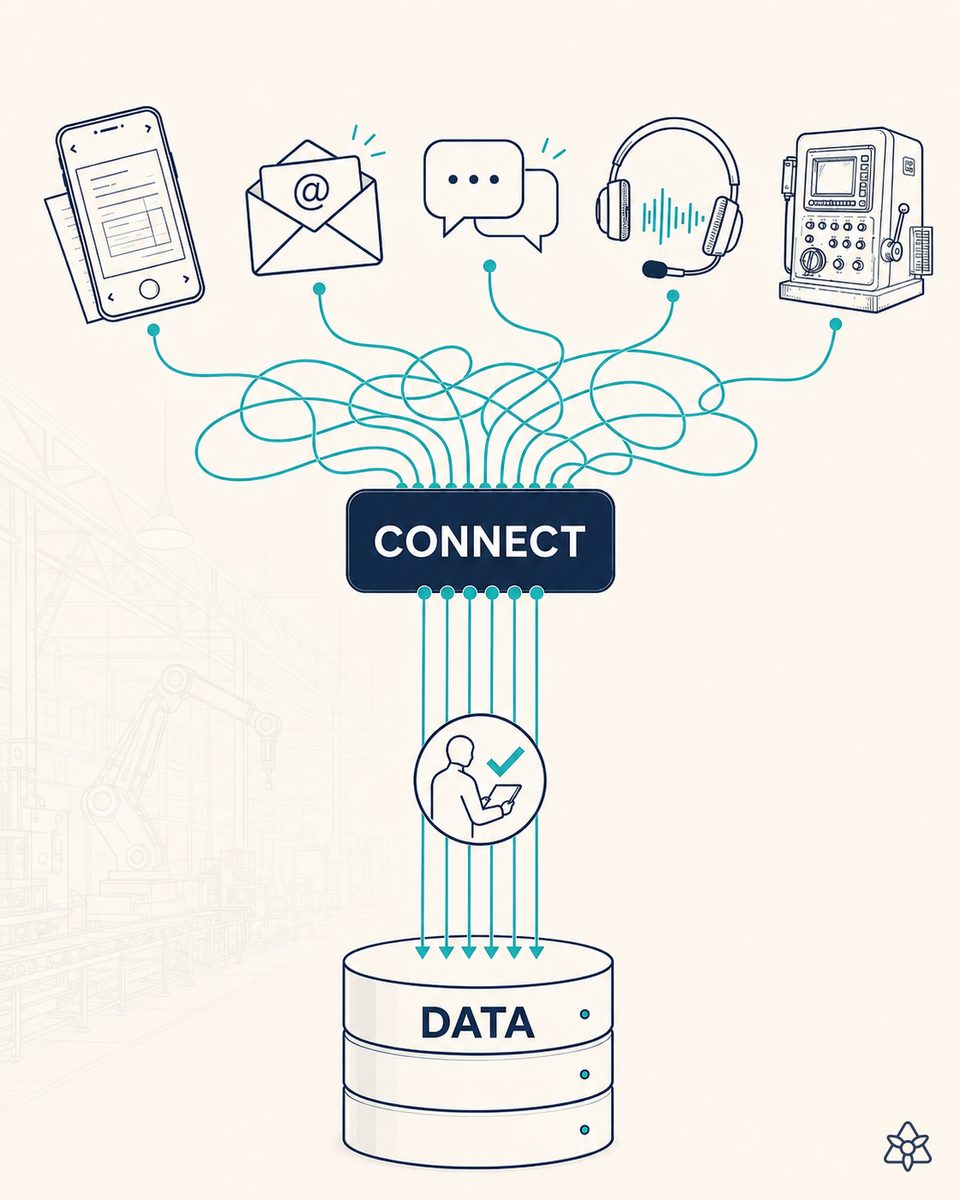
Technical nuance falls through in translation — and on the plant floor nuance is worth money.
On a tier-1 automotive line, what really matters is what the operator says in their own language:
- The part comes in wrong from the previous step — before quality control even sees it.
- The press is making a new noise — the pattern the veteran recognises and that no sensor picks up yet.
- The dashboard shows an odd anomaly — something neither the manual nor the supervisor can anticipate.
If the operator is Romanian and the supervisor is a Spanish speaker, one of three things happens: (a) the operator says nothing and the next line finds out; (b) they try in Spanish and the nuance is lost; (c) they go looking for a bilingual colleague and the rhythm breaks. All three options cost — in defects, in response time, in information that never reaches the system and stays in the operator's head until the shift ends.
It is not a cultural problem: it is an operational one. What changed is that AI is particularly good at one very specific task: transcribing and translating a data point anchored to a technical context, without losing that context. And that is exactly what is needed here.
iLEAN Connect — the ear of the plant, in the operator's language.
Connect is not “the phone app”: it is the filler that covers the gaps where live information never entered the system because there was no channel. Applied to multilingual plants, that channel is the operator's earpiece.
The operator speaks their own language. Connect transcribes, anchors and translates. The supervisor receives technical nuance, not “more or less”.
How it is set up on a multilingual tier-1 automotive plant:
- Connect (listening inwards). Every operator wears an earpiece and carries a phone (or a tablet if phones are banned), full duplex. They speak in Romanian whenever it comes naturally. Connect transcribes in Romanian and sends it to the agent.
- Plant agent. It cross-checks the transcription against the live operation: which SKU is running, which process step, which machine, which shift, which historical pattern. It recognises that “zgomot” on a press means “anomalous noise”, not “any sound”. Anchoring to context is what preserves the nuance.
- Output to the supervisor in Spanish — through an earpiece, a tablet or whichever channel the supervisor uses. With the original transcription (Romanian) in case they want it verbatim, and the contextualised translation for the fast decision.
- Bidirectional. The supervisor asks in Spanish: “check whether the part from the previous step comes in skewed”. It reaches the operator in Romanian through the earpiece. Connect carries, the agents decide, the person signs.
A multilingual line with no safety net vs. with iLEAN Connect
| Aspect | Multilingual with no net | With iLEAN Connect |
|---|---|---|
| Anomaly report | Operator says nothing or half-explains it | Speaks in Romanian, reaches the supervisor with nuance |
| Response time | Find a bilingual colleague, repeat, translate | Seconds, full duplex |
| Knowledge captured | Stays in the operator's head | Anchored to the batch and the process step |
| New operator onboarding | Long curve because of language | Assistant in their own language from day one |
| Shift with no bilingual supervisor | Blind or slowed-down line | Technical channel always operational |
| Traceability by batch | Reconstruct by hand what was said | Audio + transcription + translation, per batch |
Impact estimate for your plant — to be validated with your numbers.
The block below is an estimate to be validated with the specific data from your plant. It is an order of magnitude so the committee can size it; we refine it during the diagnostic.
- Tier-1 automotive plant with a multilingual workforce (Romanian + Spanish is typical; also Ukrainian, Moroccan, Polish depending on geography).
- Connect pilot with full-duplex voice on one press/stamping line. First value expected within a few weeks (operators talking to the system in their own language).
- Indicative payback between 4 and 9 months. The hard levers: defects avoided through early warning, response time to an anomaly, shorter onboarding, lower cost of keeping bilingual supervisors on every shift.
- Defensible reduction of ≥30% in the time between the operator detecting an anomaly and the supervisor confirming it with context. The real figure depends on the language mix and the process.
And the quality manager's reasonable doubt
“What if the AI translates badly and the operator or the supervisor makes the wrong call?” — hallucination is a problem of free generation, not of anchored tasks. Transcribing speech and translating it with the MES context in front of you is the anchored task par excellence: the best models pushed the error rate below 1.5% [1]. And even then, the critical part gets signed: if the agent proposes a decision that touches OT, the person signs. The system allows it because the architecture allows it, not because of blind trust.
[1] OpenAI paper “Why Language Models Hallucinate”, 2025 — on the reliability of AI in anchored tasks.
What people ask about multilingual voice on an automotive line
Why does the operator's language matter on a tier-1 automotive line?
Because the information that really matters on the line — “the press is making a strange noise”, “the part comes in skewed from the previous step”, “I have never seen this before” — is what the operator blurts out in their mother tongue when under pressure. If the plant is multilingual (Romanian, Ukrainian, Moroccan, Spanish in different combinations), asking the operator to describe the anomaly in a language they do not master is filtering out the technical nuance exactly where that nuance is worth money. The consequence: the supervisor gets an impoverished version, or gets nothing and finds out through the defect.
How does iLEAN Connect work with multilingual voice on the plant floor?
Every operator wears an earpiece and carries a phone (or a tablet if phones are banned) on the line, full duplex. They speak in Romanian: Connect transcribes in Romanian, sends it to the agent that cross-checks it against the live operation and the system, and the supervisor receives it in Spanish with the technical context that applies. If the supervisor wants to ask something, they speak in Spanish and Connect delivers it to the operator in Romanian through the earpiece. It is bidirectional — Connect carries, the agents decide, the person signs.
Is technical nuance lost when translating between Romanian and Spanish?
That is the right question. Free translation — literary text, marketing — does lose nuance. Translation anchored to the plant context (the part, the machine, the process step, the SKU) does not: the agent knows that “zgomot” in the context of a press means “anomalous noise”, not “any sound”. This is exactly the kind of anchored task where the best models push the error rate below 1.5%. The nuance survives because the translation does not live in a vacuum — it lives glued to the MES data and to the historical pattern.
Does this replace the supervisor who speaks Romanian and Spanish?
No, and it is worth saying so plainly. iLEAN does not build a lights-out factory: the supervisor still runs the shift. What Connect provides is a safety net: when the supervisor is on another line, when a new operator joins, when the night shift has no bilingual supervisor, the operator is never left without a technical channel to the system. The flag is on assisting and simplifying, not on replacing. The veteran's knowledge stays in the plant, captured and extended.
What does a multilingual tier-1 automotive plant gain from voice AI?
Three things. One: fewer defects caused by poor communication — the anomaly is reported and understood on the first attempt, not on the third try. Two: faster onboarding of new operators on the line — the language barrier stops delaying productive shift time. Three: plant knowledge capture — everything said through the earpiece stays anchored to the batch and the process step, and becomes a pattern for the next shift. The operator walks into their shift and finds the bed already warm.
More cases in ilean connect
- The Seveso III event happens at 04:12 — and the notification chain depends on somebody remembering who is on call.iLEAN Connect escalates Seveso III events by SMS to the on-call manager, with a countdown and automatic…
- Arabic and French voice to text in a Maghreb plant — HQ reads the shift without losing the nuance.Maghreb subsidiary with a mixed Arabic-French shift: iLEAN Connect transcribes for HQ so the plant…
- Multilingual voice in a pharma cleanroom — dictate in your own language, the EBR is filled in English without taking off the gloves.iLEAN Connect transcribes the pharma cleanroom operator's voice ES→EN, proposes the electronic batch…
- The NDT inspector dictates the finding out loud — and the batch's NADCAP pack is already assembled when the part is set down.iLEAN Connect transcribes the aerospace NDT inspector's VoIP call and Agents build the NADCAP batch…
- The GMP deviation is reported by phone first — and rewritten three hours later, from memory.iLEAN Connect transcribes the operator-to-supervisor VoIP call in pharma plants and opens the GMP OOS…
- WhatsApp andon in tier-1 automotive — the red light that does find the manager.iLEAN Connect pushes the tier-1 automotive andon over WhatsApp, escalates to the manager in a 5-minute…
Tell us your case and within 48h we'll send you the estimated ROI of this AI project for your multilingual plant.
We work on your plant's real data, not on ours. Diagnostic with no commitment.
Request estimated ROI in 48h See iLEAN Connect