The defect is seen inline, and you know which cavity it came from
At the real cadence of a molding machine, and even more with a multi-cavity mold, the human eye cannot inspect one hundred percent. Edge puts a camera at the mold outfeed with a network trained on that specific part, infers in milliseconds and separates the defective part before packing, recording which cavity produced it.
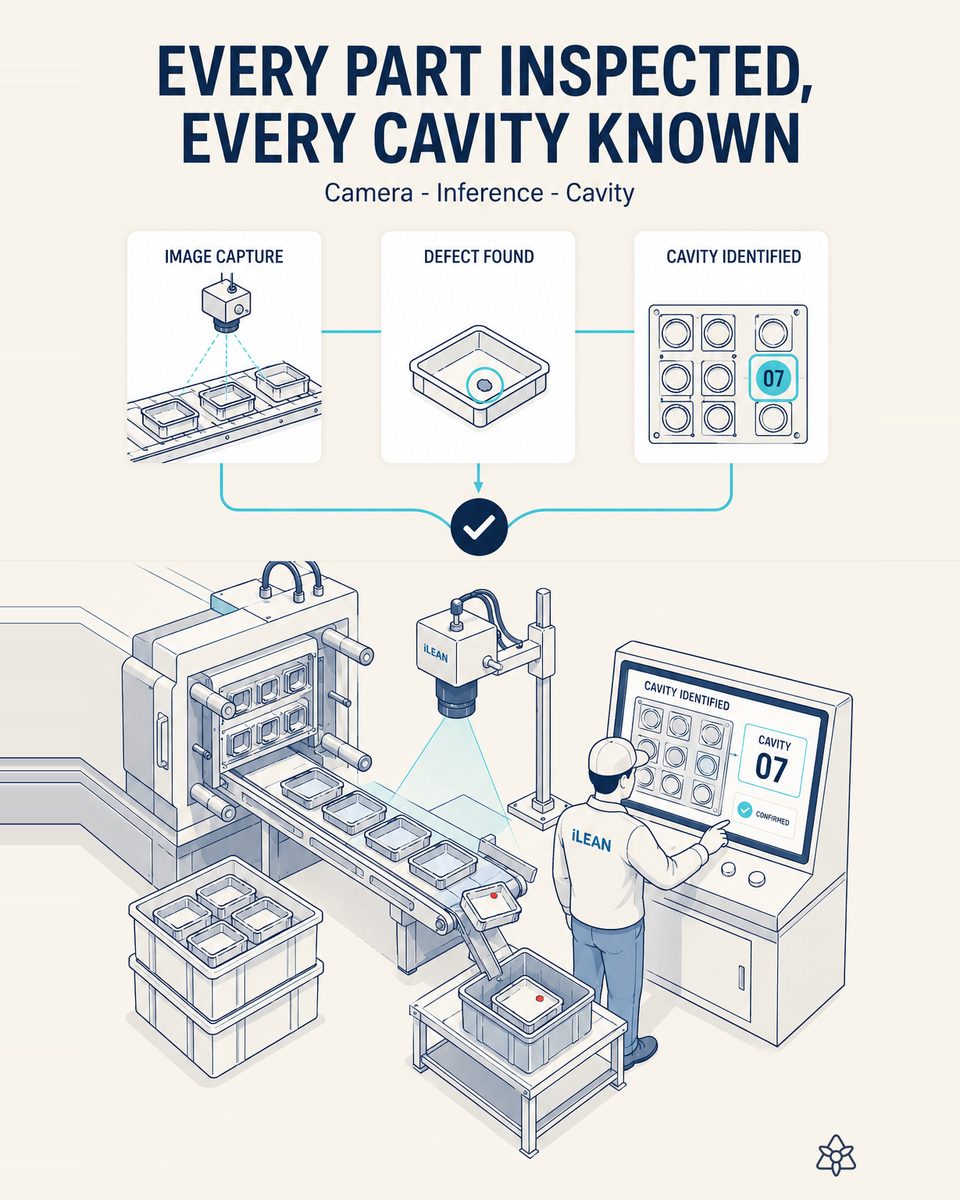
Sampling leaves holes exactly where slow drifts live.
Inspection is done by sampling, and sampling leaves holes exactly where slow drifts live: a cavity that starts giving flash and keeps doing it all shift. The characteristic defects — short shot, flash, sink mark, flow line, warpage and, on visible white-goods parts, black specks or color carryover from the previous run — reach the customer and come back as a claim.
- Inspection is done by sampling, and a cavity that starts giving flash keeps doing it all shift without anybody noticing.
- The characteristic defects — short shot, flash, sink mark, flow line, warpage — are hard to catch at cadence.
- On visible white-goods parts, black specks or color carryover from the previous run are immediate rejects.
- They reach the customer and come back as a claim, which costs far more than the part.
Edge with vision trained on the real part, inferring at the line.
Edge with a neural network trained on good and bad examples of the real part, inferring locally on a GPU at the line.
Local inference is an architecture decision, not a detail: sending every image to the cloud would add latency, cost and bandwidth dependency that inspection at mold cadence does not allow.
- Trained on your part, not on a generic defect catalog: what counts as flash on this reference is not what counts on another.
- Local inference on a GPU at the line — an architecture decision, not a detail: sending every image to the cloud would add latency, cost and bandwidth dependency that inspection at mold cadence does not allow.
- Every detection is tied to its source cavity, which is the difference between scrapping production and correcting the mold at the next maintenance.
- The part is separated before packing, so it never reaches the pallet.
Sampling vs. 100% with cavity traceability
| Aspect | Sampled inspection | With iLEAN Edge |
|---|---|---|
| Coverage | 1-2% of parts | 100% |
| Slow drift | Detected at end of shift or later | At the first parts |
| Defective part | Reaches packing | Separated at the machine |
| Problem cavity | Invisible | Identified by number |
| Corrective action | Scrap the production | Correct the mold at maintenance |
| Claims | Detected by the customer | Contained in the plant |
From 1-2% sampling to 100% of parts controlled; from finding the defect at the customer to separating it on the machine itself; from an invisible problem cavity to one identified by number.
Impact estimate — to validate against your numbers.
The block below is an estimate to be validated against your plant's actual data. We put it forward so the committee has an order of magnitude; we refine it during the assessment.
- Molding at real cadence, with multi-cavity molds and visible parts where cosmetic defects are rejects.
- Indicative payback between 5 and 12 months depending on scrap ratio and the weight of claims.
- Scrap reductions on the order of 30% or more on the part addressed.
- Start with whichever reference generates the most claims: that is where the case pays for itself first.
Estimated payback 5 to 12 months depending on scrap ratio and the weight of claims, with scrap reductions on the order of 30% or more on the part addressed. Estimate to validate on whichever reference generates the most claims.
And the fair question from the production manager
“What if it flags good parts as bad?” — the threshold is adjustable and is tuned during the training weeks with real production. The starting point is deliberately conservative: it is better for it to send a few doubtful parts to review than to let a defect through. And unlike sampling, everything it flags stays recorded with its image, so the criterion can be audited instead of argued.
[1] OpenAI paper "Why Language Models Hallucinate", 2025 — on the reliability of AI in anchored tasks.
What people ask about inline vision on molded parts
Does it need one camera per machine?
One per outfeed point you want to cover. It is not usually deployed across the whole plant at once: you start with the reference that generates the most claims or the most scrap, prove the case on that line and replicate. The training work per new reference gets shorter as the plant accumulates examples.
How long does training take?
Weeks, not months, and it needs real parts: good ones and defective ones. That is the practical constraint — if a defect appears once a month, examples take time to accumulate. For the frequent defects, which are the ones that hurt, there is usually enough material within a few production runs.
Why does the cavity matter so much?
Because it changes the action. Without it you know there is flash and you scrap production. With it you know cavity seven gives flash, you note it for the next maintenance and meanwhile you can keep running with that cavity blocked. It is the difference between an expense and a fix.
Does it work on transparent or textured parts?
It depends on the defect and the surface, and this is a case to test rather than promise. Lighting matters more than the algorithm here. On a first visit the part gets photographed under different setups to see whether the defect is separable, and if it is not, that is said before anything is committed.
Does it slow down the line?
No: inference happens in milliseconds on a local GPU, which is precisely why it is not in the cloud. The camera runs at the mold's cadence, not the other way around.
More cases from this series
- Evidence is not rebuilt, because it is not lostPhotos, parameters, batch, cavity and signatures from every changeover, organized by standard: the…
- Four rings so your part never stops the customer's lineFour verification rings from the resin sack to the pallet so your part never stops the customer's line…
- The customer's alert arrives before the mold changeEmails and messages with delivery changes or quality alerts, read instantly and cross-referenced with…
- The machine stays exactly as it is, but now it speaksAn external camera reads the extruder panel with no network: process curve digitized meter by meter…
- Nothing crosses into the system without a human signing itNothing enters the ERP without a human signing it: the startup summary appears on the tablet and the…
- One production count, and let it be the real oneCycle, downtime and real count go up to the ERP and the order comes down to the machine: one production…
Start with the reference that generates you the most claims.
We work on your plant's real data, not ours. Assessment with no commitment.
Request estimated ROI within 48h ‹ See all cases of technical plastics See plastics