No line starts without evidence
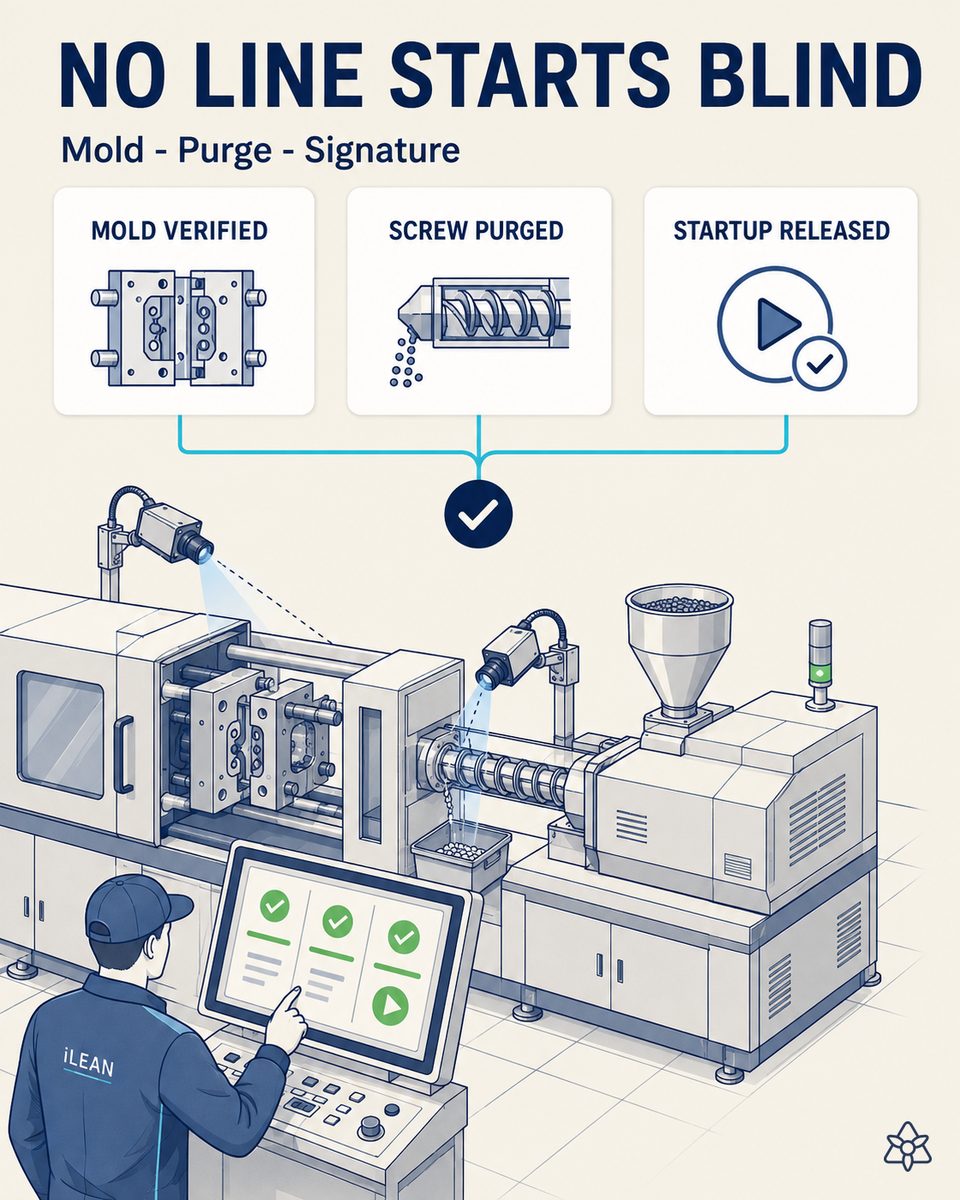
The mold and color change is the moment of maximum risk, and in a plant serving three markets it happens several times a day. With Edge, fixed cameras compare the real state against the reference state and JIDOKA AI blocks startup until everything reads OK and the lead signs on that evidence.
The mistake takes five minutes to make and gets paid for over weeks.
If the purge is incomplete, the first parts come out with color or material carryover — an outright reject on visible parts. If the wrong mold gets mounted, or the blocked cavity was not the one it should have been, a whole batch gets produced that is not what the customer ordered. The mistake takes five minutes to make and gets paid for over weeks. Today it all rests on somebody signing that it is ready, under pressure to recover machine downtime and with no record of what was actually verified.
- Incomplete purge: the first parts come out with color or material carryover, an outright reject on visible parts.
- Wrong mold, or the wrong cavity blocked: a whole batch gets produced that is not what the customer ordered.
- Today it all rests on somebody signing that it is ready, under pressure to recover machine downtime.
- And there is no record of what was verified, so afterwards there is nothing to review.
Edge plus JIDOKA AI — startup blocked until every point reads OK.
Edge plus JIDOKA AI.
The decision is still a person's. The AI supplies the evidence to sign on, not the signature.
- Cameras at the critical points — mounted and identified mold, nozzle and screw after purging, material and color in the hopper, robot and part takeout — trained to recognize the “ready to start” state.
- Startup stays blocked until every point reads OK.
- The lead signs on that evidence, point by point.
- The decision is still a person's: the AI supplies the evidence to sign on, not the signature.
Blind changeover vs. changeover with evidence
| Aspect | Current changeover | With Edge and JIDOKA AI |
|---|---|---|
| Purge check | By eye, under time pressure | Camera on nozzle and screw |
| Mounted mold | Assumed correct | Identified and verified |
| Material and color | Checked at the hopper if there is time | Verified point by point |
| Startup | Whenever the machine is ready | Blocked until everything reads OK |
| Signature | Blind | On visual evidence |
| Carryover | Detected by the customer | Before the first good part |
From a blind signature under time pressure to a signature on point-by-point visual evidence; from color carryover found by the customer to found before the first good part.
Impact estimate — to validate against your numbers.
The block below is an estimate to be validated against your plant's actual data. We put it forward so the committee has an order of magnitude; we refine it during the assessment.
- Several mold and color changes per day, serving markets with different rules.
- Indicative payback between 6 and 12 months depending on the number of changeovers per day.
- Between reduced startup scrap and, above all, avoiding the contaminated batch that triggers a containment.
- A single avoided containment usually covers a good part of the deployment.
Estimated payback 6 to 12 months depending on the number of changeovers per day, between reduced startup scrap and, above all, avoiding the contaminated batch that triggers a containment. Estimate to validate.
And the fair question from the production manager
“Won't blocking startup cost me more than it saves?” — it is a fair objection, and it is why this case travels with SMED AI: the goal is a changeover that is faster and verified, not one that is safer but slower. The check adds seconds at points that were already being looked at; what it removes is the whole batch produced with the wrong mold, which is hours of machine time plus the containment.
[1] OpenAI paper "Why Language Models Hallucinate", 2025 — on the reliability of AI in anchored tasks.
What people ask about validating the mold change
Does it stop the machine if a camera fails?
The rule is configurable and this gets defined before deploying. The usual setup is that a camera failure raises an alert and allows a supervisor override with a record, rather than halting the plant. What is not allowed is an override with no trace: if somebody starts up without a green light, that is exactly the fact worth having recorded.
How many cameras does a molding machine need?
Between three and five depending on the machine and the part: mounted mold, nozzle and screw, hopper, and part takeout when there is a robot. They are fixed cameras at points that are already being looked at today; the change is that now the look leaves a record.
Does it replace the startup checklist?
It replaces the part of the checklist that is signed without really being checked, which under time pressure is a good part of it. The technician still walks the machine and still decides. What changes is that the signature now sits on top of images of each point, and that is what makes it usable in an audit or in a claim.
What happens to blocked cavities?
They are part of what gets verified: the order defines which cavities should be active and the camera confirms the real state. Producing with the wrong cavity blocked is one of the mistakes that goes unnoticed longest, because the parts look right — there are just fewer of them, or the wrong variant.
Does it work on extrusion and corrugation too?
The same idea applies to the color and tooling change, with different checkpoints: die, calibrator, material in the hopper. The visible-part carryover problem is the same one, and so is the fact that today it is signed by eye.
More cases from this series
- Evidence is not rebuilt, because it is not lostPhotos, parameters, batch, cavity and signatures from every changeover, organized by standard: the…
- Four rings so your part never stops the customer's lineFour verification rings from the resin sack to the pallet so your part never stops the customer's line…
- The customer's alert arrives before the mold changeEmails and messages with delivery changes or quality alerts, read instantly and cross-referenced with…
- The machine stays exactly as it is, but now it speaksAn external camera reads the extruder panel with no network: process curve digitized meter by meter…
- Nothing crosses into the system without a human signing itNothing enters the ERP without a human signing it: the startup summary appears on the tablet and the…
- One production count, and let it be the real oneCycle, downtime and real count go up to the ERP and the order comes down to the machine: one production…
Verify every mold change without slowing the plant down.
We work on your plant's real data, not ours. Assessment with no commitment.
Request estimated ROI within 48h ‹ See all cases of technical plastics See plastics