Hands busy, voice free
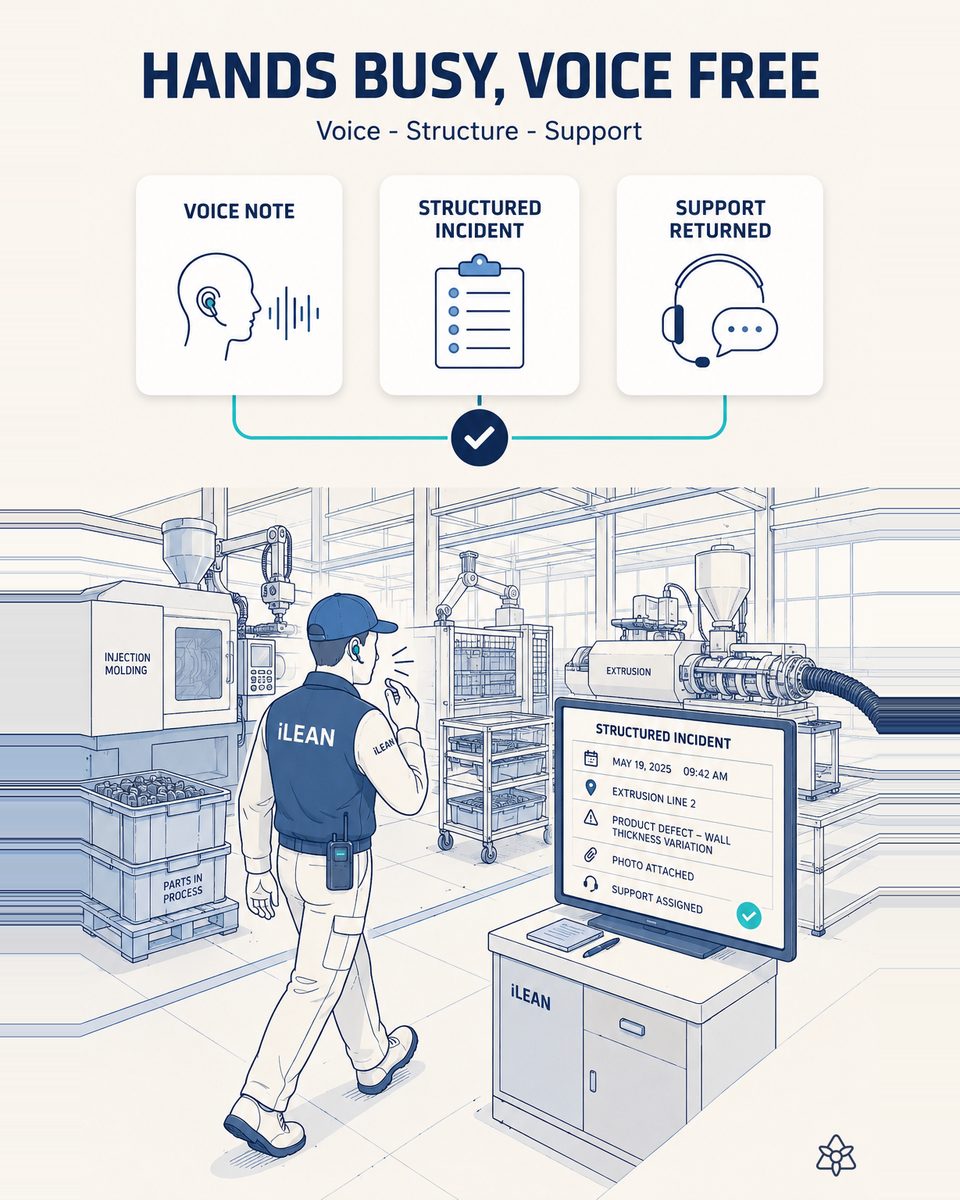
The shift supervisor walks injection, extrusion and assembly with their hands busy and background noise. Nobody expects them to record anything because they cannot type, and yet they carry the most valuable information in the plant. With Connect in voice mode they dictate it while walking: the system listens, structures it as an incident linked to machine, mold, batch and shift, and returns support within seconds.
Continuous improvement plans are built on partial memory.
That machine seven has been stretching its cycle for two days, that the new resin batch brings more black specks, that the tray mold has been flashing since the last maintenance. None of that reaches the system: it gets pieced together the next morning in the meeting from whatever each person remembers. Continuous improvement plans are built on that partial memory.
- That machine seven has been stretching its cycle for two days, and nobody has recorded it.
- That the new resin batch brings more black specks, mentioned in passing.
- That the tray mold has been flashing since the last maintenance, pieced together the next morning from whatever each person remembers.
Connect in voice mode — assistance for the shift lead, not an imposed record.
Connect in voice mode.
The system listens to what the person chooses to dictate, structures it as an incident linked to the active machine, mold, batch and shift, and returns support within seconds: for example, whether maintenance is available that afternoon.
- Bluetooth earpiece with a wake word, under the hearing protection and with the background noise of the shop.
- Dictation while walking, without stopping and without pulling out a phone, through injection, extrusion and assembly.
- Structuring as an incident linked to the active elements: machine, mold, batch and shift.
- Immediate response by voice or an alert to the role involved, which is what makes the tool give something back instead of only asking.
- It is assistance for the shift lead, not an imposed record: the system listens to what the person chooses to dictate.
Knowledge that leaves with the shift vs. knowledge that stays
| Aspect | Current situation | With Connect voice mode |
|---|---|---|
| When it is recorded | In the next morning's meeting | On the spot, while walking |
| What it takes | Remembering and telling it | Speaking |
| Link to context | None | Active machine, mold, batch and shift |
| Basis for improvement | Each person's partial memory | Structured, cross-referenceable incidents |
| Cross-reference with cycle and scrap | Impossible | Automatic, by machine and mold |
| Response to the supervisor | None | Support within seconds |
From shift knowledge that is lost when the shift ends, to incidents structured in real time and cross-referenceable with cycle and scrap history.
Why this piece is not presented with a payback
The block below is an estimate to be validated against your plant's actual data. We put it forward so the committee has an order of magnitude; we refine it during the assessment.
- Plant on three shifts with supervisors walking injection, extrusion and assembly with their hands busy.
- A full-shift trial: what gets measured is how many incidents end up recorded versus before.
- No isolatable direct payback, and it is worth saying so. Claiming otherwise would be selling smoke.
- It is the raw material of any continuous improvement plan and of predictive maintenance later on.
No isolatable direct payback, and it is worth presenting it that way. It is the raw material of any continuous improvement plan and of predictive maintenance later on. Estimate to validate with the continuous improvement manager.
And the fair question from the production manager
“What if it transcribes badly with the noise of the shop?” — the earpiece has industrial noise cancellation and recognition works over plant vocabulary, not general language. And what matters: the transcription triggers no automatic action, it structures an incident a person will read. An error here costs a correction, not a wrong decision.
[1] OpenAI paper "Why Language Models Hallucinate", 2025 — on the reliability of AI in anchored tasks.
What people ask about voice mode on the floor
Does this record the whole shift?
No. It is triggered by a wake word and captures the dictation the supervisor chooses to make, exactly as if they pulled out a phone to write a note. It is not continuous listening and it is not a people-monitoring system, and that distinction matters both legally and for adoption: nobody uses something they perceive as an open microphone on them.
Does it work with injection and extrusion noise?
It is designed for that. An earpiece with industrial noise cancellation and recognition over plant vocabulary — mold names, machine names, material names — rather than general language, which is where generic dictation fails in an industrial environment.
What if the supervisor does not want to use it?
That is the right question, because adoption is the real risk of this piece. What convinces is not the pitch, it is what comes back: when you dictate that machine seven is stretching its cycle and within seconds you learn whether maintenance is free that afternoon, it stops being a reporting duty and becomes a tool that solves something for you.
What good is linking it to the mold and the batch?
It makes the incident cross-referenceable. “The tray mold is flashing” as loose text is worth nothing; linked to the specific mold and date, it can be cross-referenced with that mold's cycle history, with the scrap of that part and with the last maintenance. That is where it stops being an anecdote and becomes data.
How do you measure whether it works?
By comparing how many incidents were recorded in a shift with the system versus before. It is a number you see in the first week. What we will not do is present a payback in months for this piece, because on its own it does not have one.
More cases from this series
- Evidence is not rebuilt, because it is not lostPhotos, parameters, batch, cavity and signatures from every changeover, organized by standard: the…
- Four rings so your part never stops the customer's lineFour verification rings from the resin sack to the pallet so your part never stops the customer's line…
- The customer's alert arrives before the mold changeEmails and messages with delivery changes or quality alerts, read instantly and cross-referenced with…
- The machine stays exactly as it is, but now it speaksAn external camera reads the extruder panel with no network: process curve digitized meter by meter…
- Nothing crosses into the system without a human signing itNothing enters the ERP without a human signing it: the startup summary appears on the tablet and the…
- One production count, and let it be the real oneCycle, downtime and real count go up to the ERP and the order comes down to the machine: one production…
Try voice mode for a full shift and measure how many incidents end up recorded.
We work on your plant's real data, not ours. Assessment with no commitment.
Request estimated ROI within 48h ‹ See all cases of technical plastics See plastics