Traceability starts at the dock, not in the filing cabinet
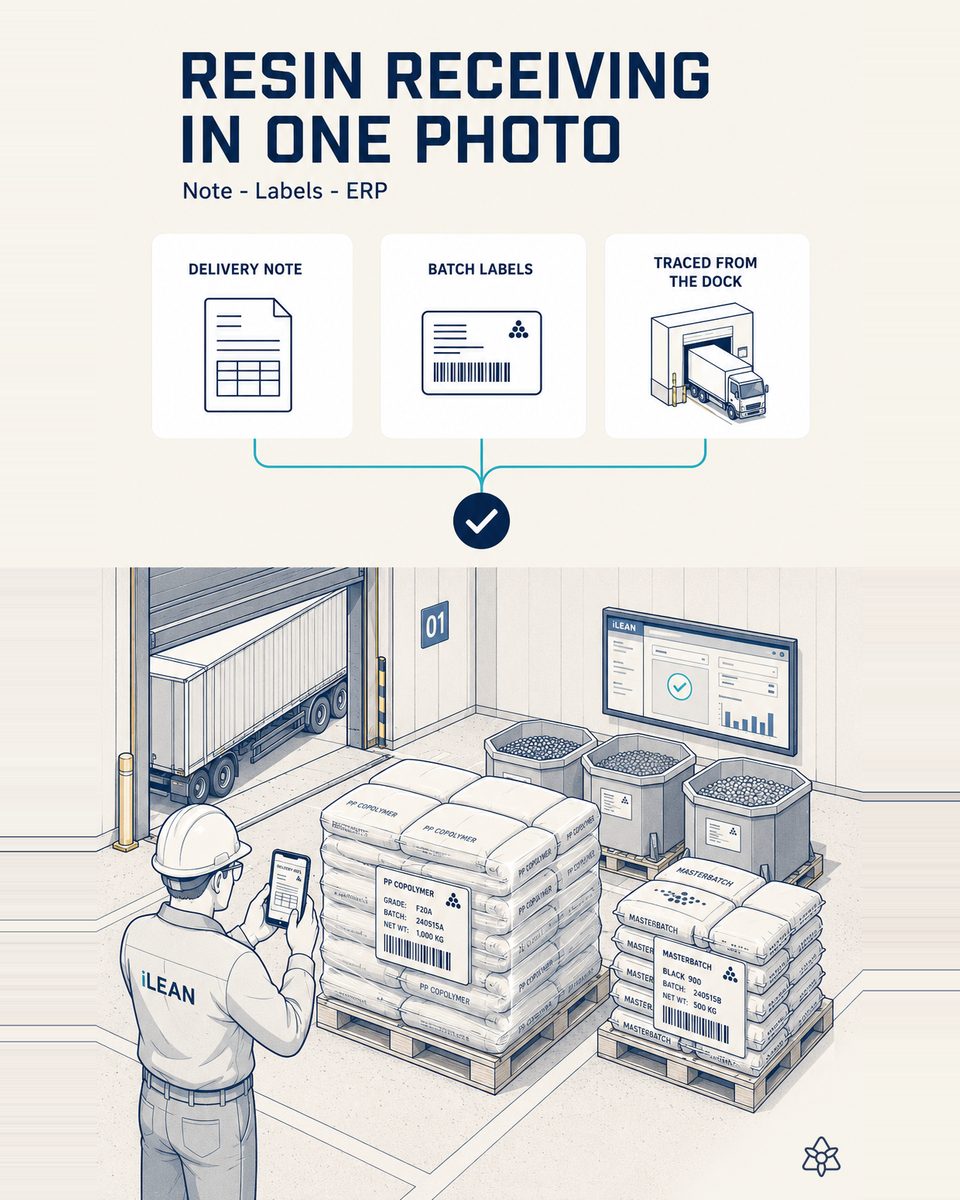
The truck arrives with resin, masterbatch or additives: a delivery note of twelve to twenty lines, one batch label per pallet and the certificate of analysis the automotive or medical customer will ask for. With Connect, one photo of the note and another of the labels are enough: the system extracts everything and, after one validation tap, pushes it to the ERP.
If the origin is wrong, no later traceability works.
Today you sign and then key it in line by line. Two bad endings come out of that: the carrier waiting forty-five minutes charging demurrage, or the fast keying that leaves batches badly linked. The second is the expensive one, though it does not look like it at the time: it comes back months later, when you have to prove which resin batch a claimed part was made with. If the origin is wrong, no later traceability works and product has to be over-contained.
- Today you sign and then key it in line by line, with the truck waiting.
- Two bad endings come out of that: the carrier waiting forty-five minutes charging demurrage, or the fast keying that leaves batches badly linked.
- The second is the expensive one, though it does not look like it at the time: it comes back months later, when you have to prove which resin batch a claimed part was made with.
- And if it cannot be bounded, product gets over-contained, with its inspection and scrap cost.
Connect in photo-the-analog mode — the supplier's note exactly as they send it.
Connect in photo-the-analog mode.
One photo of the note and another of the labels is enough. After one validation tap everything enters the ERP with the certificate of analysis linked to the batch, which is what the automotive or medical customer will ask for later.
- Photo of the delivery note — vision recognizes each supplier's format without asking them to change it and extracts the tabular structure.
- Pallet labels read by barcode, QR, GS1-128 or plain OCR when there is no code.
- On-screen summary of material, batch, quantity and supplier, to validate at a glance.
- One tap from the lead and everything enters the ERP through the API.
- Certificate of analysis linked to the batch, available in an audit without going to the filing cabinet.
Keyed receiving vs. captured receiving
| Aspect | Current receiving | With iLEAN Connect |
|---|---|---|
| Truck held | 45 min | 5 min |
| Delivery note entry | Keyed line by line | Photo and one tap |
| Batch linking | Badly linked if keyed fast | By photo and code |
| Certificate of analysis | In a filing cabinet | Linked to the batch |
| Scope of a claim | Over-contained | Bounded to the real batch |
| Receiving/warehouse licenses | 2-3 active | One, the lead |
Truck held from 45 min to 5 min; resin batches badly linked to linked by photo and code; certificate of analysis in a filing cabinet to a document linked to the batch and available in an audit.
Impact estimate — to validate against your numbers.
The block below is an estimate to be validated against your plant's actual data. We put it forward so the committee has an order of magnitude; we refine it during the assessment.
- Continuous intake of resin, masterbatch and additives, with delivery notes of twelve to twenty lines.
- CFO angle: the receiving and warehouse module usually requires two or three active licenses; with Connect only the lead validates, without logging into the ERP.
- Typical reduction of 50 to 70% in that module, plus the mass-capture module that stops being necessary.
- Indicative payback between 3 and 8 months adding licenses, avoided demurrage and bounded scope of future claims.
CFO angle — the receiving and warehouse module usually requires two or three active licenses; with Connect only the lead validates, without logging into the ERP. Typical reduction of 50 to 70% in that module, plus the mass-capture module that stops being necessary. Estimated payback 3 to 8 months adding licenses, avoided demurrage and bounded scope of future claims. Estimate to validate.
And the fair question from the production manager
“What if it misreads a quantity and stock enters wrong?” — extracting a table from a delivery note is an anchored task over a structured document, where the best models drop below 1.5% error [1]. And today's keying error under time pressure is far more frequent, with the aggravating factor that it surfaces months later. Here the summary is validated with the truck still at the dock.
[1] OpenAI paper "Why Language Models Hallucinate", 2025 — on the reliability of AI in anchored tasks.
What people ask about digitizing resin receiving
Do suppliers have to use a standard delivery note?
No, and that is what makes the case viable. Each supplier sends theirs however they want and standardizing formats is an endless project you do not even control. Vision recognizes the tabular structure of the document rather than relying on fixed templates, so it lives with different formats from day one.
And the certificate of analysis?
It is captured the same way and stays linked to the batch, which is the part lost today. In automotive and medical devices that certificate gets requested, and hunting for it in a filing cabinet months later is exactly the work that turns a claim into somebody's week. Linked to the batch, it comes out in the same dossier as the rest of the traceability.
Why does inbound traceability matter so much?
Because it is the first link: if the resin batch entered badly linked, no later traceability works. When the customer complains, you cannot bound which production went out with that material and you have to contain far more than what is really affected. The sorting and scrap cost comes from there, not from the defect itself.
Does it replace the RF terminal?
At the receiving point, largely yes, and part of the saving is there: the mass-capture module and the dedicated terminals that existed only for this step stop being needed. In the rest of the warehouse nothing is touched.
What if the note does not match the order?
Discrepancies are flagged for review instead of entering as they are. The lead sees them highlighted and decides: accept, correct or reject the line. It is exactly the case where today it gets keyed fast and the problem surfaces weeks later.
More cases from this series
- Evidence is not rebuilt, because it is not lostPhotos, parameters, batch, cavity and signatures from every changeover, organized by standard: the…
- Four rings so your part never stops the customer's lineFour verification rings from the resin sack to the pallet so your part never stops the customer's line…
- The customer's alert arrives before the mold changeEmails and messages with delivery changes or quality alerts, read instantly and cross-referenced with…
- The machine stays exactly as it is, but now it speaksAn external camera reads the extruder panel with no network: process curve digitized meter by meter…
- Nothing crosses into the system without a human signing itNothing enters the ERP without a human signing it: the startup summary appears on the tablet and the…
- One production count, and let it be the real oneCycle, downtime and real count go up to the ERP and the order comes down to the machine: one production…
Tell us how long a truck holds up your resin receiving.
We work on your plant's real data, not ours. Assessment with no commitment.
Request estimated ROI within 48h ‹ See all cases of technical plastics See plastics