Mold startup stops living on a sheet of paper
Every mold change starts with the parameter sheet and with the handwritten notes of the technician who set it up last time: the real knowledge of how that part runs. That paper lives in a folder next to the machine and gets digitized, if at all, at the end of the day. With Connect the technician takes a photo while fitting the mold and the startup exists in the central system at second zero.
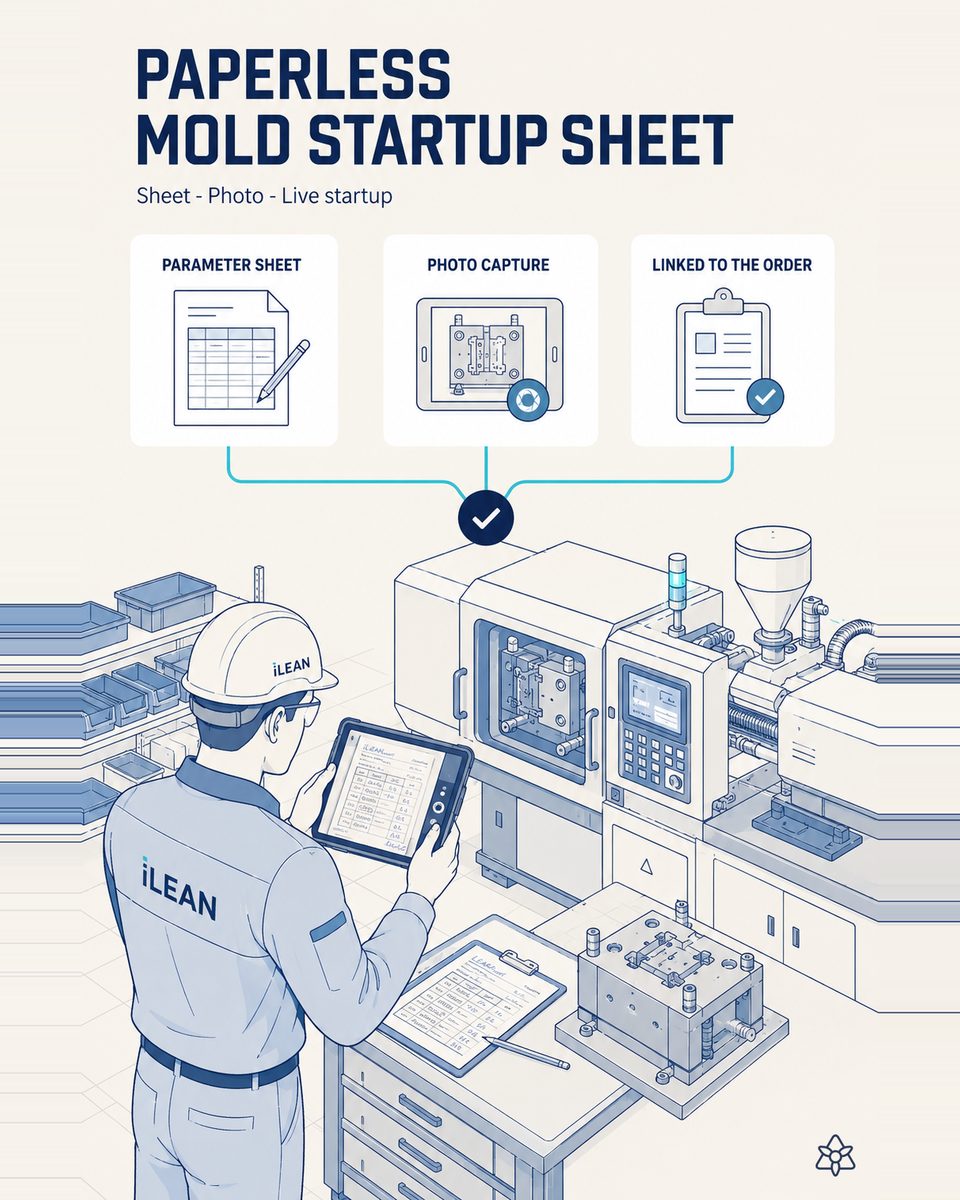
The know-how of how that part runs lives in a notebook next to the machine.
The parameter sheet carries printed zone temperatures, injection pressure and cycle time, and on top of them the pencil corrections that made the part come out right last time. When that technician is off or changes shift, the next one starts blind and burns material until finding the sweet spot. In parallel, the shift report and the scrap sheet reach production four to eight hours late, when the shift can no longer be corrected.
- The sheet carries printed zone temperatures, injection pressure and cycle time. And on top of them, the pencil corrections that made the part come out right last time.
- When that technician is off or changes shift, the next one starts blind and burns material until finding the sweet spot.
- The shift report and the scrap sheet reach production four to eight hours late, when the shift can no longer be corrected.
Connect in photo mode — the technician's phone digitizes the paper without touching the machine.
Connect in photo mode.
The technician takes a photo while fitting the mold. Connect extracts part, active cavities, material, color, temperature profile and scrap reason, and links it to the active order. The paper keeps being filled in exactly the same.
- Photo of the parameter sheet while fitting the mold, with the phone or industrial tablet the technician already carries.
- Extraction of the structured fields — part, mold, active cavities, material and color, temperature profile, cycle time, good parts and scrap reason.
- Linked to the active production order, which is what turns a photo into a record queryable by mold and by material.
- Human validation before entry — the summary goes to the tablet and the technician confirms or corrects. Humans in command.
- Zero habit change and zero keyboard on the floor: the gesture is the one everybody already makes.
A sheet digitized at the end of the day vs. a startup at second zero
| Aspect | With the sheet in the folder | With iLEAN Connect |
|---|---|---|
| Data latency | 4-8 h, or end of day | Second zero |
| Pencil corrections | Stay on the paper | Extracted and linked to the mold |
| Shift handover | The next one starts blind | Starts from parameters that worked |
| Startup scrap | Material burned finding the point | Reduced by starting from history |
| Query by mold or material | Search the folder at the machine | Queryable history |
| Load on the technician | Fill the paper, then key it in | Fill the paper and take a photo |
From 4-8 h of latency between the paper and the system to zero latency; from know-how living in a notebook to a parameter history queryable by mold and by material.
Impact estimate for your plant — to validate against your numbers.
The block below is an estimate to be validated against your plant's actual data. We put it forward so the committee has an order of magnitude; we refine it during the assessment.
- A shop with mold changes several times a day and parameter sheets per mold and material.
- Pilot on a few machines, with the phone or tablet the technician already carries. No construction work and no downtime.
- Indicative payback between 4 and 9 months depending on mold changes per day.
- Two levers: recovered clerical time and, above all, less startup scrap by starting from the parameters that already worked.
Estimated payback 4 to 9 months depending on mold changes per day, between recovered clerical time and reduced startup scrap by starting from the parameters that already worked. Estimate to validate.
And the fair question from the production manager
“What if the model misreads a temperature written in pencil?” — hallucination is a problem of free generation, not of anchored tasks. Here the AI moves a specific data point from one medium to another, and in that kind of task the best models dropped below 1.5% error [1]. And nothing enters the system without the technician validating it on the tablet.
[1] OpenAI paper "Why Language Models Hallucinate", 2025 — on the reliability of AI in anchored tasks.
What people ask about digitizing the startup sheet
Do we have to stop using the paper sheet?
No. The sheet keeps being filled in the same way, in the same format and by the same person; the only thing added is a photo. Asking the technician to also key it into a terminal is what has made this attempt fail in many plants: it competes with machine downtime exactly when everybody is in a hurry to start.
Does it also pick up the pencil corrections?
They are precisely what interests us most. The printed values are the theoretical starting point; the handwritten corrections are the real adjustment that made the part come out right. That is the knowledge lost today when the technician who wrote it changes shift, and what turns the history into something useful for the next startup.
Do you touch the molding machine or the ERP?
The molding machine is not touched at all: Connect photographs paper, not signals. With the production system there is a read-only connection to know which order and mold are active and anchor the record. And nothing is written without prior human validation.
Does it work with different sheets per machine or per customer?
Yes, and that is the normal case. The model recognizes the structure of the document rather than relying on a fixed coordinate template, so it lives with different formats without asking anyone to standardize them first. Standardizing forms is a project in itself and we do not want it to be the prerequisite for this one.
How long before it is useful?
The history starts being useful as soon as a few startups of the same mold are recorded, which in a shop with several changes a day means days, not months. The startup scrap reduction shows when the technician can start from the parameters that worked last time instead of hunting for them again.
More cases from this series
- Evidence is not rebuilt, because it is not lostPhotos, parameters, batch, cavity and signatures from every changeover, organized by standard: the…
- Four rings so your part never stops the customer's lineFour verification rings from the resin sack to the pallet so your part never stops the customer's line…
- The customer's alert arrives before the mold changeEmails and messages with delivery changes or quality alerts, read instantly and cross-referenced with…
- The machine stays exactly as it is, but now it speaksAn external camera reads the extruder panel with no network: process curve digitized meter by meter…
- Nothing crosses into the system without a human signing itNothing enters the ERP without a human signing it: the startup summary appears on the tablet and the…
- One production count, and let it be the real oneCycle, downtime and real count go up to the ERP and the order comes down to the machine: one production…
Tell us how many mold changes you do per day and we will send the estimated ROI within 48h.
We work on your plant's real data, not ours. Assessment with no commitment.
Request estimated ROI within 48h ‹ See all cases of technical plastics See plastics