Purge sign-off rests on evidence, not on memory
The changeover between polymers or between colours is the most dangerous moment of the shift. If the new batch starts with residue of the previous one in the hopper, in the screw or in the cutter, the result is cross-contamination: black pellet in a natural batch, polypropylene in a polyethylene batch, a melt flow index that no longer corresponds to anything.
It is irreversible, and it does not show at the outlet.
And it is irreversible. It is not visible on the way out. It becomes visible when the lab measures, hours later, or when the customer complains, weeks later. By then the material has been bagged and possibly shipped. Today the decision rests on somebody looking and saying it is clean now, with no objective evidence and under pressure to claw back changeover time. There is a structural conflict there: every bit of productivity pressure pushes in the opposite direction from purging properly, and the person resolving it is under pressure, every time, alone.
- Cross-contamination from the previous grade is irreversible and does not show at the outlet.
- It shows when the lab measures, hours later, or when the customer complains, weeks later. By then the material is bagged and possibly shipped.
- Today the decision rests on somebody looking and saying "it is clean", with no objective evidence and under pressure to recover changeover time.
- There is a structural conflict there: all the productivity pressure pushes against purging properly.
A reference state per critical point, and JIDOKA AI that will not let it start.
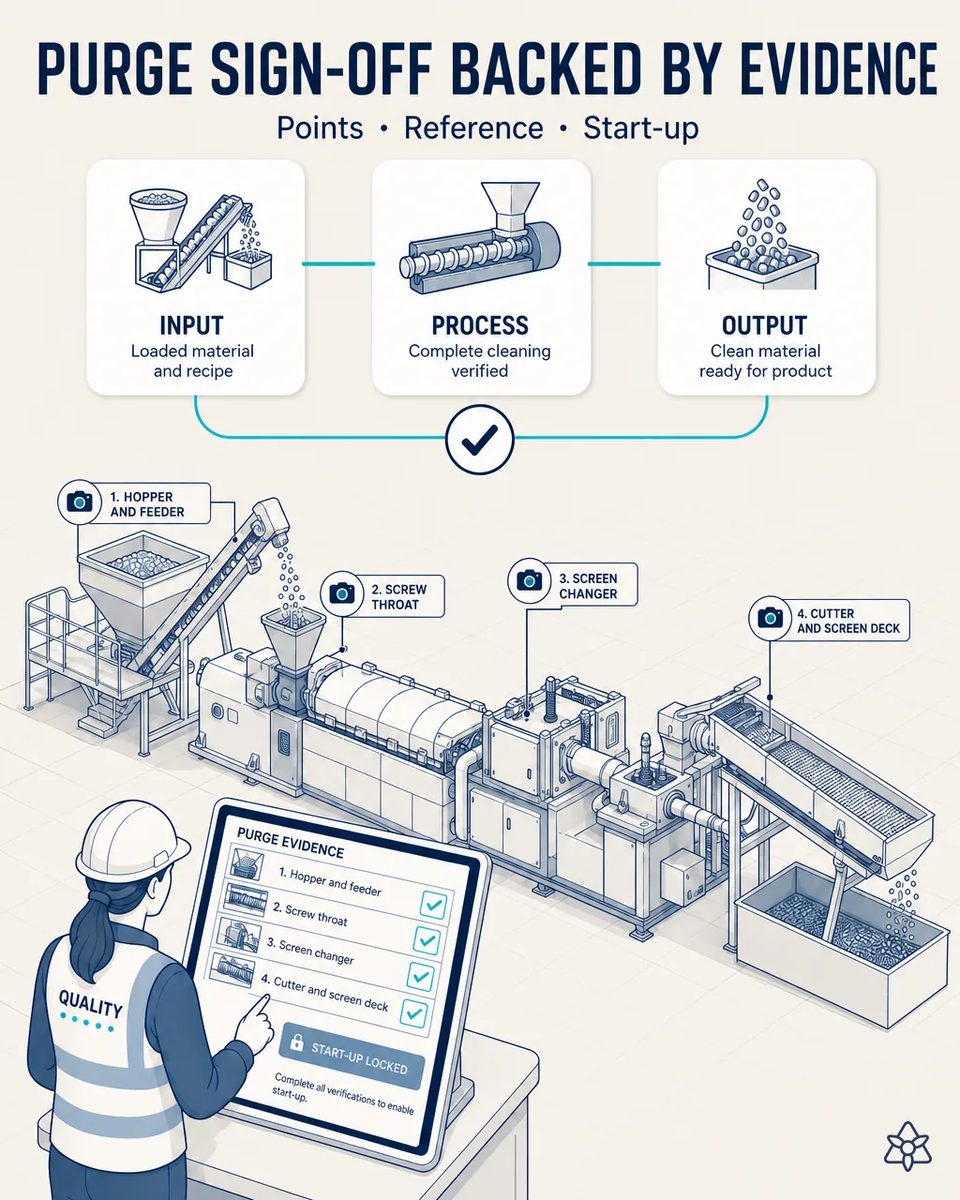
With Edge, fixed cameras at each critical point compare the current state against the reference state of purged and ready for the next grade. Hopper and feeder, screw throat, screen changer, cutter and screen deck, first metres of belt. The model is trained to tell purged apart from carrying residue of the previous grade. And then JIDOKA AI does what it does: the line does not start until every camera reports clear and the quality manager signs. But the signature now rests on visual evidence point by point, not on memory. Accountability stops being an act of faith and becomes a documented act.
The quality lead still signs. But they sign on visual evidence point by point, not on memory and haste. That changes who carries the conflict.
The grade change, before and after
| Aspect | Today | With iLEAN Edge |
|---|---|---|
| Purge verification | Somebody looks and says it is done | A camera at every critical point |
| Points covered | Whichever get looked at | Hopper, screw, screen changer, cutter, screen, belt |
| Starting with residue | Possible, with pressure in favour | The line does not start |
| What the signature rests on | Memory and haste | Visual evidence point by point |
| When contamination is caught | Hours or weeks later | Before start-up |
| Changeover time | Depends who runs it | SMED AI orders the sequence |
Impact estimate — to validate against your numbers.
The block below is an estimate to be validated against your plant's actual data. We put it forward so the committee has an order of magnitude; we refine it during the assessment.
- Less rework from cross-contamination; payback depends on grade changes per week.
- So the requirement does not penalise productivity, SMED AI runs alongside and orders the changeover sequence.
- The changeover evidence is stored on its own, and it is what the process audit asks for.
- And the conflict between purging properly and starting fast stops being settled by one person under pressure.
Less rework from cross-contamination · payback scales with changeovers per week. So that the requirement does not cost productivity, SMED AI walks the changeover sequence and orders it. The changeover does not get longer: it gets organised. The impact is a direct cut in rework and grade downgrading caused by cross-contamination, which is one of the biggest margin leaks a recycler has. Payback scales with the number of changeovers per week. An estimate to validate. Conservative ranges, an estimate to validate against the plant's real data.
And the fair question from the production manager
"Can a camera certify a purge?" — it is not asked to certify. It compares the current state against the reference at each specific point of this plant, which is an anchored comparison, and hands that evidence to whoever does certify. The signature stays human; what changes is what it rests on.
[1] OpenAI paper "Why Language Models Hallucinate", 2025 — on the reliability of AI in anchored tasks.
What people ask about validating the purge
How many points have to be instrumented?
The ones that actually carry residue: hopper and feeder, screw throat, screen changer, cutter and screen, and the first metres of belt. Instrumenting more adds cost without reducing risk.
Can the block be overridden in an emergency?
It can, but it is recorded with who and why. A block with no way out ends up physically bypassed; one with a traced override is used rarely and you can see when.
Does it not make every grade change longer?
That is the right objection, which is why the case comes with SMED AI in parallel, ordering the changeover sequence so the verification overlaps rather than adds.
Does it work with your definition of clean or ours?
Yours: it is the only way it works. The model is trained to tell purged from with-residue at each point of that plant, because clean at a cutter does not look like clean at a hopper.
What does the auditor see?
The image of each point at the moment of the change, the reference it was compared against and the signature that authorised the start. That is a stronger record than a tick on a sheet.
More cases from this series
- When the file is the product, the file is not improvisedEvery certified destruction and critical changeover builds its own evidentiary dossier, ordered by…
- Find out here, not on the customer's lineFour verification rings from bale to big-bag, automatic release lock and live mass balance per batch and…
- The pellet batch is born traced, not on a sheet that gets lostPelletising order and blend sheet captured by photo: the pellet batch exists in the central system at…
- One wrong keystroke can no longer stop the customer's linePolymer, grade, batch and certificate travel from the ERP to the printer with no keying, and no…
- The twenty-year-old pelletiser starts to talkCamera and OCR on the proprietary panel: the extruder process curve is digitised batch by batch without…
- Shift-floor judgement stops dying at the end of the shiftThe shift lead dictates while walking the floor; iLEAN structures it, ties it to the batch and answers…
Tell us how many grade changes you run a week and how you evidence the purge today.
We work on your plant's real data, not ours. Assessment with no commitment.
Request estimated ROI within 48h ‹ See all cases of plastics recycling See plastics