One wrong keystroke can no longer stop the customer's line
The big-bag label is the last physical thing standing between this plant and its customer. It carries the polymer, the grade, the batch and, when the customer requires it, the certificate of analysis number. Everything done well upstream is staked on it.
A whole pallet of polypropylene labelled as polyethylene is not a misprint.
The bagging line and its print-and-apply labeller are relatively modern, five to fifteen years old, and they already have an API or a command interface. But they are isolated from the ERP. So at every batch change somebody keys the same data in a second time on the labeller panel. It was never integrated properly because it was never the priority of the quarter. And one wrong keystroke means a full pallet of polypropylene ships labelled as polyethylene. That is not a misprinted label: that is a line stoppage at the customer, a truck coming back and a non-conformity opened. The only barrier that exists today is the attention of one person keying in a value that was already written somewhere else.
- The bagging station and its print-and-apply unit are relatively modern and already have an API or a command interface. But they are isolated from the ERP.
- So at every batch change somebody types the same data a second time on the labeller panel.
- It was never integrated properly because it was never the quarter's priority.
- And one wrong keystroke means a whole pallet labelled with the wrong polymer — which is a line stoppage at the customer.
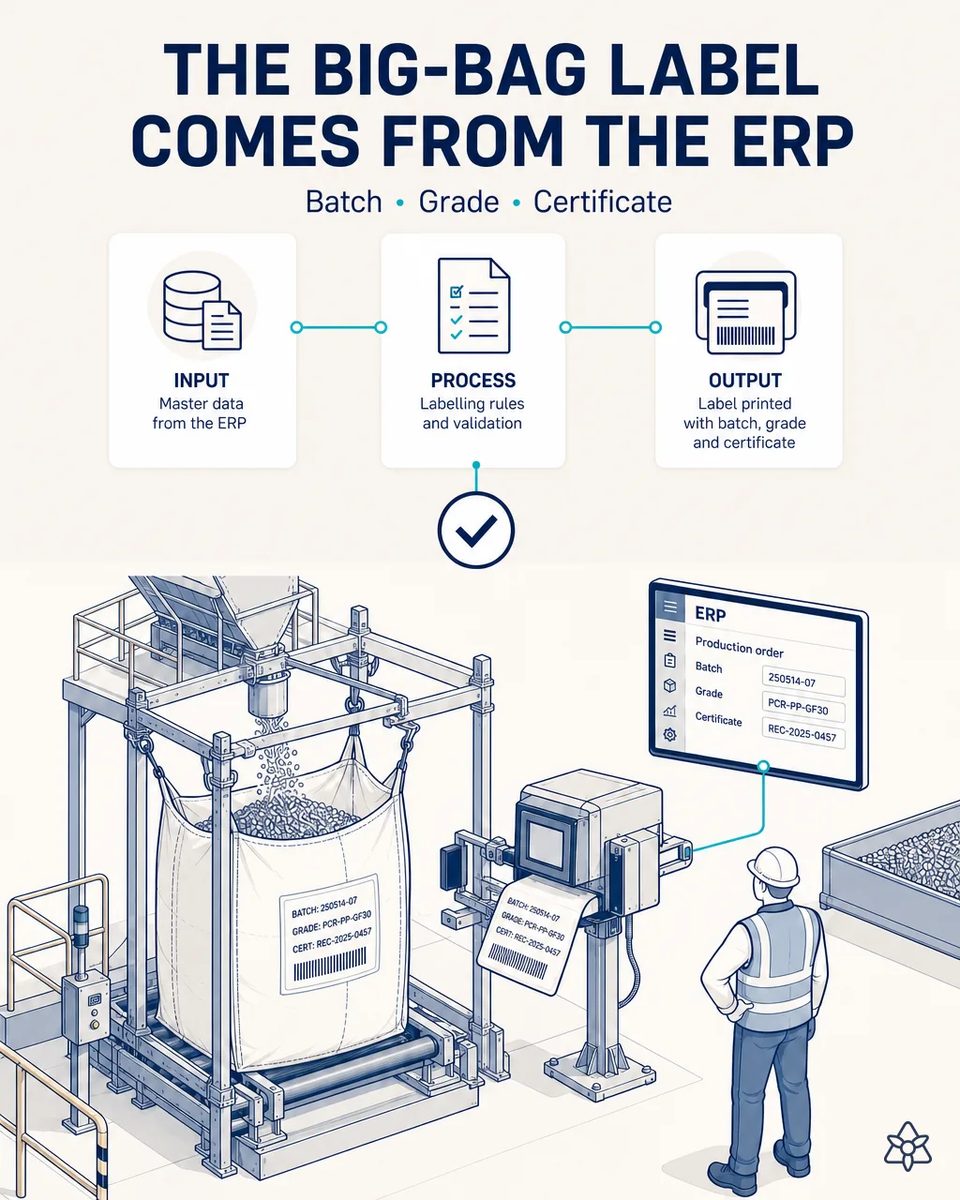
Connect stitches both systems via API. Without replacing either machine.
Connect stitches the two systems together over API. When the ERP marks the bagging order as started, it automatically publishes polymer, grade, batch, target weight and certificate reference to the printer. A batch change becomes one tap in the ERP, not a keystroke on a panel. Neither machine gets replaced. And there is a second-order effect worth more than the first: if the batch has no validated lab result, the label is simply not issued. It becomes physically impossible to label, and therefore to ship, an unreleased batch. That is where this joins up with the laboratory example.
And there is a second-order effect worth more than the first: if the batch has no validated lab result, the label is simply not issued. Shipping without release becomes physically impossible.
Labelling, before and after
| Aspect | Today | With iLEAN Connect |
|---|---|---|
| Polymer, grade, batch and weight | Typed on the panel | Published from the active order |
| A batch change | Typing on the labeller | One tap in the ERP |
| Human labelling error | Possible at every change | Removed at source |
| Batch with no validated lab result | Can be labelled and shipped | The label is not issued |
| Do the machines have to change | — | No: their own interfaces are used |
| New middleware to maintain | — | None |
Impact estimate — to validate against your numbers.
The block below is an estimate to be validated against your plant's actual data. We put it forward so the committee has an order of magnitude; we refine it during the assessment.
- Estimated payback 3-6 months — one of the fastest of the set.
- The integration is bounded and the risk it removes is high: zero human labelling error.
- No unreleased batch can leave labelled, which is a physical barrier rather than a procedure.
- And the batch change stops depending on who is standing at the panel.
Payback 3-6 months · zero human labelling error and no unreleased batch ever labelled. This is one of the fastest returns in the pool, three to six months, because the integration is narrow and the risk it removes is expensive. What drops sharply is the return caused by mislabelling and the non-conformity that comes with it. An estimate to validate against the plant's labelling incident history. Conservative ranges, an estimate to validate against the plant's real data.
And the fair question from the production manager
"Is this another system to maintain?" — no, and that is deliberate. No middleware is introduced: what gets used are the interfaces the machines already ship with and that are already paid for. The work is stitching them to the active order, not adding a layer between them.
[1] OpenAI paper "Why Language Models Hallucinate", 2025 — on the reliability of AI in anchored tasks.
What people ask about integrating the labeller
Does the line have to stop to integrate it?
No, and that is why it never got done: the perception that it means a shutdown. The interfaces are already there; what is missing is somebody publishing the active order into them.
Does it work with bagging stations and printers from different makers?
Yes. Each machine is stitched its own way, but what gets published to them comes from the same place: the ERP's active order.
What if the ERP order is wrong?
The wrong label gets published, and it is better to find that out here than at the customer. In practice this surfaces master-data errors nobody knew existed.
Can the unreleased-batch block be overridden?
It can, but it is recorded with who and why. A block with no way out ends up bypassed; one with a traced override is used rarely and you can see when.
How long does it take to get running?
It is one of the shortest, because the scope is bounded: one printer, one bagging station and an ERP interface that usually already exists for something else.
More cases from this series
- When the file is the product, the file is not improvisedEvery certified destruction and critical changeover builds its own evidentiary dossier, ordered by…
- Find out here, not on the customer's lineFour verification rings from bale to big-bag, automatic release lock and live mass balance per batch and…
- The pellet batch is born traced, not on a sheet that gets lostPelletising order and blend sheet captured by photo: the pellet batch exists in the central system at…
- The twenty-year-old pelletiser starts to talkCamera and OCR on the proprietary panel: the extruder process curve is digitised batch by batch without…
- Shift-floor judgement stops dying at the end of the shiftThe shift lead dictates while walking the floor; iLEAN structures it, ties it to the batch and answers…
- The melt flow index reaches the ERP before the truck reaches the customerMelt flow index and the rest of quality control reach the ERP on their own after sign-off, cutting…
Tell us how many times a day a batch gets typed on your labeller.
We work on your plant's real data, not ours. Assessment with no commitment.
Request estimated ROI within 48h ‹ See all cases of plastics recycling See plastics