The melt flow index reaches the ERP before the truck reaches the customer
In a recycling plant the melt flow index is the number that decides a batch's destiny: sold as technical grade, downgraded to a lesser application, or reprocessed. Alongside it sit residual moisture, bulk density, ash content and colour. All of it is measured by the lab, batch by batch.
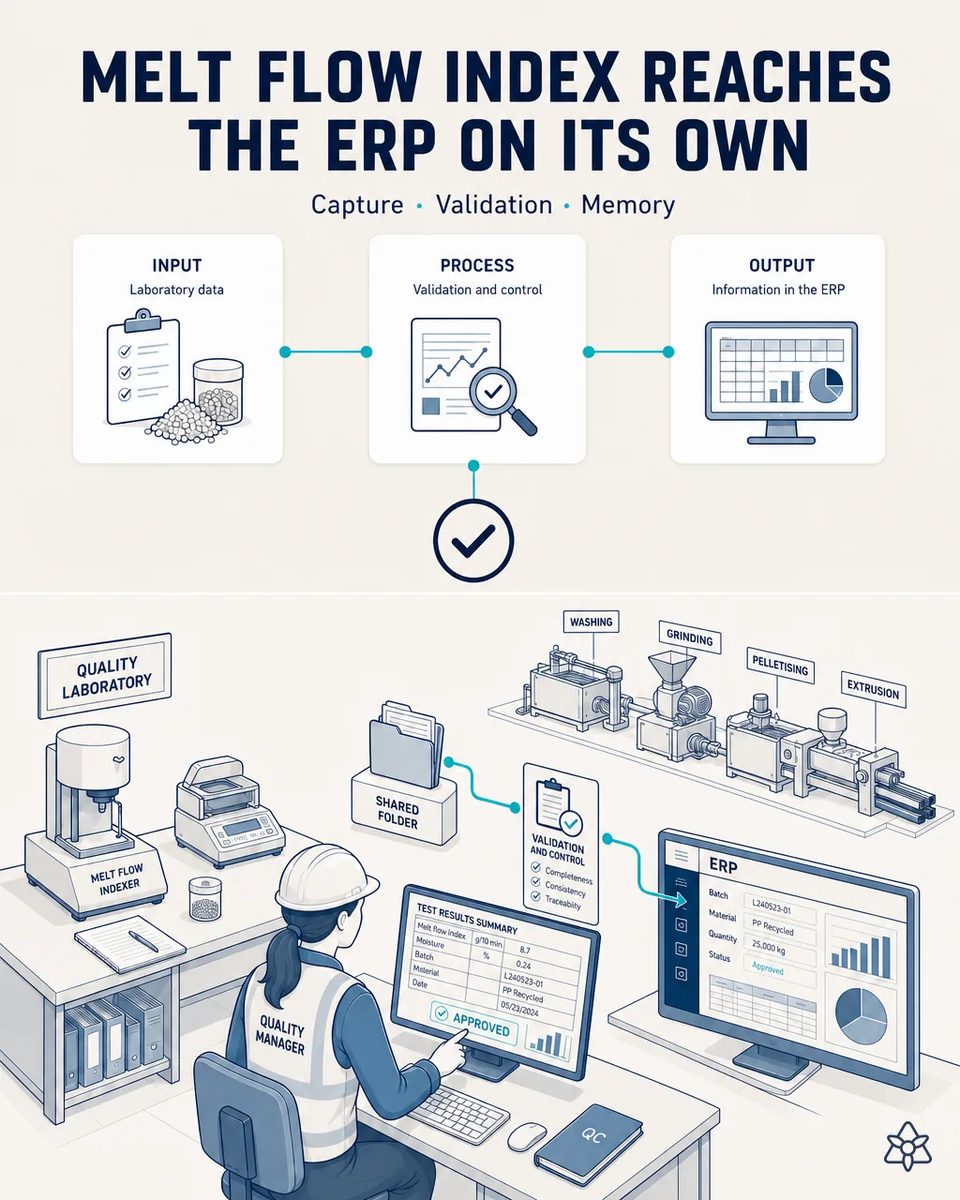
The batch gets bagged, labelled and sometimes shipped before its result is in the system.
And all of it gets written into a spreadsheet that lives in a shared folder the ERP cannot see. Two parallel worlds: the spreadsheet, where the live data is, and the official ERP, with data transcribed days later. Somebody spends half a day a month copying and pasting, and introduces errors doing it. But the transcription is not the serious part. The serious part is that the batch gets bagged, labelled and far too often shipped before its melt flow result is in the system. As long as that data does not exist in the ERP, automatic batch hold simply cannot exist. There is nothing to hold against.
- The live data lives in a spreadsheet in a shared folder the ERP cannot see.
- Two parallel worlds: the spreadsheet, with today's data, and the official ERP, with data transcribed days later.
- Somebody spends half a day a month copying and pasting, and introduces errors. But the transcription is not the serious part.
- The serious part is that the batch ships before its melt flow result is in the system. While the data travels, so does the truck.
Listen-inward mode: it watches the folder, not the person. And it holds the batch.
Connect in listen-inward mode watches the folder, not the person. It reads the file when it is saved, parses the sheet with an anchored model, shows the summary for validation and pushes it to the ERP by API against the right batch. And if the melt flow index falls outside the range of the committed grade, it flags the batch on hold before it ever reaches dispatch. The lab carries on working exactly as before. And here is the part a finance director signs without needing to believe in AI at all. The ERP charges per active user. If the lab and quality team log into the ERP purely to key in results, those are several licences being paid for typing. With Connect only the person who validates logs in: the typical reduction is between fifty and eighty per cent of the quality-module licences, and it is a recurring saving every year.
If the melt flow index falls outside the range of the committed grade, it flags the batch as held before it reaches dispatch. The lab carries on working exactly as before.
The lab result, before and after
| Aspect | Today | With iLEAN Connect |
|---|---|---|
| Lag between measurement and ERP | Days | The moment the file is saved |
| Who types it in | Somebody, half a day a month | Nobody |
| An out-of-range batch | Found after shipping | Held before dispatch |
| Quality module licences | One per person entering data | One, the lead who validates |
| Evidence for the customer | Spreadsheet and ERP, not matching | One series against the batch |
| The lab spreadsheet | Everyone tries to kill it and fails | It stays: it is the tool that works |
Impact estimate — to validate against your numbers.
The block below is an estimate to be validated against your plant's actual data. We put it forward so the committee has an order of magnitude; we refine it during the assessment.
- Estimated payback 4-9 months, plus the recurring annual licence saving.
- Typical reduction of 50-80% in quality module licences.
- The licence saving is immediate and depends on no improvement hypothesis: it is a cost line that goes down.
- And an out-of-range batch can no longer be shipped, which is the return you actually feel.
Payback 4-9 months · typical 50-80% cut in quality-module ERP licences. Estimated payback is four to nine months, with the recurring annual licence saving on top. It is an estimate to validate, and it validates quickly: the real ERP invoice and the number of active lab users are all it takes. Conservative ranges, an estimate to validate against the plant's real data.
And the fair question from the production manager
"What if the sheet changes format?" — listening mode does not depend on a frozen template: it parses the sheet with an anchored model, respecting its structure as it is [1]. If a new column shows up, it is flagged for review rather than silently accepted.
[1] OpenAI paper "Why Language Models Hallucinate", 2025 — on the reliability of AI in anchored tasks.
What people ask about integrating the lab
Do we have to stop using the spreadsheet?
No. The spreadsheet stays, because it is the tool that lab has been measuring well with for years. What disappears is the second keying.
Are you watching what the technician does?
No. The folder is watched and the save is detected — the folder, not the person. Nothing about who edited what is captured or reported.
Do ERP licences really come back?
It is the easiest thing to check: count how many users log into the quality module only to enter data. That number is the saving, and it rests on no estimate.
Who decides to hold a batch?
The system flags it; the release is signed by the quality lead. What changes is that the flag happens before dispatch and not after shipping.
How does it post to the ERP: API or screen automation?
Through the API. Automating the screen looks quicker to build and breaks at the next ERP update; the API is what survives in production.
More cases from this series
- When the file is the product, the file is not improvisedEvery certified destruction and critical changeover builds its own evidentiary dossier, ordered by…
- Find out here, not on the customer's lineFour verification rings from bale to big-bag, automatic release lock and live mass balance per batch and…
- The pellet batch is born traced, not on a sheet that gets lostPelletising order and blend sheet captured by photo: the pellet batch exists in the central system at…
- One wrong keystroke can no longer stop the customer's linePolymer, grade, batch and certificate travel from the ERP to the printer with no keying, and no…
- The twenty-year-old pelletiser starts to talkCamera and OCR on the proprietary panel: the extruder process curve is digitised batch by batch without…
- Shift-floor judgement stops dying at the end of the shiftThe shift lead dictates while walking the floor; iLEAN structures it, ties it to the batch and answers…
Tell us how many batches you have shipped without their melt flow in the system.
We work on your plant's real data, not ours. Assessment with no commitment.
Request estimated ROI within 48h ‹ See all cases of plastics recycling See plastics