The twenty-year-old pelletiser starts to talk
The pelletiser is the most expensive asset in this plant and it is typically ten to twenty years old. It runs perfectly. What it does not do is talk: its panel is proprietary and isolated from the network by the manufacturer's design. Replacing it costs hundreds of thousands of dollars and weeks of downtime, so nobody is going to replace it just to gain connectivity.
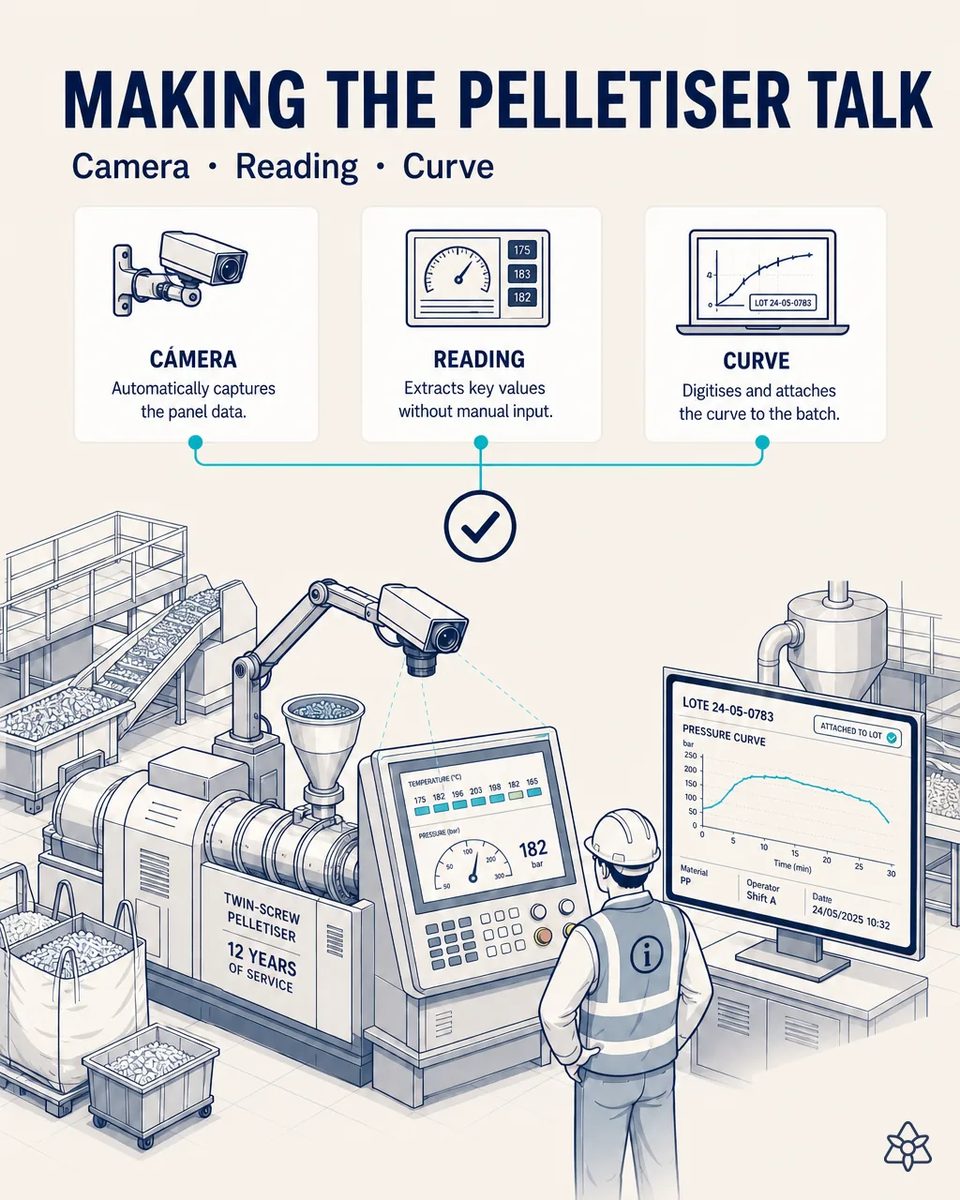
The four numbers that explain a good batch are born and die on a screen.
And yet that screen holds exactly the four numbers that explain why a batch turns out well or badly: the zone temperature profile, the melt pressure, the screw amperage and the screen-changer differential pressure. Rising screen-changer pressure is the early warning that incoming material carries more contamination than expected. Screw amperage is the early warning that the blend has shifted. Both are visible on the panel, and both die on the panel.
- The temperature profile by zone, the melt pressure, the screw amperage and the screen-changer differential pressure.
- The screen-changer pressure rise is the early warning that incoming material carries more contamination than expected.
- The amperage is the early warning that the blend has changed.
- Both are visible on the panel and lost there: not historised, not tied to the batch, not comparable between shifts.
A camera pointed at the panel. No PLC, no touching the original control, no warranty risk.
Connect solves this from the outside. A fixed industrial camera points at the panel and captures every few seconds. iLEAN reads each frame with an anchored model, structures the time curve and ties it to the active batch. No PLC work, no touching the original control, no warranty exposure and nothing to ask of the machine builder. The machine stays exactly as it is, but now the plant owns its curve. With the curve tied to the batch, the plant can finally cross process conditions against lab results. Root-cause analysis on a batch goes from being a conversation based on memory to being a query that takes minutes. And filter saturation gets caught while it is still climbing, rather than once it has already turned into out-of-spec material.
With the curve tied to the batch, the plant can finally cross process conditions against lab results. Root-cause analysis stops being a conversation and becomes a query.
Extruder control, before and after
| Aspect | Today | With iLEAN Connect |
|---|---|---|
| The process curve | Seen on the screen and lost | Time series tied to the batch |
| Screen-changer pressure | Seen by whoever walks past | Continuous trend, with an alert |
| Screw amperage | Same | Cross-referenced with the batch blend |
| Root cause of a bad batch | A conversation between shifts | A query over the curve |
| Intervention on the machine | Touch the PLC and risk the warranty | None: external camera |
| A fleet of different ages | One project per machine | The same method for all |
Impact estimate — to validate against your numbers.
The block below is an estimate to be validated against your plant's actual data. We put it forward so the committee has an order of magnitude; we refine it during the assessment.
- Estimated payback 5-10 months.
- A process curve per batch without touching the machine or its warranty.
- Control-retrofit CAPEX deferred, which on a pelletiser is not a minor line.
- And the early warning of incoming contamination, which today surfaces once the filter is already blinded.
Payback 5-10 months · a process curve per batch without touching the machine or its warranty. Estimated payback is five to ten months. Two things usually left off the sheet should be added to that: the replacement CAPEX for the pelletiser is deferred indefinitely, and yield loss from undetected filter saturation goes down. An estimate to validate against the plant's downtime and rework history. Conservative ranges, an estimate to validate against the plant's real data.
And the fair question from the production manager
"What if the camera misreads a digit?" — reading a fixed-layout panel is about as anchored a task as there is [1]. And nothing is decided on a single reading: the alert comes from the trend, which one bad reading does not move. If somebody nudges the camera, the system flags it instead of carrying on reading wrong.
[1] OpenAI paper "Why Language Models Hallucinate", 2025 — on the reliability of AI in anchored tasks.
What people ask about digitising a legacy pelletiser
Does the line have to stop for installation?
No. The camera and its mount go up during a grade change or between shifts, and nothing is wired to the machine. That is why this gets through where touching the control is off the table.
Does it affect the manufacturer's warranty?
No, and it is the first question every plant asks. Nothing is opened, nothing is wired and no firmware is touched: what is read is what the panel already displays to anyone standing in front of it.
We have extruders from three makers. Does it work?
It does, and that is where it shows most. The method does not depend on the machine's protocol but on what its panel displays, so a mixed fleet is handled like a uniform one.
Does it replace sensors or the lab?
No. It adds continuity between one measurement and the next, which is where there is nothing today, and it lets you cross process condition against the lab result of the same batch.
Can we start with one machine?
That is the recommendation: the one generating the most rework today, for a few weeks. That curve alone shows whether drift is the problem you suspect or it is somewhere else.
More cases from this series
- When the file is the product, the file is not improvisedEvery certified destruction and critical changeover builds its own evidentiary dossier, ordered by…
- Find out here, not on the customer's lineFour verification rings from bale to big-bag, automatic release lock and live mass balance per batch and…
- The pellet batch is born traced, not on a sheet that gets lostPelletising order and blend sheet captured by photo: the pellet batch exists in the central system at…
- One wrong keystroke can no longer stop the customer's linePolymer, grade, batch and certificate travel from the ERP to the printer with no keying, and no…
- Shift-floor judgement stops dying at the end of the shiftThe shift lead dictates while walking the floor; iLEAN structures it, ties it to the batch and answers…
- The melt flow index reaches the ERP before the truck reaches the customerMelt flow index and the rest of quality control reach the ERP on their own after sign-off, cutting…
Tell us how many of your extruders give any data to the system today.
We work on your plant's real data, not ours. Assessment with no commitment.
Request estimated ROI within 48h ‹ See all cases of plastics recycling See plastics