The pellet batch is born traced, not on a sheet that gets lost
In a plastics recycling plant, a pellet batch is not born in the ERP. It is born on two pieces of paper: the printed pelletising order, and a sheet where the operator writes by hand which bales are being fed and in what proportion, because the actual blend is never exactly the planned one. That sheet is the only traceability that exists between the material that crossed the weighbridge and the big-bag that leaves the plant.
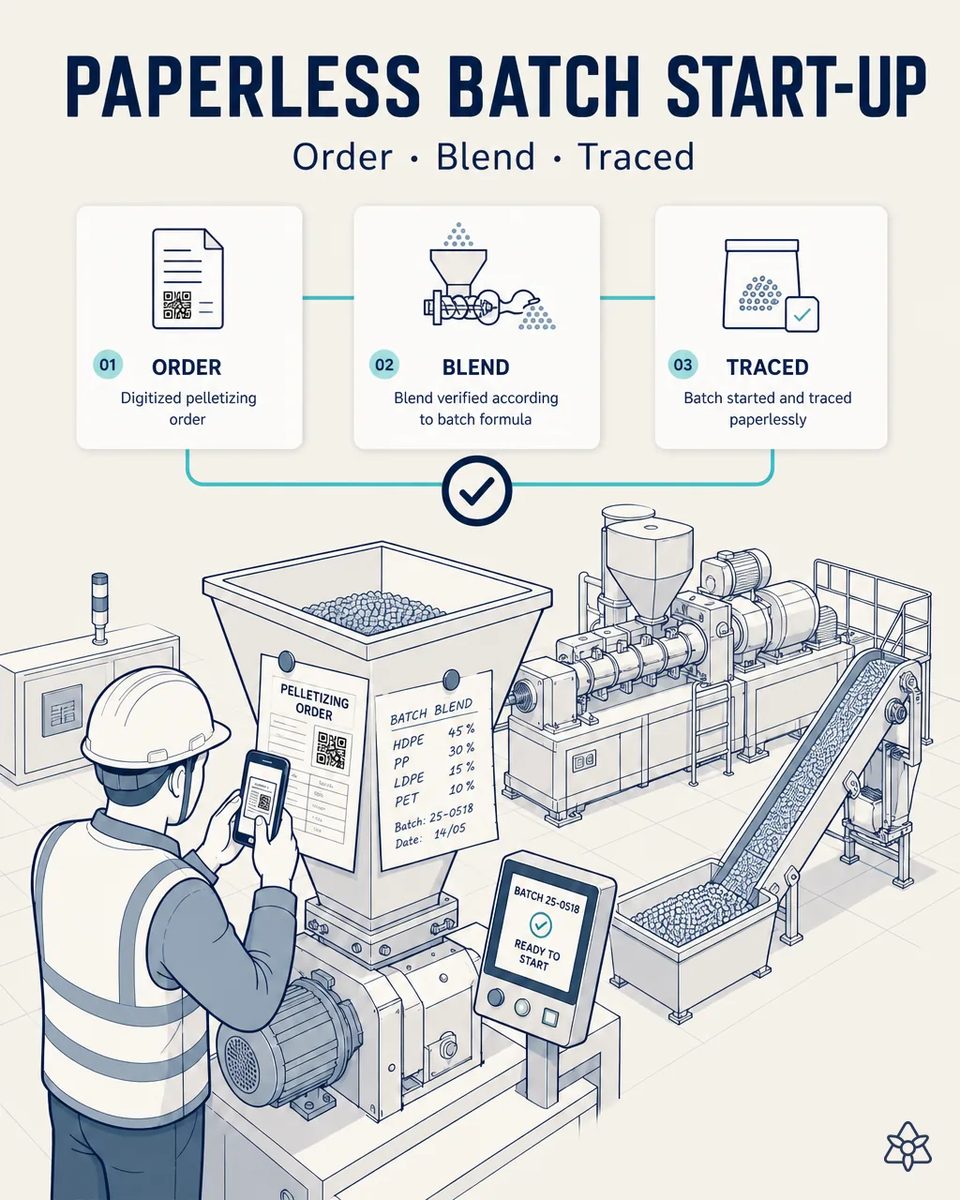
Paper is not the problem. The hours before it exists for the system are.
And today that sheet sits on the office desk until somebody collects it at the end of the day. Between start-up and the moment the data exists for the system, four to eight hours go by. When a customer complains three weeks later and someone has to answer which material that batch came from, the answer is on a piece of paper that has to be found, and that was sometimes filled in from memory.
- The blend sheet sits on the office desk until somebody collects it at the end of the day.
- Between start-up and the moment the data exists for the system, four to eight hours go by.
- When a customer complains three weeks later and you have to say what material that batch came from, the answer is on a sheet that has to be hunted down.
- And that was sometimes filled in from memory — which is worse than not having it: it gives a certainty that is not there.
Two photos at start-up — the operator fills in the same sheet as always.
With Connect, the operator takes two photos at start-up: the order and the blend sheet. Nothing in the routine changes, the sheet still gets filled in exactly as before. iLEAN recognises the structure of the document and extracts the fields: batch number, polymer, blend suppliers and their proportion, start-up temperature profile, screw speed and remarks. The result is that the batch exists in central memory at second zero, and it exists with the real blend rather than the planned one. That is what later makes it possible to correlate what a batch was made of with how it behaved: the melt flow index it returned, the colour, the fines load. Without this first step, no downstream root-cause analysis has anything to work with.
The batch exists in the central memory at second zero, and it exists with the real blend, not the planned one. That difference is what everything downstream rests on.
The blend sheet on paper vs. the sheet captured
| Aspect | On paper today | With iLEAN Connect |
|---|---|---|
| When the batch exists in the system | 4-8 h later, or at shift close | Second zero |
| Which blend is recorded | The planned one | The real one, supplier by supplier |
| Start-up profile and screw speed | On the sheet, cross-referenced with nothing | Tied to the batch |
| Answering a claim from three weeks back | Hunt for the sheet | A query by batch |
| A sheet filled in from memory | False certainty | The photo remains as evidence |
| Operator routine | — | Unchanged: still writing by hand |
Impact estimate — to validate against your numbers.
The block below is an estimate to be validated against your plant's actual data. We put it forward so the committee has an order of magnitude; we refine it during the assessment.
- Estimated payback 4-9 months, depending on batches per day.
- From 4-8 h of latency to traceability at second zero.
- Recovers the support team's transcription time, which today is half a day gone every week.
- And the real blend on record is the basis of root-cause analysis: without it, everything else measures on sand.
Payback 4-9 months · from 4-8 h of latency to traceability at second zero. Estimated payback is four to nine months depending on the number of batches per day. It gives the production manager back the transcription time, but the real value is elsewhere: inbound traceability stops depending on a sheet of paper not getting lost. This is an estimate to validate against the plant's actual volumes. Conservative ranges, an estimate to validate against the plant's real data.
And the fair question from the production manager
"What if it misreads one supplier's proportion?" — reading fields off a sheet with a known structure is an anchored task, where the best models drop below 1.5% error [1]. And nothing enters on its own: the summary goes to the tablet and somebody confirms or corrects it before it crosses into the system.
[1] OpenAI paper "Why Language Models Hallucinate", 2025 — on the reliability of AI in anchored tasks.
What people ask about digitising batch start-up
Does the blend sheet have to change?
No, and that is the condition. The sheet is tuned to how that plant works, and every attempt to replace it with a form on a screen ends with the operator writing on paper anyway and keying it in later.
Does it work with handwriting from several shifts?
Yes, because the model is not asked to guess: it is asked to fill fields on a sheet it already knows. A low-confidence field is flagged on the tablet instead of slipping through.
The blend changes several times in one shift. Is every change captured?
Every blend change is a start-up and is captured as one. In a plant running scrap from several origins that is the norm, not the exception.
Do we need coverage across the whole plant?
Not for this. The photo is taken on a phone and syncs when there is signal. What cannot wait for the network is process control, and that lives in Edge with local inference.
How long before it is running?
The AI Discovery is two weeks on one line. That defines which fields are captured, what they are validated against and which ERP interface is used; the rollout follows and is short, because no machine is touched.
More cases from this series
- When the file is the product, the file is not improvisedEvery certified destruction and critical changeover builds its own evidentiary dossier, ordered by…
- Find out here, not on the customer's lineFour verification rings from bale to big-bag, automatic release lock and live mass balance per batch and…
- One wrong keystroke can no longer stop the customer's linePolymer, grade, batch and certificate travel from the ERP to the printer with no keying, and no…
- The twenty-year-old pelletiser starts to talkCamera and OCR on the proprietary panel: the extruder process curve is digitised batch by batch without…
- Shift-floor judgement stops dying at the end of the shiftThe shift lead dictates while walking the floor; iLEAN structures it, ties it to the batch and answers…
- The melt flow index reaches the ERP before the truck reaches the customerMelt flow index and the rest of quality control reach the ERP on their own after sign-off, cutting…
Tell us how many hours pass today between a batch starting and the data reaching the system.
We work on your plant's real data, not ours. Assessment with no commitment.
Request estimated ROI within 48h ‹ See all cases of plastics recycling See plastics