Find out here, not on the customer's line
The capital pain of a plastics recycler and transformer is always the same, and it is not the variability of the material. The material is variable by nature and that is not going to be fixed. The pain is finding out late: that the off-spec batch gets discovered on the customer's line rather than on your own.
Approval takes years to build and is lost in a week.
When a batch with an out-of-range melt flow index, with cross-contaminated resin or with black specks reaches an injection moulder or a thermoformer, the customer's line stops. The whole truck comes back. A non-conformity is opened. And if the customer is pharmaceutical or demanding manufacturing, the approved-supplier status itself is at risk, which takes years to build and is lost in a week.
- When a batch with an out-of-range melt flow index, cross-contaminated resin or black specks reaches an injection or thermoforming machine, the customer's line stops.
- The whole truck comes back. A non-conformity is opened.
- And if the customer is pharmaceutical or a demanding manufacturer, supplier approval is put at risk.
- Approval that takes years to build and is lost in a week.
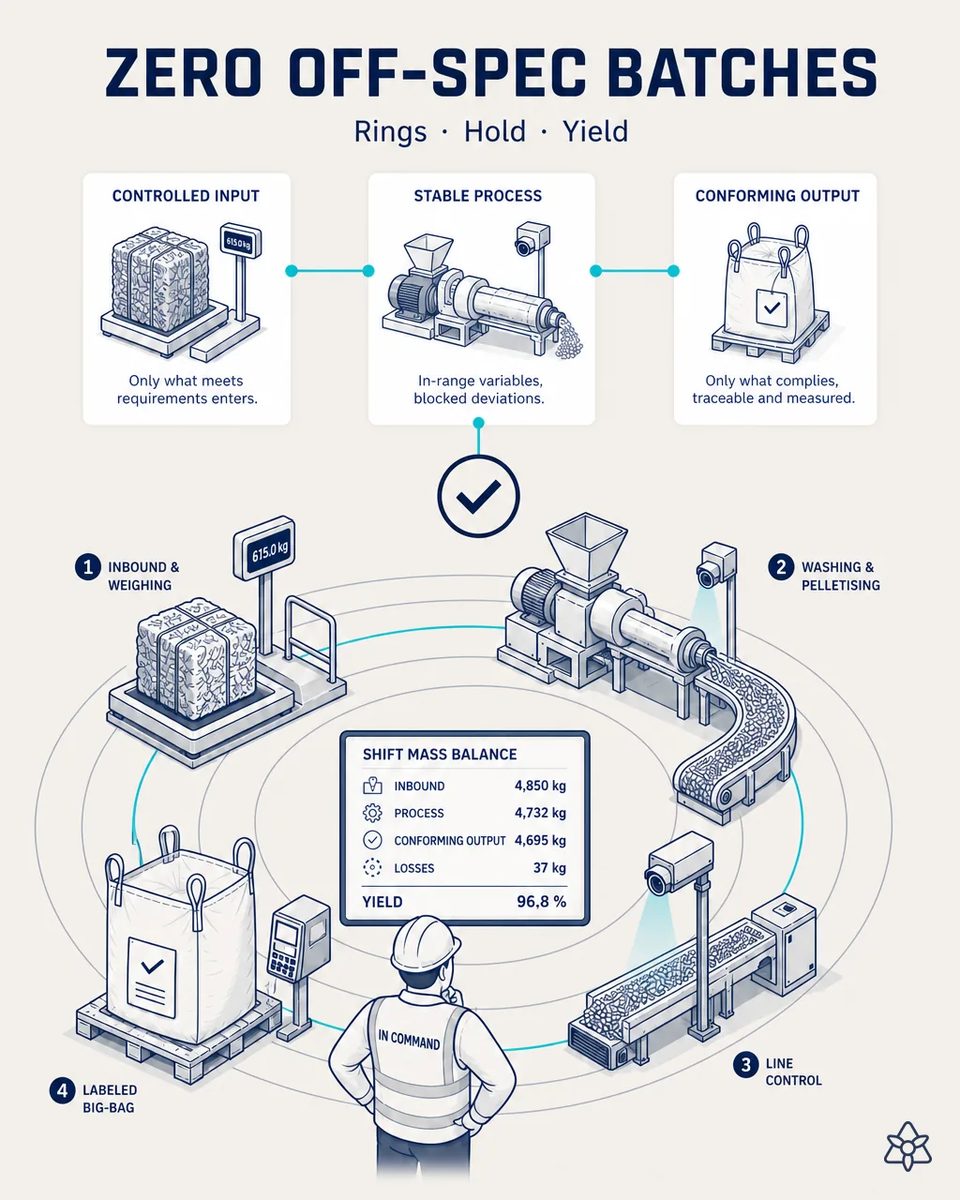
Four verification rings running from the bale to the big bag.
The flagship system coordinates the eleven previous pieces into four verification rings that run from the bale to the big-bag. The first is inbound: the real blend is recorded from the weighbridge and the blend sheet, so we know what every kilo is made of. The second is process: the pelletiser curve is read off the panel and tied to the batch, so deviation is visible while it is happening. The third is product. The Edge camera controls black specks, gels and colour continuously over the belt, and purge validation protects start-up after every changeover. If the defect crosses threshold, JIDOKA AI diverts the material and halts bagging. It does not alert somebody so they can decide: it stops the line, and then it alerts. The fourth is release, and it is the lock. The lab result reaches the ERP on its own, and the big-bag label is issued from the ERP. A batch with no validated result cannot be labelled, and what is not labelled does not ship. The auditable pack travels with the shipment. And SMED AI orders the grade changeovers so that the demands of the four rings are not paid for in productivity. Above the four rings sits a fifth thing, and for the P and L it may be the main one: live mass balance. Kilos in across the weighbridge against kilos of saleable pellet out, per batch and per shift, on the screen of the person who can correct it during the shift rather than the following month. In this business yield is margin, and today it is known once nothing can be done about it.
None of the eleven previous pieces solves this alone. What solves it is that all four share one central memory: a signal at intake can hold a big bag at dispatch.
The four rings, one by one
| Ring | What it secures | With what |
|---|---|---|
| 1 · Intake | What every kilo is made of | Weighbridge and blend sheet, with the real blend |
| 2 · Process | Seeing the deviation while it happens | The pelletiser curve tied to the batch |
| 3 · Product | Black specks, gels and colour | Continuous Edge over the belt |
| 4 · Evidence | That all of the above can be shown | Agents indexing by standard and period |
| Coordination | That intake can stop dispatch | One central memory shared by all four |
| Final decision | Release the big bag or hold it | Signed by a person |
Impact estimate — measured against the rejection, not the batch.
The block below is an estimate to be validated against your plant's actual data. We put it forward so the committee has an order of magnitude; we refine it during the assessment.
- Estimated payback 6-12 months measured against the first batch rejection avoided.
- And yield loss becomes visible by batch and by shift, where today it is a monthly figure with no assignable cause.
- Less exposure of your supplier approval, which is what is really at stake with a demanding customer.
- And the eleven pieces before this one stop being eleven separate projects and become one chain.
Payback 6-12 months against the first rejection avoided · and yield becomes visible per batch and shift. Estimated payback is six to twelve months measured against the first batch rejection avoided, and that only counts freight, material, rework and the customer's downtime. Protecting approved-supplier status is another order of magnitude and it is multi-year. An estimate to validate against the rejection history and the plant's real yield. Conservative ranges, an estimate to validate against the plant's real data.
And the fair question from the production manager
"Do we have to implement all twelve for this to work?" — no, and trying would be a bad idea. The rings are built in order: intake first, because it holds up the other three. Each ring pays on its own; what multiplies is that they share the same central memory.
[1] OpenAI paper "Why Language Models Hallucinate", 2025 — on the reliability of AI in anchored tasks.
What people ask about coordinating the four rings
Where do you start?
With the first ring, intake, because without knowing what every kilo is made of the other three measure on sand. It also tends to have the shortest payback.
How long until the full chain is running?
It depends on the number of lines and grades, but it is not framed as a single project: each ring goes into production on its own and pays from that moment.
Does this replace our quality system?
No. It leans on it and gives it what does not reach it today. Replacing the quality system of a certified plant is not an AI project, it is something else.
What happens if one ring fails?
The others carry on, and that is by design. What is avoided is the current situation, where one barrier failing is not seen by any of the others.
How do you measure whether it works?
By batches rejected by the customer and by yield loss per batch and shift. Both can be measured today, before starting, and the first is the one the customer decides on.
More cases from this series
- When the file is the product, the file is not improvisedEvery certified destruction and critical changeover builds its own evidentiary dossier, ordered by…
- The pellet batch is born traced, not on a sheet that gets lostPelletising order and blend sheet captured by photo: the pellet batch exists in the central system at…
- One wrong keystroke can no longer stop the customer's linePolymer, grade, batch and certificate travel from the ERP to the printer with no keying, and no…
- The twenty-year-old pelletiser starts to talkCamera and OCR on the proprietary panel: the extruder process curve is digitised batch by batch without…
- Shift-floor judgement stops dying at the end of the shiftThe shift lead dictates while walking the floor; iLEAN structures it, ties it to the batch and answers…
- The melt flow index reaches the ERP before the truck reaches the customerMelt flow index and the rest of quality control reach the ERP on their own after sign-off, cutting…
Tell us what the last batch a customer sent back cost you.
We work on your plant's real data, not ours. Assessment with no commitment.
Request estimated ROI within 48h ‹ See all cases of plastics recycling See plastics