Zero critical deviations and batch release in days — 4 rings coordinated by Agents
The capital pain of an exporting CMO hormonal pharma plant is double and simultaneous: zero critical deviations (Quality's primary metric) and cutting the batch release cycle from weeks to days (Ops' primary metric). iLEAN coordinates four cross-checking verification rings — the ERP + MBR, the suite signing, the coder + Edge, the evidence pack — so that neither a wrong serial, nor a cleaning without evidence, nor a documentary deviation leaves the plant. It is the flagship built so the Plant Director and the Technical Operations Director defend the same decision before the CFO and before Regulatory without translation.
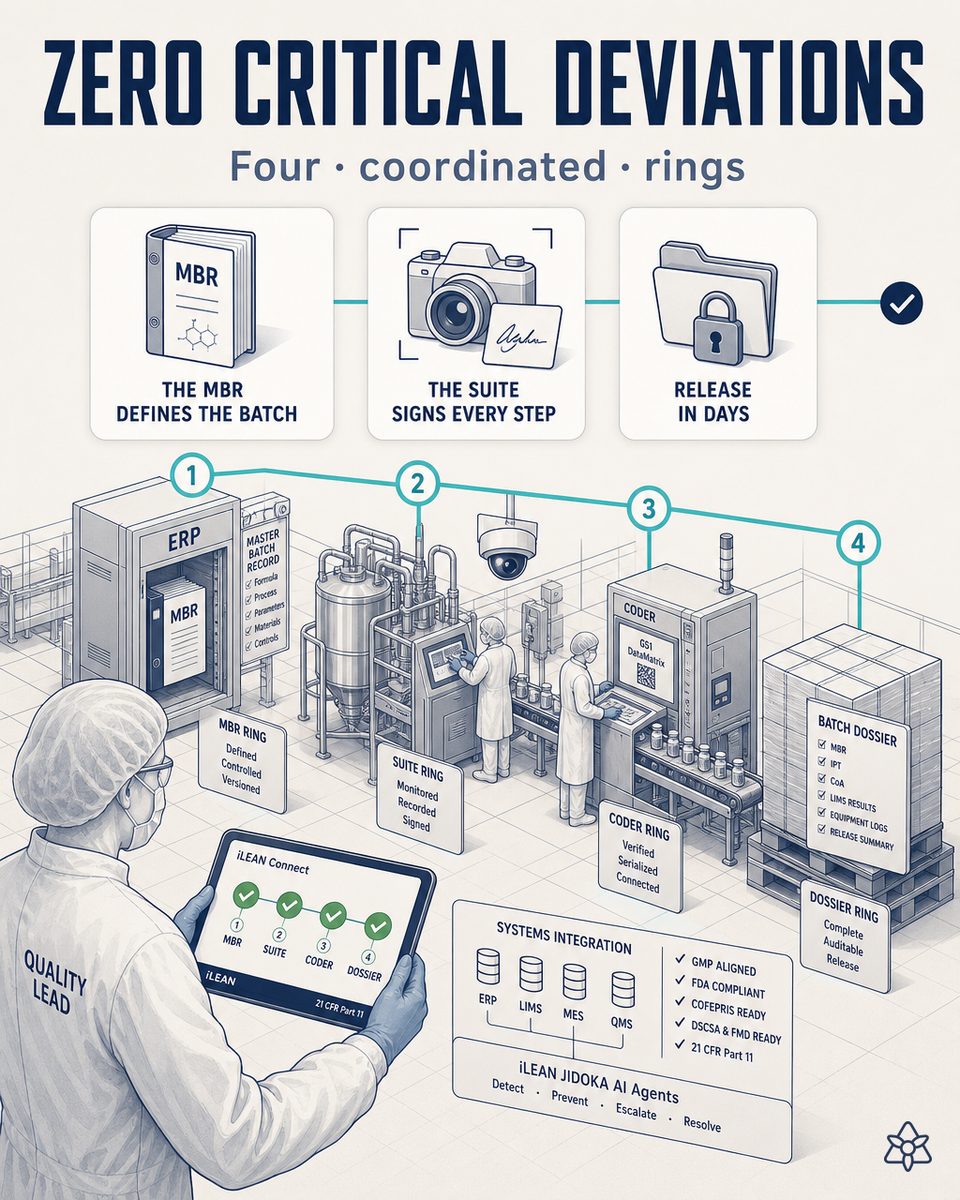
A critical deviation is not a quality incident: it is the CMO qualification at stake.
At a hormonal pharma site manufacturing for third parties and exporting, a critical deviation — cross-contamination between high-potency products, a serial mix-up, an OoS from a deviated process curve, a documentary gap in the batch record — costs between tens and hundreds of thousands of euros in direct terms. But the direct cost is the least of it: behind it comes the suspension of the CMO qualification and, in the worst case, an FDA warning letter whose impact drags for years over the site's ability to win and retain manufacturing contracts.
The error is almost never in the product. It lives in the coherence between four points that should say the same thing and sometimes do not: what the ERP and the MBR define at batch startup, what the suite executes and signs on the floor, what the coder prints and leaves serialized on the box, and what remains documented as evidence of every cleaning and every deviation when the batch is released. A mismatch at any of those four points is indistinguishable from the rest until the customer receiving the batch reads it or, worse, until the inspector detects it.
And there is a second front running in parallel: every week the QA-release cycle stretches is a week of delayed export revenue. The batch is manufactured, passes specification, but cannot be invoiced until Quality recomposes and signs the file. The two fronts — zero deviations and release in days — are not solved separately: either they are solved simultaneously or neither is, because both are born of the same problem of coherence and scattered evidence.
The 4 rings coordinated by Agents — the heart of the system.
No ring closes the risk on its own. What shields the site is that the four cross-check each other: each one verifies what the previous one said, and none lets a batch be released without the other three agreeing.
- Ring 1 · ERP + MBR. As the single source of truth, the ERP and the Master Batch Record define the batch, the potency, the excipients, the authorized serial range and the prior qualified cleaning enabling the line for that high-potency product. Everything that happens afterwards is measured against this definition, not against anyone's memory.
- Ring 2 · The suite signing. The suite executing on the floor signs every MBR photo and every granulator panel curve on the tablet, crossing them against the ERP's active specification. It is early human verification: the qualified professional signs the moment the data is generated, not days later reconstructing it — and that signature stays anchored to the specification it was compared against.
- Ring 3 · Coder + Edge. The coder publishes the serial from the ERP and an overhead Edge camera reads what was actually printed on the box and crosses it in real time against that authorized range. If it does not match — a serial mix-up, a box from another batch — JIDOKA AI blocks the line before the badly serialized product advances: there is no waiting for the error to pile up to detect it.
- Ring 4 · The evidence pack. Every batch is released with a dossier crossing the three previous rings — the ERP + MBR definition, the suite's signatures on photos and curves, and the coder + Edge serial verification — plus the evidence of every hormonal cleaning and of every deviation opened and closed. If the inspector or the customer asks, the answer already exists reconciled; nobody has to rebuild it by hand.
A fifth element is not a ring — it is what lets the four not penalize productivity: SMED AI accelerates the change between batches and high-potency products — its qualified cleaning sequence included — so coordinating four verification points does not mean penalizing OEE. The coordination protects without slowing down.
See the full IRIS architecture →
Satellite cases from the same site, with each ring's technical detail: coder + serializer (Ring 3) · hormonal cleaning validation with Edge (Ring 4) · the evidence pack for FDA and COFEPRIS (Ring 4).
Site without coordinated rings vs. site with the 4 iLEAN rings
| Aspect | Site without coordination | Site with the 4 iLEAN rings |
|---|---|---|
| Batch startup (potency, excipients, prior cleaning) | Read on paper or a screen, transcribed by hand into the floor's MBR | Ring 1 (ERP + MBR) defines batch, potency, serial range and qualified cleaning as the single source |
| MBR photos and granulator curves | Signed on paper and reviewed at closure, days later | Ring 2: the suite signs every photo and every curve on the tablet against the ERP's active specification |
| The box's serialization | Manual visual sampling; the mix-up is detected late or at the customer | Ring 3 (coder + Edge): the printed serial crossed 100%, JIDOKA AI blocks the line if it does not match |
| Evidence of hormonal cleaning and deviations | Scattered across paper and spreadsheets; recomposed at release | Ring 4 (evidence pack): a dossier reconciled in the moment, crossed with the other three rings |
| The batch release cycle | Weeks — QA reconstructs the complete file by hand | Days — review by exception; the file is already compiled |
| Critical deviations/year with warning letter risk | 1-3 per year | Zero — detection on the line, not at the customer or the auditor |
Impact estimate for your plant — to be validated with your own numbers.
The block below is an estimate to be validated against your plant's actual data. We put it forward so the committee has an order of magnitude; we refine it during the assessment.
- Exporting CMO site of high-potency hormonal solid forms, lines serialized for LATAM and regulated markets, a mix of products and potencies with qualified cleaning between changes.
- Pilot on the highest-risk line with the 4 rings coordinated — ERP + MBR, the suite signing, coder + Edge with JIDOKA AI and a per-batch evidence pack. First value within a few weeks starting with the coder + Edge ring.
- Quality's hard lever is protection against an FDA warning letter and the CMO qualification's suspension — a one-off impact above €1,000,000 and a multi-year drag on the site's contract portfolio.
- Ops' hard lever is the acceleration of the batch release cycle from weeks to days, with a direct impact on LATAM and export revenue: every batch is invoiced sooner because it is released sooner.
- Indicative payback between 6 and 12 months, counted against the first warning letter or the first Class-I recall avoided. With a single serious event avoided, the system pays for itself.
And the fair question: "what if the system itself gets it wrong?"
The right question from the Quality lead. Two answers that hold each other up. The technical one: hallucination is a problem of free generation, not of anchored tasks — reading a printed serial and comparing it with the range published by the ERP, or crossing an MBR photo against the active specification, are as anchored as tasks get. In tasks of this kind, the best models brought the error below 1.5% [1]. The architectural one: the system sits on the three IRIS safety rings — Connect transports, the Agents decide, the person signs. And because the case's 4 rings cross-check each other, an isolated failure in one is exposed by the other three before it becomes a deviation. It is not that everything passes through a person; it is that the system allows it where it matters — and here it matters.
[1] OpenAI paper "Why Language Models Hallucinate", 2025 — on the reliability of AI in anchored tasks.
What people ask about the iLEAN 4-ring system in hormonal pharma
Do the 4 rings have to be installed at once, or can we start in phases?
In phases — and that is the recommendation. Each ring protects on its own and deploys without waiting for the others. The most common sequence starts with Ring 3 (coder + Edge), because it is the one catching the serial mix-up just before the box leaves the line; then Ring 1 (ERP + MBR), so the batch, the potency, the excipients, the serial range and the prior qualified cleaning activate as the single source of truth without typing; then Ring 2 (the suite signing every MBR photo and every granulator curve); and finally Ring 4 (the evidence pack), which closes the circle by crossing the previous three. The zero critical deviations effect appears when the four cross-check each other — each ring acting as the previous one's witness — but the risk reduction starts with the first.
How exactly does it cut the batch release cycle from weeks to days?
The release's bottleneck is not QA's decision: it is the file's reconstruction. Today Quality spends most of the cycle recomposing the batch record by hand — reconciling the signed MBR, the granulator curves, the serial traceability, the hormonal cleaning records and the open deviations — because that evidence lives scattered across paper, spreadsheets and systems that do not talk. With the 4 rings, Ring 4 (the evidence pack) compiles that file in the moment, already reconciled and with every data point crossed against the other three rings: review by exception instead of full review. QA reviews what deviated, not everything that went well. The cycle goes from weeks to days because the recomposition work disappears. An estimate to be validated with your real release times.
How do you guarantee the system itself does not get it wrong — Quality's fair question?
Two answers that hold each other up, one technical and one architectural. Technical: hallucination is a problem of free generation, not of anchored tasks. Reading a printed serial and crossing it against the range published by the ERP, or comparing an MBR photo against the active specification, are anchored tasks — the best recent study (OpenAI's paper "Why Language Models Hallucinate", 2025) puts the best models' error in anchored tasks below 1.5%. Architectural: the system sits on the three IRIS safety rings — Connect transports, the Agents decide, the person signs. The critical verification never runs alone: there is always a person signing before releasing. And because the case's 4 rings cross-check each other (the ERP against the suite, the suite against coder + Edge, Edge against the evidence pack), an isolated failure in one ring is exposed by the other three before it becomes a deviation.
How long does the complete system take to be operational at a site?
The standard iLEAN method — a 3-5 day immersion with a mixed team (your site's people + embedded industrial AI engineers), Pareto applied, first value within a few weeks on the most urgent ring, and a pilot line with the 4 rings coordinated typically in 3-4 months. The rollout to the remaining lines, dosage forms and areas is replicated by your own people, trained in the pilot. Starting with a single ring (usually coder + Edge) delivers measurable value in weeks; coordinating the 4 is the complete project, but there is no need to wait for everything to start reducing the deviation risk and shortening the release cycle. An estimate to be validated with your project team.
What does Regulatory see of the system — is it validatable and auditable?
Regulatory sees a computerized system treated as such: a defined scope, a risk analysis, installation and operational qualification, and traceability of every decision. Every system verification leaves a record with who signed, when and against which ERP specification it was crossed — the same kind of evidence an FDA or COFEPRIS auditor expects from a batch record, but generated in the moment and not reconstructed. The AI does not release the batch: the person signs, and that signature stays anchored to the evidence pack. IRIS's human ring is precisely what makes the system defensible at an inspection: the qualified professional's judgment is not replaced, they are handed the already-reconciled file so they decide with the data in front of them. The evidence pack is the artifact Regulatory puts on the inspector's table.
More cases from this series
- iLEAN in regulated industry — five compliance pillars by design5 compliance pillars making iLEAN deployable in regulated pharma: audit trail, ALCOA+, non-invasive,…
- A pre-inspection evidence pack for FDA, COFEPRIS and ANVISA — zero documentary reconstructionZero hours of pre-audit reconstruction. iLEAN Agents organizes photo, log and signature by certifying…
- From the supplier’s email to the concrete action with no human latencyiLEAN Connect listens to the API supplier’s email and WhatsApp, crosses them with active orders and…
- From the delivery note and the CoA to the ERP with a single photo — 50-70% fewer receiving licensesAPI receiving in 5 min. iLEAN digitizes the delivery note, the Certificate of Analysis and the GS1…
- Coder and serializer stitched to the ERP — zero serial mix-upsBatch, serial and aggregation from the ERP to the coder with no typing. Zero serial mix-ups, eliminating…
- Giving the qualified granulator’s panel life without requalifying the assetAn external camera reads the qualified panel’s curve without touching the GMP asset. Zero…
Zero deviations and batch release in days — at the same time.
We work on your site's real data, not ours. Assessment with no commitment.
Request estimated ROI within 48h ‹ See all 13 hormonal pharma cases See pharma