From the supplier’s email to the concrete action with no human latency
In a hormonal pharma factory the API supplier's critical notices — a delay, a Certificate of Analysis deviation, a specification change — arrive to specific people who cannot watch the inbox in real time. iLEAN Connect is silently copied 24/7, crosses each message with the ERP's active orders and returns to the planner the concrete action before dispensing.
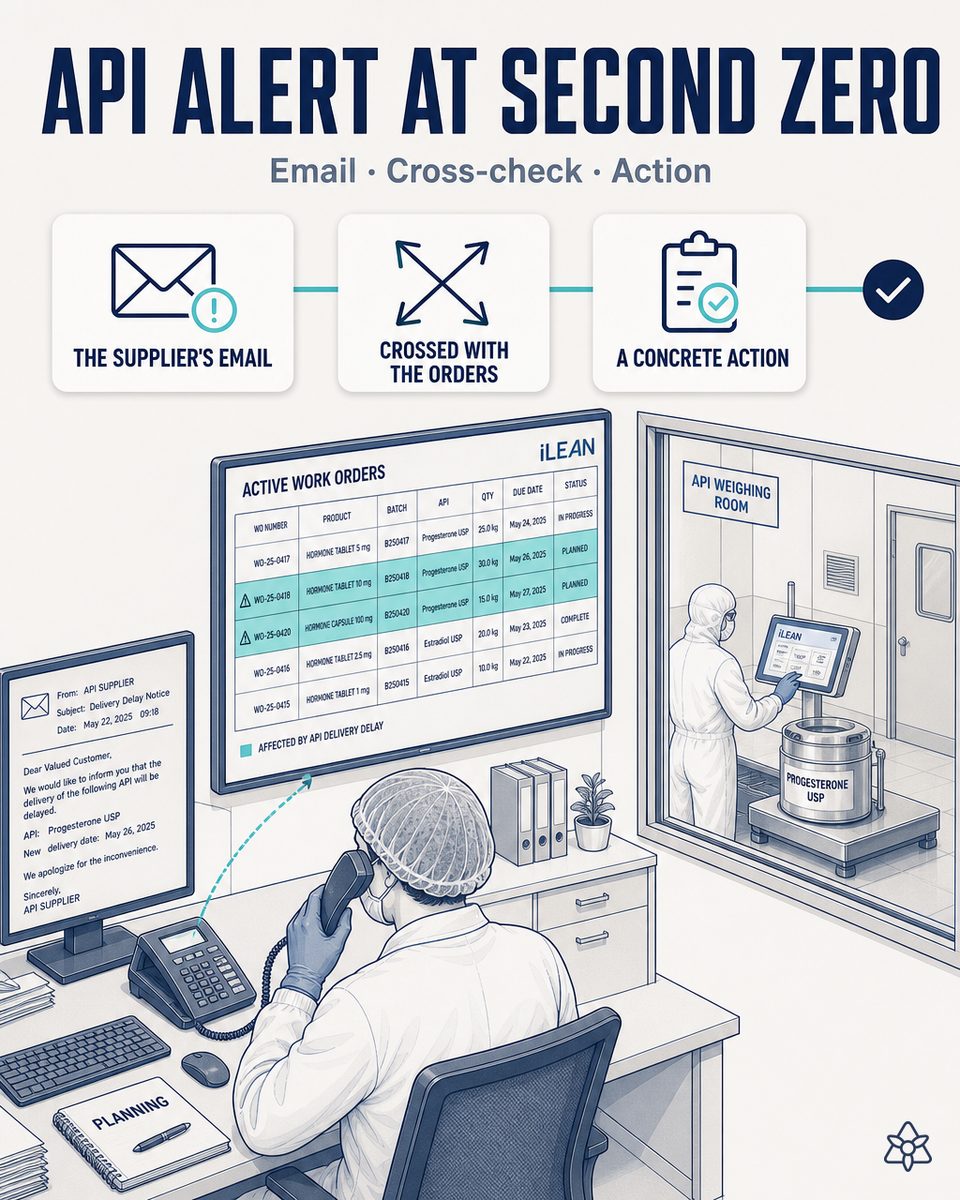
The API supplier's notice arrives on time. Whoever has to read it does not.
In a hormonal pharmaceutical plant the critical supply — API, qualified excipients — depends on messages that do arrive, but arrive in personal inboxes:
- At 09:15 an email enters from the supplier warning of a 72-hour delay on the API pallet expected that same afternoon.
- In parallel another enters with a deviation sheet on the Certificate of Analysis of an excipient already received and located in the warehouse.
By the time the purchasing manager or the planner reads them — because they were on the line, in an audit or in another meeting — there is already a qualified order starting with a material that will not arrive, or a batch about to be dispensed with deviated material. And in a GMP environment every badly informed decision is not only a delay: it is a candidate for a deviation and an investigation file that can keep QA weeks documenting what an email already said at 09:15. It is the inbox's natural bottleneck, not the factory's.
Connect in chaotic-sources mode — it listens to the supplier's email and WhatsApp before the batch is dispensed.
The supplier's notice needs no EDI integration project or ERP change. The message that already arrives by email or WhatsApp needs to be read, understood and crossed with the active orders and pending dispensings the instant it enters — without waiting for the right person to have a moment. That is what Connect in chaotic-sources mode is for.
A message enters the mailbox or WhatsApp Business. Connect reads it at second zero, extracts what the supplier is warning about and on which material and batch, and returns a concrete action to the planner. Nothing is touched in the ERP without a person confirming it.
How Connect operates in chaotic-sources mode on the API supplier's notices:
- A dedicated mailbox silently copied 24/7 plus the planner's WhatsApp Business — Connect receives a copy of the mail and of the WhatsApp Business number where the supplier's notices arrive, replacing nobody and without changing the channel the supplier already uses.
- The LLM extracts intent and entities — a delivery delay, a CoA deviation or a nonconformity as the intent; API or excipient, batch number and date as entities. In seconds, the message stops being loose text and becomes structured data.
- Immediate cross-reference with active orders and pending dispensings — Connect compares the extracted intent against the ERP's real state and detects which qualified orders and which dispensings are affected by the notice.
- A concrete action returned to the planner or Regulatory affairs — not a summary of the email, but a proposal landed on the real state: "reorder order X that depended on the delayed pallet, hold batch Y's dispensing, notify Regulatory of the CoA deviation on excipient Z". The person sees the option already built, they do not reconstruct it by reading the thread.
- Human confirmation before touching the ERP — Connect neither reorders nor holds anything on its own. The person confirms the action and only then does it move to the ERP or the production plan.
An inbox with no cross-reference vs. a supplier notice managed with Connect
| Aspect | Inbox with no cross-reference | Supplier notice with Connect |
|---|---|---|
| Detecting the critical notice | Email/WhatsApp read when the planner or purchasing has a moment — 2-3 h of human latency | Read and extracted in seconds, 24/7 |
| Cross-reference with active orders and dispensings | Manual, reviewing the plan and the warehouse by hand | Automatic, against the ERP's state at second zero |
| The replanning decision | With the ERP's picture from when the person finally reads the message | Based on the ERP's state at the notice's second zero |
| A dispensing with deviated material | Dispensed anyway — a deviation and an investigation file for QA | A hold proposed before dispensing — the deviation avoided |
| Confirmation before touching the ERP | Not applicable, the whole circuit is manual | Human confirmation required, nothing executes alone |
| The notice's traceability | Reconstructing the email/WhatsApp thread after the fact | Message, extraction and action archived by order and batch |
Impact estimate for your plant — to be validated with your own numbers.
The block below is an estimate to be validated against your plant's actual data. We put it forward so the committee has an order of magnitude; we refine it during the assessment.
- Hormonal pharmaceutical plant with critical supply of API and qualified excipients from one or several suppliers.
- Connect pilot in chaotic-sources mode on the dedicated mailbox and the purchasing and planning team's WhatsApp Business — without touching the ERP except on human confirmation. First value expected within a few weeks.
- Indicative payback between 3 and 7 months, depending on the frequency of critical supplier notices your plant handles. Estimate to be validated.
- Expected avoidance of deviations from dispensing with deviated material — every investigation file avoided is weeks of QA not consumed. Estimate to be validated with your data.
- The hard lever is a dispensing held in time: the same batch about to start with deviated material or without available API gets replanned because the notice was read at second zero.
And the fair question from the production manager
"What if Connect misinterprets an email and holds a dispensing it should not have?" — hallucination is a problem of free generation, not of anchored tasks. In tasks where the AI limits itself to recontextualizing a specific data point from one medium to another (reading a supplier's notice and comparing it with the ERP's open orders), the best models brought the error below 1.5% [1]. And even then, nothing critical is decided alone: Connect proposes the action and the person confirms before touching the ERP. The three safety rings are there precisely for this.
[1] OpenAI paper "Why Language Models Hallucinate", 2025 — on the reliability of AI in anchored tasks.
What people ask about API supplier notices in hormonal pharma
How does Connect tell a critical supplier notice from a routine one?
Connect does not turn everything entering the mailbox into an alert: the LLM first extracts the message's intent (a delivery delay, a Certificate of Analysis deviation, a specification change, a nonconformity — or a simple shipment confirmation or an invoice with no effect on production) and the entities it refers to (API or excipient, batch number, date, quantity). Only when that intent affects an active order or a pending dispensing in the ERP does the message become an actionable alert for the planner or Regulatory affairs. An acknowledgment, a commercial notice or a message unrelated to any material in play generates no action — it is archived, adding no noise.
Is there a risk of Connect acting alone on the ERP unsupervised?
No. Connect proposes, it does not execute. When it detects a notice affecting an active order or a pending dispensing, it returns a concrete action — reordering an order, holding a dispensing, escalating a CoA deviation to Regulatory affairs — but that action stays in proposal state. Nothing moves to the ERP, the production plan or the batch's documentation until a person confirms the change. In a GMP environment that is not a nuance: it is the same three-safety-rings principle governing the rest of the IRIS system — the critical is not decided alone.
What happens if the supplier's message is ambiguous or incomplete?
If the message does not allow clearly extracting which material, which batch or which date is affected, Connect does not guess: it flags the message as incomplete, shows the planner which data is missing and which orders or dispensings are candidates based on what was understood, and waits for the person to complete or confirm before suggesting an action. We prefer an alert with a visible gap over a hold proposed on an assumption — in pharma, acting on a forced reading of an email is as dangerous as not reading it in time.
How does Connect connect to WhatsApp Business securely?
Connect integrates with the purchasing or planning team's official WhatsApp Business API, as a silent copy on the conversation with the supplier — it does not connect to personal numbers or scrape chats. Access is limited to the conversations relevant to supply, messages are processed encrypted and the history is archived by order and by material batch — a traceability that in a regulated plant additionally adds up: the notice's thread stays linked to the affected batch, available if QA needs it in an investigation.
What about notices arriving after hours?
Connect reads and extracts the notice's intent at second zero, 24 hours a day, including outside the planner's or the purchasing manager's hours. What changes after hours is not the reading, but the execution: the proposal — reordering the order, holding the dispensing planned for the shift's start — is prepared and prioritized by impact, ready for the person to confirm as soon as they return to their post, instead of discovering the delay or the deviation with the batch already dispensed and the deviation already open.
More cases from this series
- iLEAN in regulated industry — five compliance pillars by design5 compliance pillars making iLEAN deployable in regulated pharma: audit trail, ALCOA+, non-invasive,…
- A pre-inspection evidence pack for FDA, COFEPRIS and ANVISA — zero documentary reconstructionZero hours of pre-audit reconstruction. iLEAN Agents organizes photo, log and signature by certifying…
- From the delivery note and the CoA to the ERP with a single photo — 50-70% fewer receiving licensesAPI receiving in 5 min. iLEAN digitizes the delivery note, the Certificate of Analysis and the GS1…
- Coder and serializer stitched to the ERP — zero serial mix-upsBatch, serial and aggregation from the ERP to the coder with no typing. Zero serial mix-ups, eliminating…
- Giving the qualified granulator’s panel life without requalifying the assetAn external camera reads the qualified panel’s curve without touching the GMP asset. Zero…
- The IPT lead’s earpiece — operational knowledge enters the system in real timeThe Production Lead dictates walking between suites and iLEAN structures it as a preliminary deviation…
Let the purchasing inbox stop being the bottleneck before dispensing. Tell us your case and we will send the estimated ROI within 48h.
We work on your plant's real data, not ours. Assessment with no commitment.
Request estimated ROI within 48h ‹ See all 13 hormonal pharma cases See pharma