From the delivery note and the CoA to the ERP with a single photo — 50-70% fewer receiving licenses
The hormonal API truck stops blocking the receiving manager for an hour. iLEAN Connect digitizes the delivery note, the Certificate of Analysis and the containers' GS1 DataMatrix labels and links them to the batch in the ERP and the LIMS after an electronic signature. Typical saving of 50-70% in receiving module licenses.
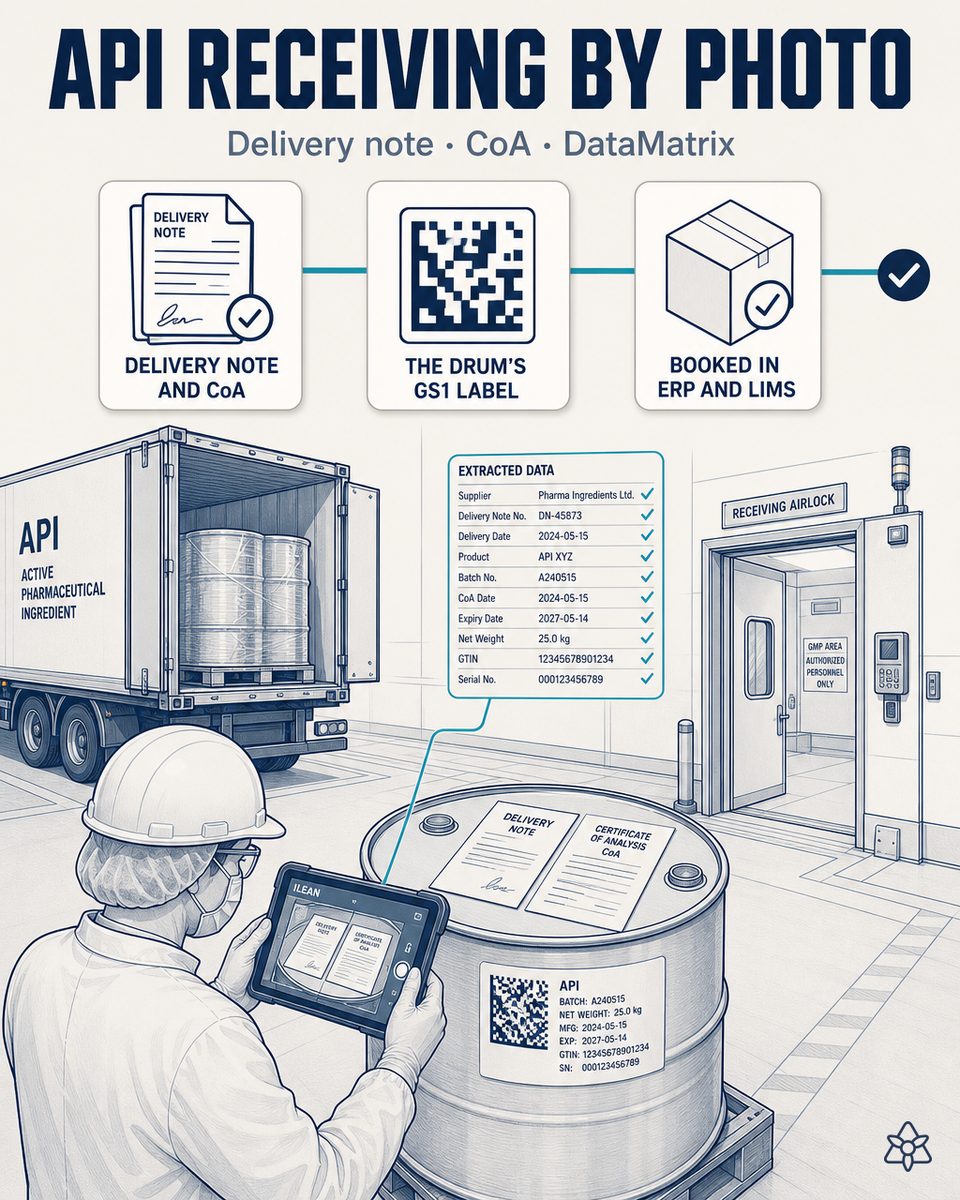
API receiving is where the manager gets blocked — and where the documentary deviation Quality lives with year after year is born.
In a hormonal pharmaceutical plant, receiving each API truck rests on three documents at once, and today all three pass through the receiving manager's typing:
- The delivery note — 8-12 lines of material, batch, quantity and containers, typed by hand into the ERP while the truck waits at the dock charging demurrage.
- The Certificate of Analysis (CoA) — the manufacturer's certificate with potency, impurities, moisture and particle size. Today it is attached by hand to a shared folder, in the hope someone associates it correctly with the batch.
- The containers' labels — GS1 DataMatrix, QR or plain text depending on the supplier, cross-checked from memory against the delivery note, drum by drum.
Between the truck arriving and the last container being registered, a typical 45 minutes pass, with the carrier billing the wait. And if the manager goes fast to release it sooner, they enter batches wrong or lose the CoA↔batch association — an error that does not appear in the moment, but 3 weeks later, in an incoming-material traceability finding: the classic documentary deviation Quality lives with year after year.
Connect in photo-the-analog mode — delivery note, CoA and GS1 DataMatrix labels linked to the batch with no typing.
API receiving needs no new dock station and no suppliers changing their documentation. The paper delivery note, the manufacturer's CoA and the labels the containers already carry need to reach the ERP and the LIMS at second zero, linked to the right batch. That is what Connect in photo-the-analog mode is for.
The receiving manager photographs the delivery note, the CoA and the containers' labels with the dock's industrial tablet. AI vision extracts the fields, validates the critical parameters against the ERP's specification and, after the electronic signature, everything is linked to the batch in the ERP and the LIMS — the truck has not waited for the typing.
How Connect photo operates at hormonal API receiving:
- A photo of the delivery note — AI vision recognizes each supplier's delivery note format, with no predefined templates, and digitizes its 8-12 lines by OCR in seconds, without anyone transcribing a single line.
- A photo of the Certificate of Analysis — AI vision identifies the CoA's critical parameters (potency, impurities, moisture, particle size) even if each manufacturer presents them differently, and validates them against the material's specification in the ERP.
- Container label reading — Connect recognizes GS1 DataMatrix, QR or plain text by OCR, whatever each drum carries, with the tablet's camera and no dedicated scanner.
- Validation with an electronic signature — the receiving manager reviews what was extracted on the industrial tablet; if a CoA parameter is out of specification or a label does not match the delivery note, Connect flags it before the signature. The person decides, not the system.
- Linking to the batch in the ERP and LIMS — after the electronic signature, the delivery note is recorded in the ERP and the CoA linked to the batch also in the LIMS, with complete incoming-material traceability from minute zero.
API receiving with manual typing vs. receiving digitized with Connect
| Aspect | Receiving with manual typing | Receiving digitized with Connect |
|---|---|---|
| Truck time at the dock | A typical 45 min, charging demurrage | 5 min — a photo and an electronic signature on the tablet |
| Recording the delivery note | 8-12 lines typed by hand into the ERP | A photo of the note — automatic OCR extraction |
| The Certificate of Analysis | Attached by hand to a shared folder | Linked to the batch in the ERP and the LIMS after the signature |
| The CoA's critical parameters | Reviewed by eye, time permitting | Validated against the ERP's specification before signing |
| Batch errors and CoA↔batch unlinking | Appear 3 weeks later, as a documentary deviation | Zero — flagged and corrected at the dock |
| Incoming-material traceability | Broken — reconstructed by hand at every finding | Complete by photo and GS1 DataMatrix from receiving |
Impact estimate for your plant — to be validated with your own numbers.
The block below is an estimate to be validated against your plant's actual data. We put it forward so the committee has an order of magnitude; we refine it during the assessment.
- Hormonal pharmaceutical plant receiving API from several manufacturers: one receiving dock, several trucks a week, 8-12 delivery note lines and a multipage CoA per batch.
- Connect photo pilot on receiving — only the dock's industrial tablet, with no construction work or new supplier integration. First value expected within a few weeks.
- Estimated reduction of the ERP's receiving/materials module licenses: -50% to -70%, going from several typing-license stations to one validation station with an electronic signature. Estimate to be validated.
- Elimination of the LIMS's bulk capture module: the CoA's parameters enter linked to the batch from receiving, with no later recapture in the laboratory. Estimate to be validated.
- Indicative payback between 3 and 8 months, plus a recurring saving in licenses, carrier demurrage hours and avoided documentary deviations. Estimate to be validated with your data.
- The CFO's hard lever is double: fewer ERP and LIMS licenses in the incoming-material chain and fewer truck hours charging demurrage at the dock — both measurable from the pilot's first month.
And the fair question from the plant manager
"What if the system misreads the CoA or links a certificate to the wrong batch?" — hallucination is a problem of free generation, not of anchored tasks. In tasks where the AI limits itself to recontextualizing a specific data point from one medium to another (reading the delivery note, the CoA and the printed labels and extracting their fields), the best models brought the error below 1.5% [1]. And even then, nothing critical is decided alone: if a parameter does not match the specification, Connect holds the container and the person electronically signs the validation on the tablet. The three safety rings are there precisely for this.
[1] OpenAI paper "Why Language Models Hallucinate", 2025 — on the reliability of AI in anchored tasks.
What people ask about API receiving in a hormonal pharmaceutical plant
What happens if the container's GS1 DataMatrix label is damaged or illegible?
Connect first tries the GS1 DataMatrix reading; if the label is damaged, wrinkled or partially covered — common on a drum that has passed through a cold room or a long transport —, it automatically falls back to reading the alternative QR if one exists and, ultimately, to OCR of the plain text printed next to the code (batch, expiry, net content). If no reading reaches the reliability threshold, Connect does not invent the data: it flags the container as pending manual verification and the receiving manager enters it on the tablet, container by container, without blocking the rest of the unload or compromising the batch link.
How does Connect validate the Certificate of Analysis against the specification?
AI vision locates the CoA's critical parameters — potency, impurities, moisture, particle size — even if each manufacturer presents them with different formats and units, and compares them one by one against the material specification in force in the ERP. If a value is out of range or a specification-required parameter is missing, Connect flags it on the tablet before the electronic signature: the person decides whether to accept, quarantine the batch or open a query with the supplier. The system approves or rejects nothing on its own — it only guarantees the out-of-specification does not go unnoticed at the dock.
Which delivery note and CoA formats does Connect recognize?
AI vision recognizes each document's format without predefined templates: paper delivery notes of any size with 8-12 lines, digital delivery notes in PDF or email, and multipage CoAs with result tables in each API manufacturer's own format. There is no need for all suppliers to use the same layout or for the supplier to change anything: when a new manufacturer enters the supplier panel, Connect learns its format with the first receivings and the receiving manager's flow stays the same — a photo, a review on the tablet and an electronic signature.
What changes for the carrier at the dock?
Nothing in how they work: they deliver the delivery note and the shipment's documentation, and wait for the receiving to be recorded before leaving. What changes is how long that wait lasts and how much it costs. Instead of waiting for the receiving manager to type 8-12 lines into the ERP and file the CoA by hand — with the demurrage clock running —, they wait for the photos to be taken and the tablet to be signed: minutes, not three quarters of an hour. The carrier installs nothing, needs no app and does not change how they hand over the documentation.
What about suppliers that do not use standard GS1 labeling?
Connect does not require the supplier to label with GS1 DataMatrix to digitize the receiving. If the container only carries a manufacturer's own label with printed batch and expiry, or even handwritten notes, Connect reads whatever is there by plain OCR and crosses it just the same against the delivery note, the CoA and the expected purchase order in the ERP. Automatic coverage is lower than with a standard code — more cases ask for manual confirmation on the tablet —, but the receiving manager still does not type the whole receiving by hand and the CoA↔batch link is recorded all the same.
More cases from this series
- iLEAN in regulated industry — five compliance pillars by design5 compliance pillars making iLEAN deployable in regulated pharma: audit trail, ALCOA+, non-invasive,…
- A pre-inspection evidence pack for FDA, COFEPRIS and ANVISA — zero documentary reconstructionZero hours of pre-audit reconstruction. iLEAN Agents organizes photo, log and signature by certifying…
- From the supplier’s email to the concrete action with no human latencyiLEAN Connect listens to the API supplier’s email and WhatsApp, crosses them with active orders and…
- Coder and serializer stitched to the ERP — zero serial mix-upsBatch, serial and aggregation from the ERP to the coder with no typing. Zero serial mix-ups, eliminating…
- Giving the qualified granulator’s panel life without requalifying the assetAn external camera reads the qualified panel’s curve without touching the GMP asset. Zero…
- The IPT lead’s earpiece — operational knowledge enters the system in real timeThe Production Lead dictates walking between suites and iLEAN structures it as a preliminary deviation…
API receiving in 5 minutes — tell us your case and we will send within 48h the estimated ROI for your hormonal pharmaceutical plant.
We work on your plant's real data, not ours. Assessment with no commitment.
Request estimated ROI within 48h ‹ See all 13 hormonal pharma cases See pharma