iLEAN in regulated industry — five compliance pillars by design
That iLEAN is deployable in a regulated industry like pharmaceuticals is not commercial talk: it is an architecture decision. Five pillars sustain that decision and are checked one by one with Regulatory affairs — an immutable audit trail, ALCOA+ data integrity, non-invasive over qualified systems, humans in command with a 21 CFR Part 11 electronic signature, and change control of the LLM model and the CNN model. Each of the sub-sector's 12 cases lands at least one of these pillars.
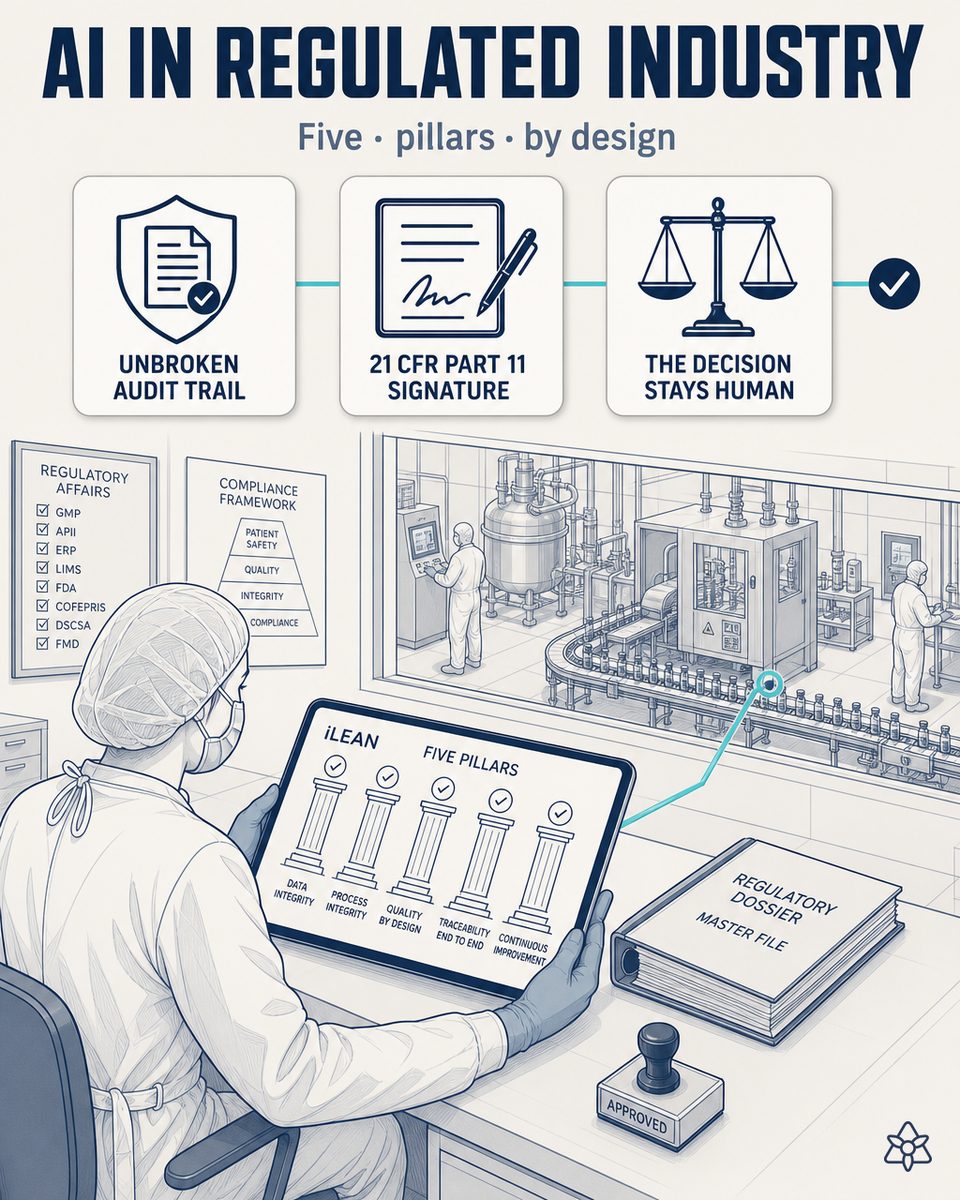
"Can iLEAN be deployed here without breaking cGMP, 21 CFR Part 11 and GxP?" — the question that decides everything else.
In the first conversation with a pharma site it is common for Regulatory affairs to raise, or for the Technical Operations Director / Quality Lead to ask outright: "Can iLEAN be deployed here without breaking cGMP, 21 CFR Part 11 and GxP?". It is the right question — and it deserves a structural answer, not a slide. Without it:
- The doubt reappears in every case — every new Connect, Edge or Agents piece presented afterwards reopens the same compliance conversation from scratch, and slows every pilot even when the business case is clear.
- Regulatory becomes a late blocker instead of a project counterpart: they enter at the end, when expectations are already set, and rightly demand what nobody presented at the start.
- At sites that have already lived through FDA/COFEPRIS audits with documentary gap findings, the question weighs even more: nobody will introduce a new system that could open another finding.
iLEAN's answer is not "trust us". It is a five-pillar compliance contract checked pillar by pillar, with Regulatory affairs at the table.
The compliance contract: five pillars checked one by one with Regulatory affairs.
The five pillars are not roadmap promises: they are architecture decisions already taken, and each can be verified separately against the site's regulatory framework. None depends on the others being accepted first.
Deployable by design: each pillar is checked separately, and each of the sub-sector's 12 cases lands at least one.
The five pillars, one by one:
- 1 · An immutable audit trail — every iLEAN event stays with the qualified user, a timestamp, a structured meaning and a hash: an auditable electronic record, with retention configurable per the site's documentary policy. What happened, who did it and why, verifiable event by event.
- 2 · ALCOA+ data integrity — Attributable, Legible, Contemporaneous, Original, Accurate + Complete, Consistent, Enduring, Available: fulfilled by design on every capture, not as a documentary layer added after the fact.
- 3 · Non-invasive over GMP-qualified systems — Connect photographs vintage panels, reads shared folders and listens to mailboxes without touching the qualified SCADA's network or the LIMS's core: zero revalidation of the original asset.
- 4 · Humans in command with a 21 CFR Part 11 electronic signature — nothing enters the batch record without the qualified operator's signature, with a 2-second tablet validation at the line. The AI proposes; the qualified person decides and signs.
- 5 · Change control of the LLM model and the CNN model — versioned models with a deployment date and an application scope; any version change passes through the site's internal change control before reaching production.
Loose doubts at every meeting vs. a five-pillar contract closed from minute 1
| Aspect | Loose doubts at every meeting | Five-pillar contract from minute 1 |
|---|---|---|
| The first conversation with Regulatory | Loses 30–60 min answering loose doubts (estimate to be validated) | Structured around the 5-pillar contract, closing each point separately |
| Regulatory affairs' role | A late blocker — entering at the end, with expectations already set | A project counterpart from minute 1 |
| Compliance doubts per case | Reappear in every Connect, Edge or Agents case and slow every pilot | Closed once — the same contract covers the sub-sector's 12 cases |
| Qualified systems (SCADA, LIMS) | Fear of asset revalidation with every new system | Non-invasive: the original asset's validated state does not change |
| Traceability before FDA/COFEPRIS | A documentary gap as a latent finding risk | An immutable audit trail + ALCOA+ by design on every capture |
Impact estimate for your plant — to be validated with your own numbers.
The block below is an estimate to be validated against your plant's actual data. We put it forward so the committee has an order of magnitude; we refine it during the assessment.
- Hormonal pharmaceutical site under cGMP, 21 CFR Part 11 and GxP, with a qualified SCADA and a LIMS in production — the scenario where Regulatory's question arrives at the first meeting.
- The compliance contract is landed on your site in a 30-minute session with Regulatory affairs: pillar by pillar, against your specific documentary framework.
- Each of the sub-sector's 12 cases lands at least one of the five pillars: with the contract closed once, no pilot restarts the compliance conversation from scratch.
- Without this contract, the other 12 cases' ROIs do not materialize — not because the technology fails, but because no pilot starts at a regulated site with the compliance doubt open.
And the fair question from Regulatory affairs
"What if the model gets it wrong inside a regulated process?" — that is why pillar 4 exists: humans in command means nothing enters the batch record without the qualified operator's signature, and the iLEAN models' work is an anchored task — reading, structuring and organizing the site's real data, not free generation. In anchored tasks, the best models brought the error below 1.5% [1]. And with pillar 5, any result is traceable to the exact model version that produced it.
[1] OpenAI paper "Why Language Models Hallucinate", 2025 — on the reliability of AI in anchored tasks.
What Regulatory affairs asks about the compliance contract
Does the audit trail meet retention and is it truly immutable?
Every iLEAN event is recorded with the qualified user, a timestamp, a structured meaning and a hash, in an append-only auditable electronic record: events are added, never edited or deleted. Each record's hash makes any later alteration detectable at verification — no silent modification is possible. Retention is configurable per the site's documentary policy (by record type and the period cGMP demands), and the complete trail is exportable in a readable format for inspection, so Regulatory affairs can review it event by event without depending on iLEAN.
How does it demonstrate ALCOA+ on a photo capture?
Take a Connect capture over a vintage panel: the photo is attributed to the qualified user originating it (Attributable), its metadata and the extracted data are legible throughout the lifecycle (Legible), the timestamp is generated at the capture's moment, not later (Contemporaneous), the original image is kept unedited next to the interpreted data (Original), and the qualified operator's validation confirms the data is correct before it enters the record (Accurate). The "+" is also covered: the event includes complete context (Complete), the format is the same on every capture (Consistent), configurable retention makes it enduring (Enduring) and it is available for inspection at any time (Available).
What does non-invasive mean for a qualified SCADA?
It means iLEAN installs nothing inside the qualified system and does not connect to its network: Connect photographs the vintage panels from outside, reads the shared folders where the system already deposits files and listens to the mailbox where notifications already arrive. The qualified SCADA and the LIMS's core receive not a single new line of code, no driver, no additional connection. Since the original asset's validated state does not change, its revalidation is not triggered: iLEAN is qualified as a new, independent system, under the computerized systems validation approach the site itself already uses.
Does the signature comply with 21 CFR Part 11 subparts B and C?
Yes, and it is checkable subpart by subpart. For subpart B (electronic records): a secure, timestamped audit trail, exact and complete copies for inspection, configurable retention and per-qualified-user access controls. For subpart C (electronic signatures): the signature is unique per person and neither reusable nor reassignable, it is composed of the required identification components and stays indelibly bound to its record, with the signer's name, date/time and the signature's meaning. In operation, nothing enters the batch record without the qualified operator's signature — with a 2-second tablet validation at the line, so compliance does not slow the shift.
How does change control of an AI model work?
Just like any other critical component of the site's, and it applies to both the LLM model and the CNN model: each model is versioned, with a documented deployment date and application scope. A version change does not reach production by iLEAN's decision: it passes through the site's internal change control — an impact assessment, verification within the defined scope and quality's approval — before operating on real data. Moreover, the audit trail records which model version intervened in each event, so any historical result is traceable to the exact version that produced it, also after several model changes.
More cases from this series
- A pre-inspection evidence pack for FDA, COFEPRIS and ANVISA — zero documentary reconstructionZero hours of pre-audit reconstruction. iLEAN Agents organizes photo, log and signature by certifying…
- From the supplier’s email to the concrete action with no human latencyiLEAN Connect listens to the API supplier’s email and WhatsApp, crosses them with active orders and…
- From the delivery note and the CoA to the ERP with a single photo — 50-70% fewer receiving licensesAPI receiving in 5 min. iLEAN digitizes the delivery note, the Certificate of Analysis and the GS1…
- Coder and serializer stitched to the ERP — zero serial mix-upsBatch, serial and aggregation from the ERP to the coder with no typing. Zero serial mix-ups, eliminating…
- Giving the qualified granulator’s panel life without requalifying the assetAn external camera reads the qualified panel’s curve without touching the GMP asset. Zero…
- The IPT lead’s earpiece — operational knowledge enters the system in real timeThe Production Lead dictates walking between suites and iLEAN structures it as a preliminary deviation…
Deployable by design is proven pillar by pillar — bring Regulatory affairs to the table and we will close the compliance contract against your documentary framework.
We work on your site's real data, not ours. Assessment with no commitment.
See the contract landed on your site in 30 min ‹ See all 13 hormonal pharma cases See pharma