Giving the qualified granulator’s panel life without requalifying the asset
The GMP-qualified wet granulator or rotary press lives with an isolated proprietary SCADA. Changing the asset costs more than half a million euros and months of stoppage. iLEAN Connect places an external industrial camera aimed at the panel and digitizes the process curve into central memory without touching the original asset and without demanding GMP revalidation. It is the compliance contract's "non-invasive" pillar landed on a real asset.
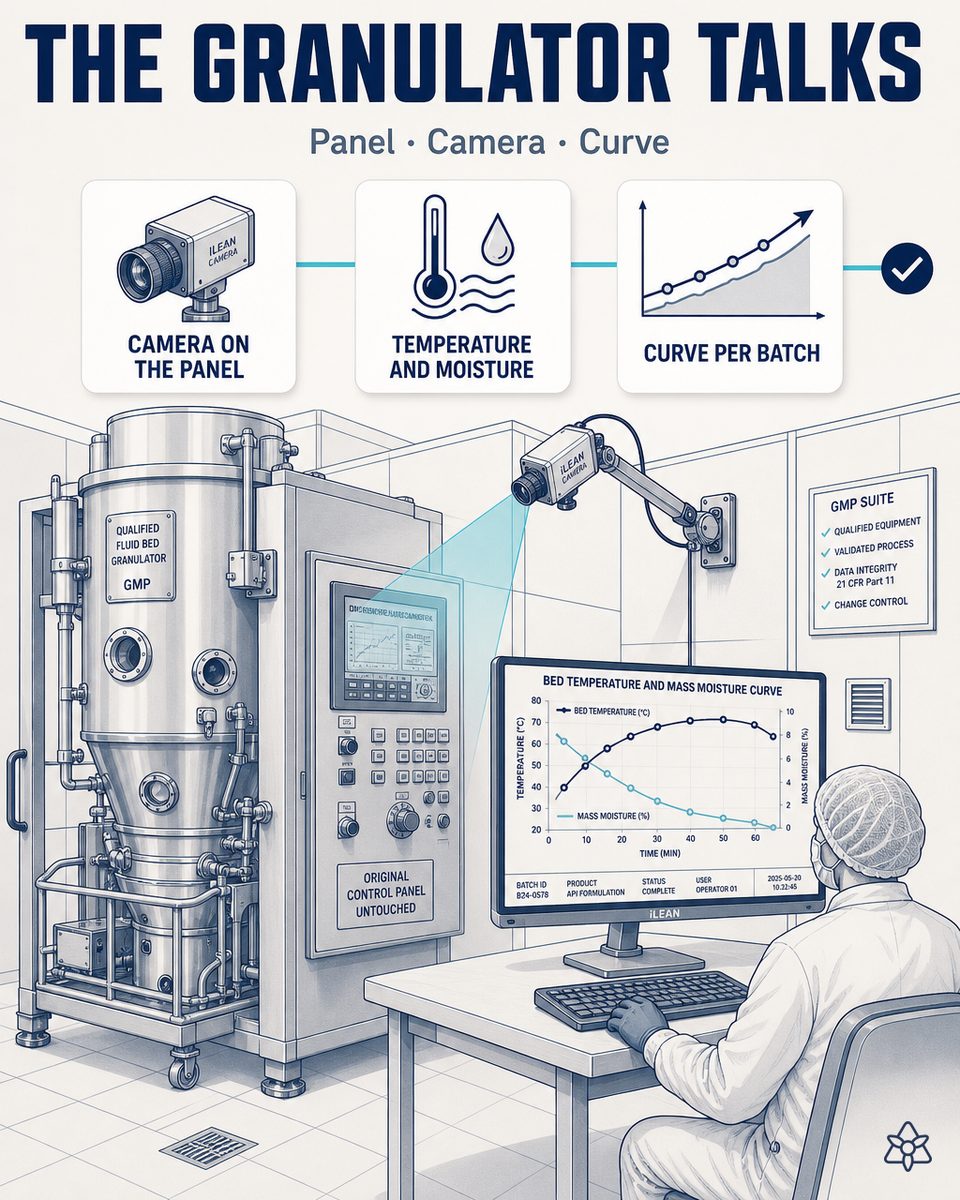
The plant's most expensive asset is also the most cut-off.
The wet granulator, rotary press or autoclave qualified 10-20 years ago is the line's bottleneck and its most expensive asset. Its panel shows in real time data defining the batch's quality — data that dies on the screen's glass as soon as the shift rotates.
- An isolated proprietary SCADA — the panel shows bed temperature, mass moisture, mixing time, compression curve and sterilization curve, but that data lives and dies on the screen. When the screen rotates, or when someone mis-notes by hand at the batch's end, the curve is lost.
- Changing the asset is not realistic in the short term — a new granulator or press with native connectivity costs more than €500,000 and demands months of stoppage and requalification. While the qualified asset keeps producing within tolerance, that CAPEX does not get signed.
- A direct consequence on quality — zero correlation between the process curve and the batch's OoS deviation, and zero ability to reconstruct the root cause when a batch goes out of specification.
Investigating a batch's OoS deviation becomes manual archaeology with a high risk of never reconstructing the root cause — because the only witness of what happened during the batch is a screen nobody photographs or records in a structured way.
Connect in photo mode on the panel — the camera reads the curve, the asset stays qualified.
The granulator's panel needs no new PLC, no communications card nobody manufactures anymore, and no intervention triggering the asset's GMP revalidation. It needs the curve that already shows on the screen — bed temperature, mass moisture, mixing time, compression curve, sterilization curve — to be recorded without depending on someone noting it by hand. That is what Connect in photo-on-panel mode is for.
A fixed industrial camera, qualified as non-GxP equipment, watches the granulator's panel without touching the original asset's network. Connect reads the screen by OCR with an anchored LLM, structures the per-batch time curve and cross-references it with the active MBR. The process curve ↔ tablet hardness ↔ friability ↔ dissolution correlation starts existing in real time.
How Connect operates on the granulator's panel:
- A fixed industrial camera qualified as non-GxP equipment — installed watching the panel from outside, without touching the original asset's network or wiring. It captures the screen frame by frame throughout the batch.
- OCR with an anchored LLM interprets each frame — each capture is read by OCR specialized in industrial panels, anchored to that specific screen's layout, to extract bed temperature, mass moisture, mixing time and compression curve without interpretation errors.
- It structures the per-batch time curve and crosses it with the MBR — each reading is ordered into a per-batch time series and automatically crossed with the plant's existing active Master Batch Record.
- Curve ↔ quality attributes correlation in real time — the relation between process curve, tablet hardness, friability and dissolution starts existing in real time, so the granulator's replacement CAPEX is deferred indefinitely without losing visibility.
A cut-off granulator vs. a granulator with Connect on the panel
| Aspect | Cut-off granulator | With Connect on the panel |
|---|---|---|
| The panel's process curve (bed temperature, moisture, mixing time, compression) | Only visible on screen, lost when the shift rotates | Camera-captured and structured as a per-batch time curve |
| Process curve ↔ OoS deviation correlation | Zero — no exportable data exists from the asset | An automatic correlation in real time, available per batch |
| Root cause analysis of an OoS deviation | Manual archaeology, high risk of not reconstructing the cause | An analysis in minutes with the curve history at hand |
| Correlation with tablet hardness, friability and dissolution | Nonexistent — the curve never leaves the panel | Automatically crossed with the MBR and the batch's attributes |
| Intervention on the qualified asset | Requires touching network or hardware and triggering GMP revalidation | None — an external camera, without touching the asset or demanding revalidation |
| The granulator's replacement CAPEX | Pending, undated, on the committee's table | Deferrable indefinitely while the asset performs, without losing visibility |
Impact estimate for your plant — to be validated with your own numbers.
The block below is an estimate to be validated against your plant's actual data. We put it forward so the committee has an order of magnitude; we refine it during the assessment.
- Pharmaceutical plant with a 10-20-year-old GMP-qualified wet granulator, rotary press or autoclave, an isolated proprietary SCADA.
- Connect pilot in photo mode on the critical asset's panel — only an external camera qualified as non-GxP equipment, without touching the original asset or triggering GMP revalidation.
- Indicative payback between 5 and 10 months, depending on the frequency of OoS deviations with no reconstructible cause and each batch investigation's cost at your plant.
- Avoidance of a replacement CAPEX above €500,000 per asset by deferring the granulator's change while it keeps performing, plus the reduction of the per-OoS-batch deviation investigation time. Estimate to be validated with your data.
And the fair question from the quality manager
"What if the camera misreads a digit of the curve on a 15-year-old screen and gives me false data in an OoS investigation?" — hallucination is a problem of free generation, not of anchored tasks. In tasks where the AI limits itself to recontextualizing a specific data point from one medium to another — reading a fixed field of the panel's curve and moving it into a structured series —, the best models brought the error below 1.5% [1]. And even then, nothing critical is decided alone: Connect discards the reading when it does not reach the confidence threshold and the person reviews and signs the history under 21 CFR Part 11. The three safety rings are there precisely for this.
[1] OpenAI paper "Why Language Models Hallucinate", 2025 — on the reliability of AI in anchored tasks.
What people ask about digitizing a qualified granulator's panel without requalifying it
Does the camera touch the qualified SCADA's network?
No. The industrial camera is an independent device, qualified as non-GxP equipment, installed on an external mount aimed at the panel from outside. It does not connect to the proprietary SCADA's network, shares no wiring with the original asset and writes to no point of its control logic. It limits itself to photographing the screen the operator already sees, just as a person noting into the batch record would. The granulator or rotary press remains exactly the same qualified asset, without a single change in its validated configuration.
Does it demand the granulator's GMP revalidation?
No, and that is the approach's pillar. Since Connect does not modify the qualified asset — it touches neither its hardware, its software nor its network — the granulator's or rotary press's qualification status is unaffected and no GMP revalidation of the process equipment is triggered. The camera and its software are validated separately as a non-GxP capture system under their own plan, aligned with 21 CFR Part 11 for the electronic record and its signature. The GMP asset keeps its original qualification intact; what is added is a parallel record, not an intervention on the validated.
How does the OCR read a manufacturer's proprietary screen?
Connect combines OCR specialized in industrial panels with a language model anchored to that screen's specific layout — it does not interpret the machine generically, it reads the same fields (bed temperature, mass moisture, mixing time, compression curve, sterilization curve) at their fixed positions, frame after frame, and reconstructs the batch's time curve. It is an anchored recontextualization task, not free generation: in that type of task the best models bring the error below 1.5%. When a reading does not reach the confidence threshold — a reflection, a screen on another view, a covered digit — it discards that capture instead of forcing a value.
What happens if the panel's layout changes?
Infrequent on an asset qualified 10-20 years ago with no firmware changes, but if the operator navigates to another view, changes the language or the manufacturer updates the screen, Connect detects it as a layout deviation and stops automatically structuring that reading until the model is re-anchored to the new field arrangement — a documented configuration adjustment, not a reinstall or a change to the asset. In the meantime it invents no data: the capture is flagged for review and the previous curve history remains intact and traceable.
How is the curve↔OoS correlation used in practice?
Facing a batch's OoS deviation, the quality manager enters the per-batch history and sees the process curve captured from the panel (bed temperature, moisture, mixing time, compression curve) in the same time series, crossed with the active MBR and with that batch's tablet hardness, friability and dissolution results. Instead of reconstructing by hand what happened weeks ago, they filter the OoS batch and check in minutes which stretch of the curve deviated versus the conforming batches — for example, a high mass moisture at the end of kneading. That root cause analysis, which today does not exist because the curve dies on the screen, is the basis for justifying the deviation and preventing it in the next batch.
More cases from this series
- iLEAN in regulated industry — five compliance pillars by design5 compliance pillars making iLEAN deployable in regulated pharma: audit trail, ALCOA+, non-invasive,…
- A pre-inspection evidence pack for FDA, COFEPRIS and ANVISA — zero documentary reconstructionZero hours of pre-audit reconstruction. iLEAN Agents organizes photo, log and signature by certifying…
- From the supplier’s email to the concrete action with no human latencyiLEAN Connect listens to the API supplier’s email and WhatsApp, crosses them with active orders and…
- From the delivery note and the CoA to the ERP with a single photo — 50-70% fewer receiving licensesAPI receiving in 5 min. iLEAN digitizes the delivery note, the Certificate of Analysis and the GS1…
- Coder and serializer stitched to the ERP — zero serial mix-upsBatch, serial and aggregation from the ERP to the coder with no typing. Zero serial mix-ups, eliminating…
- The IPT lead’s earpiece — operational knowledge enters the system in real timeThe Production Lead dictates walking between suites and iLEAN structures it as a preliminary deviation…
Tell us your case and we will send within 48h the estimated ROI of this AI project to give life to the panel of your pharmaceutical plant's most expensive qualified asset without requalifying it.
We work on your plant's real data, not ours. Assessment with no commitment.
Request estimated ROI within 48h ‹ See all 13 hormonal pharma cases See pharma