The IPT lead’s earpiece — operational knowledge enters the system in real time
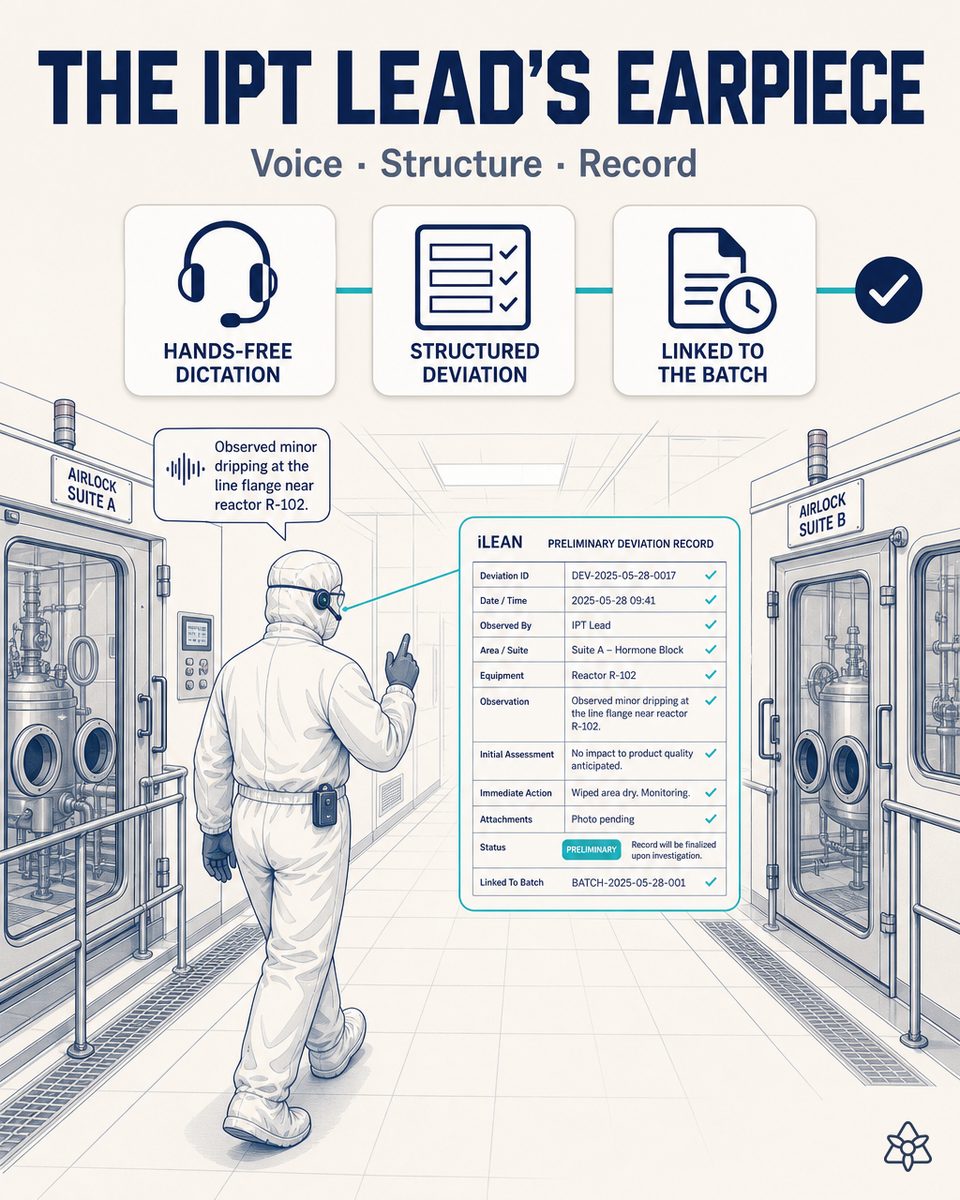
The IPT lead or Production Lead spends 7 hours a day walking between hormonal suites with busy hands. With iLEAN Connect in earpiece mode they dictate incidents, changes and observations while walking, and the AI structures them as a preliminary deviation tied to the active batch, line and shift.
Critical operational knowledge lives in the IPT lead's head and does not enter the system in real time.
At a hormonal manufacturing site, the Production Lead is not sitting in front of a screen: they are walking between containment suites, hands busy, wrapped in PPE, seven hours a day. They are the person who first sees when something starts to deviate:
- An incipient deviation in granulation — a batch starting to behave differently long before the data reaches any batch record review.
- A change in a suite's operations — an adjustment, a handover, a replaced consumable — that today nobody notes in the moment because inside the PPE there is nowhere to type.
- An observation that should be a deviation — and gets reconstructed hours later, from memory, if it gets reconstructed at all.
At a site with an FDA audit on the radar, that undocumented information is not only an inefficiency: it is warning letter risk. What is not written, for the auditor did not happen — or worse, happened and nobody documented it. And the site's continuous improvement plans — Hoshin Kanri, Lean Six Sigma, the MPS — depend on that knowledge existing as data: today they feed on what someone manages to remember at the weekly meeting.
Connect in hands-free voice mode — the IPT lead takes notes by dictating, without letting go of anything.
The earpiece is not a system recording the IPT lead during the shift: it is a tool they activate voluntarily when they want to note something. They decide when to speak and what to dictate. Connect structures it, ties it to the plant's active context and returns it in seconds.
The IPT lead says "iLEAN, note this". They dictate the observation in their own words, walking between suites. Connect structures it as a preliminary deviation incident tied to the active batch, line and shift. Seconds later, the return arrives by voice on the earpiece or as a push to the tablet.
How Connect operates in earpiece mode at a hormonal pharma site:
- A personalized wake-word — the IPT lead opens the dictation with their own phrase pronounced deliberately. Outside that phrase, the earpiece transcribes and sends nothing.
- Free dictation, no forms — they speak in their own words, just as they would tell a colleague: "the suite 3 granulator has been giving odd granulometry since the batch change".
- The LLM structures the incident — Connect turns the dictation into a preliminary deviation incident with clear fields, automatically tied to the batch, line and shift active at that moment, without the IPT lead reciting those data.
- A return by voice or push — the confirmation arrives on the same earpiece or, if more context is needed, as a push notice to the nearest tablet. The IPT lead keeps walking, with the observation already in the system.
- Human verification before signing — nothing signs as a formal deviation without passing through the early human verification on the tablet: a person reviews the draft, completes it and escalates it per the site's SOP.
Knowledge that dies at the end of the shift vs. knowledge that enters the system in real time
| Aspect | Knowledge dying at shift end | Knowledge entering in real time |
|---|---|---|
| An observation caught between suites | Stays in the head until the end of the shift, if at all | Dictated in the moment, hands-free and with the PPE on |
| The link to batch, line and shift | Depends on someone remembering and reconstructing it | Automatic, the system knows what is active |
| The record as a deviation | Written hours later, from memory, or not at all | Enters as a preliminary deviation in real time, pending human verification |
| Cross-reference with the MBR's data | Impossible: the data does not yet exist when it happens | Crossed with the MBR's live data from the first minute |
| Preparation for an FDA audit | Undocumented operational knowledge, a potential finding | Observations traceable from the moment they happen |
| Continuous improvement (Hoshin Kanri, Lean Six Sigma, MPS) | Fed by recollections at the weekly meeting | Fed by real data captured in the plant |
Impact estimate for your plant — to be validated with your own numbers.
The block below is an estimate to be validated against your plant's actual data. We put it forward so the committee has an order of magnitude; we refine it during the assessment.
- Hormonal manufacturing site with a Production Lead walking most of the day between containment suites, hands busy and with no practical keyboard access inside the PPE.
- Connect earpiece pilot on one shift or one line — without changing the IPT lead's role, without adding administrative tasks.
- The return is not a countable hour saving: it is enabling Hoshin Kanri, Lean Six Sigma and the MPS with real data instead of memory reconstructions at the weekly meeting — and reducing documentary exposure at an FDA audit.
- The impact estimate in deviations captured in time and in the quality of the continuous improvement plans is an estimate to be validated with the site's continuous improvement manager, not a generic figure invented here.
And the fair question from the plant manager
"Doesn't this end up being a system recording everything my Production Lead says?" — no. It is exactly the other way round: the earpiece listens to nothing until the IPT lead activates it with their wake-word. There is no background recording, no continuous transcription, nobody listening to their conversation with a suite operator. The only thing entering the system is what they decide to dictate — because they want it recorded, not because someone above asked. And the second doubt, "what if the AI invents half a deviation?": for anchored tasks like this — structuring a dictation against the active batch, line and shift — the AI's reliability is very far from free generation's hallucination problem [1], and even so nothing signs as a formal deviation without passing through the early human verification on the tablet.
[1] OpenAI paper "Why Language Models Hallucinate", 2025 — on the reliability of AI in anchored tasks.
What people ask about the IPT lead's earpiece at a hormonal site
Does the earpiece listen the whole shift or only when the IPT lead activates it?
Only when they activate it. The system uses a personalized wake-word ("iLEAN, note this") the IPT lead pronounces deliberately to open the dictation, and closes it with a pause or a closing phrase ("done"). Outside that interval, the earpiece transcribes and sends nothing: there is no continuous listening or background recording, and a normal conversation with a suite operator does not become a record. It is a tool the IPT lead decides to use to take notes, not a system recording what they do or say during the shift.
Does it work with a hormonal suite's PPE and the plant's noise?
It is designed exactly for that environment. The proximity microphone integrates with the usual hormonal containment PPE — hood, mask or PAPR — without compromising gowning, and the voice model is trained on real plant conditions: HVAC systems, granulators, tablet presses running. When the transcription's confidence drops below a threshold, Connect does not invent the missing word: it asks for a short voice confirmation ("did you say batch 7 or batch 17?") before structuring anything. Better one extra question than a data point badly linked to the wrong batch.
Who can later consult what the Production Lead dictated?
What is dictated does not remain as free audio anyone can listen to out of context: it is structured as a preliminary deviation tied to batch, line and shift, and access is defined by the site per its org chart and SOPs — QA and production see their area's incidents, management sees the aggregate for continuous improvement. It is the record of the observation the IPT lead themselves decided to note, with their name because they sign the data, just as they would sign a batch record annotation. It is not a record of their activity during the shift.
How does what is dictated become a formal deviation?
Never automatically. What Connect generates is a preliminary deviation: a structured draft with the fields already tied to the active batch, line and shift. Before anything signs as a formal deviation, it passes through the early human verification on the tablet: a person reviews the draft, corrects or completes it, and escalates it per the site's deviation SOP — with the usual QA signatures and flows. The AI prepares the data the moment it happens; the decision and the signature remain human, as the quality system demands.
What does this contribute to Hoshin Kanri, Lean Six Sigma or the MPS?
Those plans depend on operational knowledge existing as data, not as recollection. Today the site's Hoshin Kanri, Lean Six Sigma projects and MPS feed on what someone manages to reconstruct at the weekly meeting: what deviated, in which suite, how often. With Connect, every IPT lead observation enters structured and tied to its batch and line the moment it happens, and crosses with the MBR's live data. Continuous improvement teams start from real data captured in the plant, not memory — that is the enabling piece.
More cases from this series
- iLEAN in regulated industry — five compliance pillars by design5 compliance pillars making iLEAN deployable in regulated pharma: audit trail, ALCOA+, non-invasive,…
- A pre-inspection evidence pack for FDA, COFEPRIS and ANVISA — zero documentary reconstructionZero hours of pre-audit reconstruction. iLEAN Agents organizes photo, log and signature by certifying…
- From the supplier’s email to the concrete action with no human latencyiLEAN Connect listens to the API supplier’s email and WhatsApp, crosses them with active orders and…
- From the delivery note and the CoA to the ERP with a single photo — 50-70% fewer receiving licensesAPI receiving in 5 min. iLEAN digitizes the delivery note, the Certificate of Analysis and the GS1…
- Coder and serializer stitched to the ERP — zero serial mix-upsBatch, serial and aggregation from the ERP to the coder with no typing. Zero serial mix-ups, eliminating…
- Giving the qualified granulator’s panel life without requalifying the assetAn external camera reads the qualified panel’s curve without touching the GMP asset. Zero…
See how the earpiece deploys over a full shift — tell us your case and we will send within 48h the estimated ROI of this AI project for your hormonal pharma site.
We work on your plant's real data, not ours. Assessment with no commitment.
Request estimated ROI within 48h ‹ See all 13 hormonal pharma cases See pharma