Cleaning between hormonal products validated by Edge — zero cross-contamination
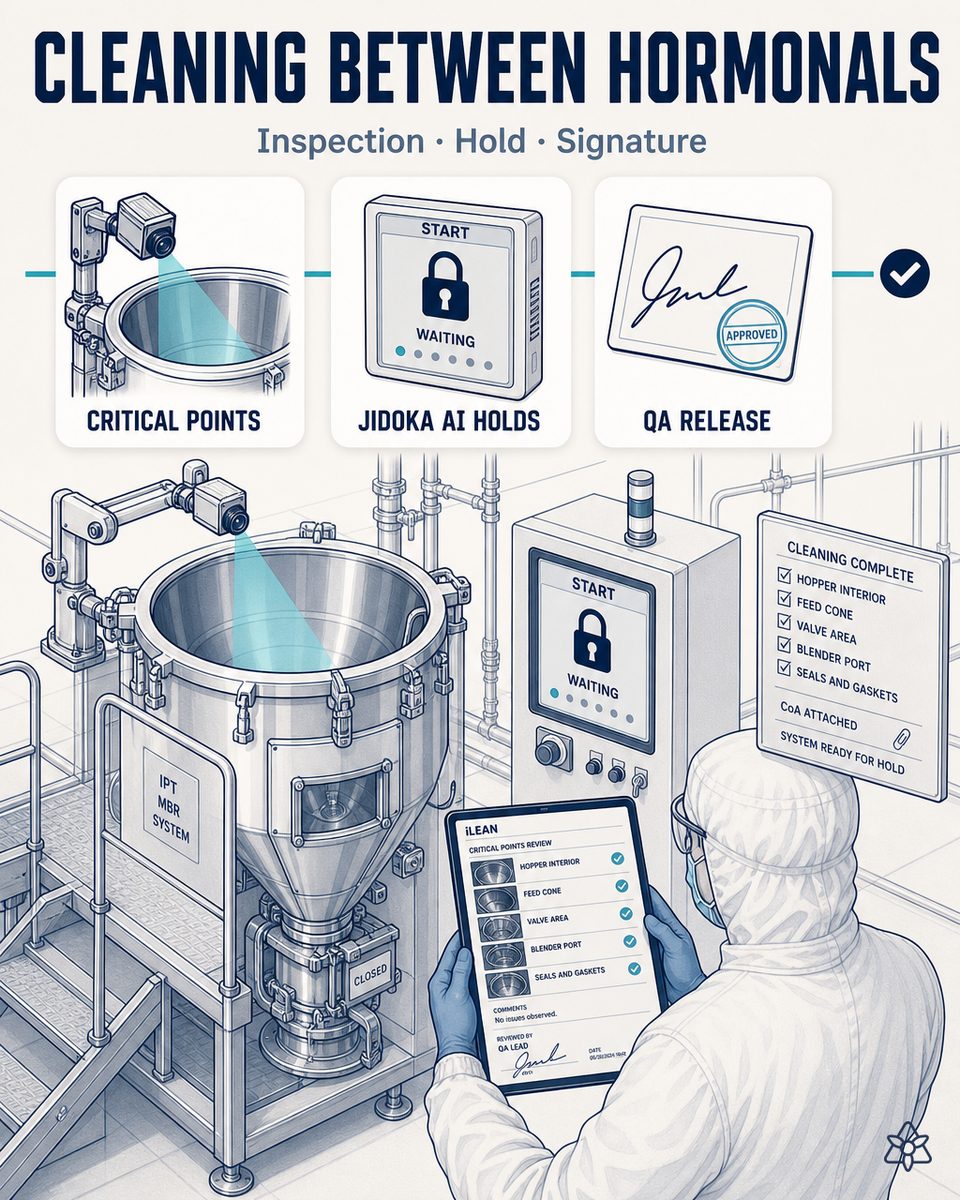
A hormonal suite changing between highly active compounds demands certified cleaning validation before the change. iLEAN Edge places fixed cameras on the dispensing hopper, granulator, press, chute and blistering hopper, compares with the clean reference state and does not let the suite start until the cameras give OK and the QA lead signs with visual evidence + a confirmatory swab. It is the front where Quality stakes the site's exporting CMO qualification.
Hormonal cross-contamination is the site's zero-tolerance risk.
In a suite changing between highly active compounds, the process in steady state is stable. The risk concentrates in the change between compounds: the moment the same dispensing hopper, the same granulator or the same press goes from one hormonal to another and everything depends on the cleaning having been perfect at every point of the product's route.
- The responsibility rests today on a human signature with partial evidence — the QA lead signs the change's release with limited visual evidence and a swab arriving late from the laboratory, often with the suite already running.
- A failure here is not a minor deviation — it is a regulator's warning letter (FDA, COFEPRIS) and the loss of the exporting CMO qualification. A residue of the previous compound below the visual limit contaminates the new product's first batch before anyone detects it.
- The critical deviations curve is decided here — every badly verified change between hormonals feeds the metric the certifier and the auditor look at first.
Hormonal cross-contamination translates into the same thing: a critical deviation, warning letter risk and the loss of the site's exporting CMO qualification. A qualification built over years can be compromised in a single badly verified compound change.
Edge gives the OK point by point — JIDOKA AI does not let the suite start until all have said yes.
Cleaning between hormonals is not solved with a longer protocol for the QA lead: it is solved by giving them objective visual evidence of each critical point before they sign the release, and by making the suite physically unable to start while that evidence is incomplete. That combination is Edge plus JIDOKA AI.
Edge watches every critical point of the change — dispensing hopper, granulator, press, chute, blistering hopper. JIDOKA AI does not release the startup until all the cameras give OK. QA signs on the visual evidence and the confirmatory swab, not blind.
The iLEAN pieces applied to cleaning between hormonals:
- Edge — industrial cameras with CNN networks trained to recognize "clean vs. residue below the visual limit", fixed at the change's critical points: dispensing hopper, granulator, press, chute and blistering hopper. Each camera learns that point's clean reference state and compares against it on every compound change.
- JIDOKA AI — receives each camera's verdict and acts as the startup gate: while a single critical point is not OK, the suite stays held. It is not an alert someone can ignore under plan pressure; it is an active block on the startup until the evidence is complete.
- QA's electronic signature on evidence — when all the cameras give OK, the QA lead receives the summary with each critical point's photos and signs the release. The signature remains human and mandatory — what changes is that it is no longer blind, it is given on structured visual evidence point by point.
- Three safety rings in parallel — Edge visual verification, the laboratory's confirmatory chemical swab and the QA lead's electronic signature. No ring replaces another; all three are archived per compound change, ready for the auditor or the regulator without reconstructing anything weeks later.
Signing blind vs. signing on per-critical-point visual evidence
| Aspect | Classic hormonal cleaning | With iLEAN Edge + JIDOKA AI |
|---|---|---|
| Evidence QA signs on | Signed blind or with a late swab, with cross-contamination risk | Structured per-point visual evidence + a confirmatory swab |
| Verifying the residue below the visual limit | By eye, per protocol, with no objective record | A CNN at each critical point compares with the clean reference state |
| The chemical swab's timing | Arrives late from the laboratory, sometimes with the suite already running | A confirmatory swab as the third ring, on points already validated by Edge |
| The suite's startup | Depends on judgment and the plan's pace | JIDOKA AI holds it until all the cameras give OK |
| A camera failing or with no reading | Assumed OK if nobody says otherwise | Block held — absence of data is not a green light |
| The file for the auditor or regulator | Reconstructed by hand after the finding | A per-change dossier: photo + Edge verdict + swab + signature, archived |
Impact estimate for your plant — to be validated with your own numbers.
The block below is an estimate to be validated against your plant's actual data. We put it forward so the committee has an order of magnitude; we refine it during the assessment.
- Hormonal suite with machines shared between several highly active compounds, with several compound changes per week, each with its cleaning validation.
- Edge + JIDOKA AI pilot on the product route's five critical points (cameras + startup gate + integration with QA's signature and the swab). First value expected within a few weeks.
- What is protected is the site's exporting CMO qualification — worth more than €1M a year in export revenue — and the FDA certification in progress. A single qualification loss compromises that entire volume, not only the affected batch. Estimate to be validated.
- The payback is a function of the hormonal line's volume: the greater the share of exporting production on shared machines, the sooner the pilot amortizes. Estimate to be validated with your data.
- The hard lever acts directly on the critical deviations metric: every change between hormonals validated with structured evidence takes risk out of the curve the auditor looks at first.
And the fair question from the QA lead
"What if the camera gives OK to a point that is not really OK, or the other way round, blocks the suite for no real reason?" — hallucination is a problem of free generation, not of anchored tasks. In tasks where the AI merely compares a critical point's current image against its previously validated clean reference state — which is exactly what Edge does here —, the best models brought the error below 1.5% [1]. And even then, the critical is not decided alone: JIDOKA AI holds the startup, the chemical swab confirms and the QA lead signs, seeing the evidence behind each point. iLEAN's three safety rings are there precisely for this — the AI proposes, the QA lead decides.
[1] OpenAI paper "Why Language Models Hallucinate", 2025 — on the reliability of AI in anchored tasks.
What people ask about cleaning between hormonals with Edge and JIDOKA AI
What exactly is JIDOKA AI and how does it block the hormonal suite's startup?
JIDOKA AI is the orchestration layer turning the Edge cameras' verdict and QA's signature into a block on the suite's startup. It takes its name from the classic jidoka principle — stopping at the anomaly instead of letting it advance — applied by AI to the change between highly active compounds: until it receives the OK from all the cameras at their critical points and the QA lead's electronic signature on that evidence, JIDOKA AI keeps the suite held. The gate does not open just because the estimated cleaning time has elapsed; it opens when the structured visual evidence is complete and signed.
How many cameras are needed and where are they placed in the hormonal suite?
The usual range is five fixed cameras at the points where the change between hormonals leaves residue traces below the visual limit: dispensing hopper, granulator, press, chute and blistering hopper. Each camera learns that point's clean reference state after the validated cleaning and compares against it on every compound change, not once a day. The final number depends on your suite's critical point plan; these five cover the product's route end to end.
What happens if a camera fails or loses its reading?
The system is designed to fail closed, not open. If a camera stops giving a valid reading — dirt on the lens, a connection failure or framing drift — JIDOKA AI does not interpret the silence as OK: it records "point without valid reading — block held" and keeps the suite held until the camera is repaired or that point is validated manually with QA's signature and a swab. Absence of data never translates into a green light; in a change between hormonals it translates into more verification, not less.
How does Edge tell a clean surface from a residue below the visual limit?
The cameras mount CNN networks trained to recognize "clean vs. residue below the visual limit" by comparing the current image against that point's validated clean reference state. The network looks for specific indicators — a film of the previous compound, dry residue in joints, chutes and guides, a haze on the hopper — that the human eye can miss after hours of shift. When the difference from the reference state exceeds the confidence threshold, the point is marked nonconforming; in borderline cases no automatic decision is forced: it is flagged for manual verification with a signature before the point is accepted.
With Edge running, is the chemical swab still necessary?
Yes, always. Edge does not replace the chemical swab or the human signature: it reinforces them. iLEAN keeps three safety rings active in parallel — Edge visual verification at each critical point, the laboratory's confirmatory chemical swab and the QA lead's electronic signature on that evidence. Edge's contribution is that the signature stops resting on partial, late evidence: the QA lead signs on structured per-point visual evidence at the change's moment, and the confirmatory swab closes the chemical ring. No ring depends on another to exist.
More cases from this series
- iLEAN in regulated industry — five compliance pillars by design5 compliance pillars making iLEAN deployable in regulated pharma: audit trail, ALCOA+, non-invasive,…
- A pre-inspection evidence pack for FDA, COFEPRIS and ANVISA — zero documentary reconstructionZero hours of pre-audit reconstruction. iLEAN Agents organizes photo, log and signature by certifying…
- From the supplier’s email to the concrete action with no human latencyiLEAN Connect listens to the API supplier’s email and WhatsApp, crosses them with active orders and…
- From the delivery note and the CoA to the ERP with a single photo — 50-70% fewer receiving licensesAPI receiving in 5 min. iLEAN digitizes the delivery note, the Certificate of Analysis and the GS1…
- Coder and serializer stitched to the ERP — zero serial mix-upsBatch, serial and aggregation from the ERP to the coder with no typing. Zero serial mix-ups, eliminating…
- Giving the qualified granulator’s panel life without requalifying the assetAn external camera reads the qualified panel’s curve without touching the GMP asset. Zero…
Tell us your case and we will send within 48h the estimated ROI of Edge + JIDOKA AI for your suite's cleaning between hormonals.
We work on your site's real data, not ours. Assessment with no commitment.
Request estimated ROI within 48h ‹ See all 13 hormonal pharma cases See pharma