4 coordinated rings against batch rejection
A batch rejection by the bottling customer — leak, out-of-range torque, off-tolerance color — can stop their filling line and put a multi-year contract at risk. The active order defines mold, color, resin batch and destination customer.
One rejected closure batch can stop a bottler's filling line.
A batch rejection by the bottling customer — leak, out-of-range torque, off-tolerance color — can stop their filling line and put a multi-year contract at risk. The active order defines mold, color, resin batch and destination customer.
- A batch rejection by the bottling customer — a leak, out-of-range removal torque, a color off tolerance — can stop their filling line and put a multi-year contract at risk.
- It rarely comes from one failure. It is a resin batch at the edge of spec, a purge cut short, a cavity running warm and a startup signed in a hurry, each acceptable on its own.
- The active order defines mold, color, resin batch and destination bottler. When nothing cross-checks the line against that order, the discrepancy is found at the bottler's incoming inspection.
- By then the batch is on their dock, the sorting and freight are yours, and the conversation is about the contract, not the closure. Even when the contract survives, the next renewal starts from a weaker position.
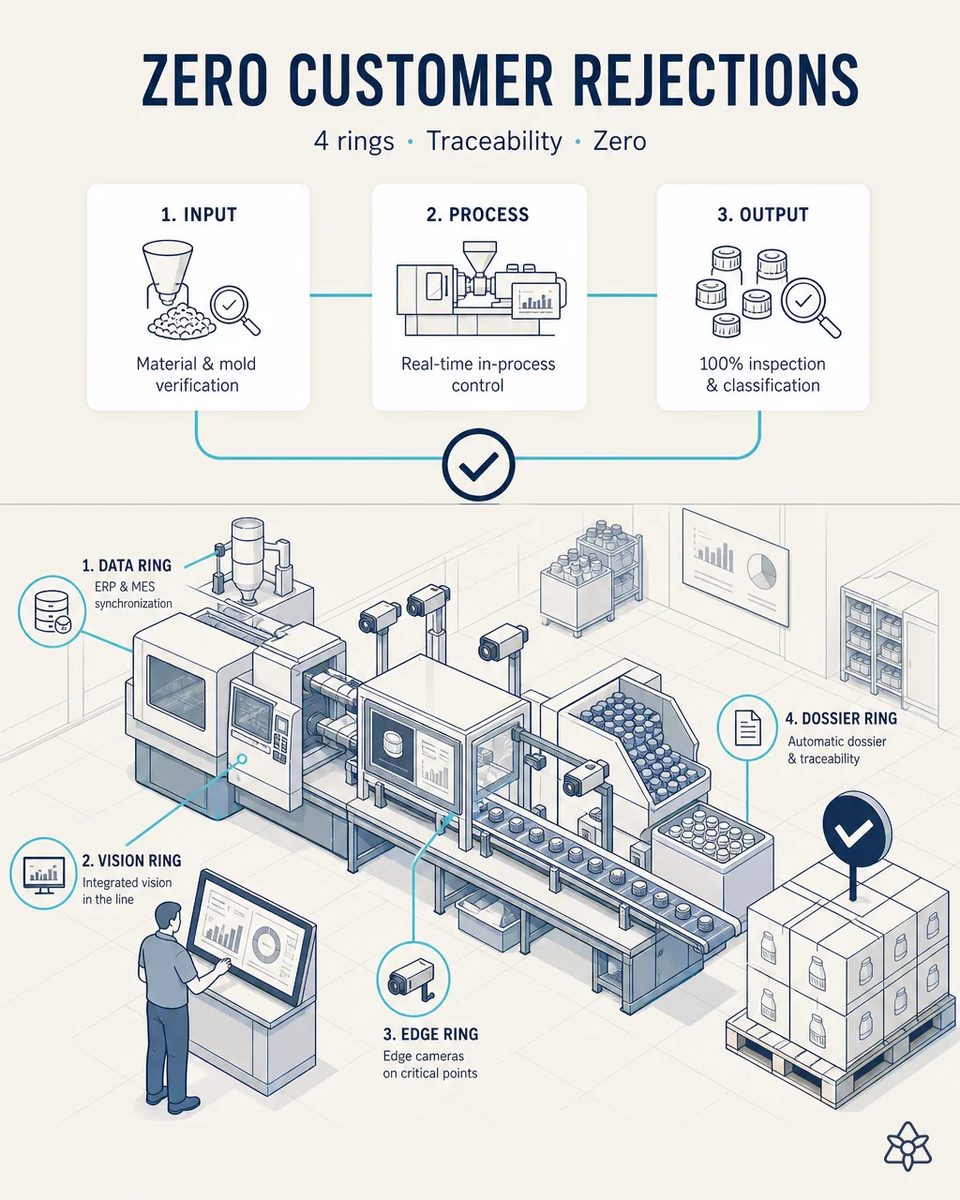
Four coordinated rings — production order, vision, Edge and pallet dossier, orchestrated by Agents.
The piece-by-piece verdict from the existing vision system is automatically linked to the batch through the inspection-camera-to-ERP integration. Edge cameras validate mold and color before full-speed startup; if it doesn't match the order, JIDOKA AI blocks the startup. Every pallet ships with the dossier that cross-references the 3 previous rings and the quality sign-off. SMED AI speeds up changeovers so productivity isn't penalized.
No single ring solves the problem; each already exists in some form today and the bad batch still ships. The strength is in the cross-check: when the order, the vision verdicts, the startup images and the dossier stop agreeing, the pallet stays at the plant. It leaves when the discrepancy is explained and signed, not before, and the bottler never sees it. That is the whole promise: discrepancies stay a plant matter.
The four rings against a closure batch rejection
| Ring | Which cases it draws on | What it closes |
|---|---|---|
| 1 · Production order | Mold startup photo (1) + resin receiving (7) | Which mold, color and resin batch make up the batch |
| 2 · Vision | Inspection camera stitched to the ERP (8) | Piece-by-piece verdicts linked to the batch |
| 3 · Edge at the press | Defective closure (9) + mold changeover (10) | Wrong mold or shade blocked before full speed |
| 4 · Pallet dossier | Evidence pack (11) + quality sign-off | Every pallet ships with its cross-referenced file |
| Ring coordination | JIDOKA AI + SMED AI | Stops on mismatch without slowing changeovers |
| Human gate | Verification tablet (5) | No closure data reaches the ERP unchecked |
Rejection risk caught by the customer → discrepancy caught on the line, before the pallet ships.
Impact estimate — to be validated against your bottler contracts.
The block below is an estimate to be validated against your plant's actual data. We put it forward so the committee has an order of magnitude; we refine it during the assessment.
- Estimated payback 6-12 months, measured against the first batch rejection avoided. One avoided rejection usually pays for several layers.
- Protection of the multi-year commercial relationship with the bottling customer, which is worth far more than the batch itself. Bottlers renew with the supplier who never stopped their line.
- The discrepancy is caught on the line, before the pallet ships, instead of at the bottler's incoming inspection. Sorting, freight and penalties simply do not happen.
- SMED AI keeps validation from penalizing changeovers, so the protection does not cost press productivity.
Payback 6-12 months · protects multi-year contracts. Protection against batch rejection and against the multi-year commercial relationship with the bottling customer. Estimated payback of 6 to 12 months against the first avoided rejection. Estimate to validate.
And the fair question from the production manager
“Do we have to deploy all twelve cases before this works?” — no, and framing it that way would be the way never to start. The rings are built in layers and each case pays on its own. Most plants start with one ring and add the next once the first has paid. Checking that order, verdicts and startup images agree is an anchored task, where the best models drop below 1.5% error [1]; with the mold startup photo and the vision stitching you already have rings 1 and 2. Edge and the dossier then close the loop.
[1] OpenAI paper "Why Language Models Hallucinate", 2025 — on the reliability of AI in anchored tasks.
What people ask about protecting closure batches from bottler rejection
Where does a closure plant usually start?
With the photo at mold startup and the vision stitching, which have the fewest dependencies and pay on their own. Edge and the dossier are added on top. The order matters less than making sure each layer pays before the next one is added.
What does the cross-check catch that each closure control misses?
The concatenation: a resin batch at the edge, a short purge and a warm cavity each pass their own check, and together produce the batch the bottler rejects. Only cross-checking sources reveals the combination before the pallet ships.
What happens when the rings disagree but the closures look fine?
The pallet is held and the discrepancy goes to the quality supervisor with the evidence of each ring. JIDOKA AI stops on a verifiable mismatch, not on model uncertainty. Every held pallet and its resolution are recorded, so false alarms become visible and get tuned out.
Does it replace our ERP or production system?
No. Ring 1 relies on the order being the truth. iLEAN cross-checks the systems against each other and against what actually happens at the press. It adds the cross-check that no single system can do on its own.
How do we estimate the return for our closure plant?
With your claim history, the cost of the last rejected batch and your changeovers per week, the return of each layer is estimated before deciding the order. The estimate is shared with you before any commitment.
More cases from this series
- Connect listens to the lab's Excel and pushes it to the ERPILEAN absorbs the lab's quality-control Excel and pushes it to the ERP after validation. Saves ERP…
- External camera on a legacy press panelAn external camera reads a veteran press's panel without touching it; its parameters are digitized batch…
- Human-verification tablet next to the pressEvery iLEAN capture passes through a tablet by the press; the technician confirms with two taps before…
- Photo to the order at mold startupThe technician photographs the production order and startup sheet; the batch exists in the system at…
- Photo to the delivery note and the resin octabin labelPhoto the delivery note and resin octabin label; iLEAN extracts the batch and pushes it to the ERP after…
- ILEAN silently copied on the resin supplier's emailILEAN silently reads the resin supplier's alert and suggests replanning before the press goes idle.
Tell us what your last batch rejection by a bottler cost you.
We work on your plant's real data, not ours. Assessment with no commitment.
Request estimated ROI within 48h ‹ See all cases of plastic closures See packaging