Edge blocks startup until mold and color are validated
A mold or color change is the moment of highest risk: a wrongly mounted cavity or residual color can ruin the first tens of thousands of pieces. Verifying that 'mold and color are correct' today depends on a technician confirming it visually, with no structured evidence.
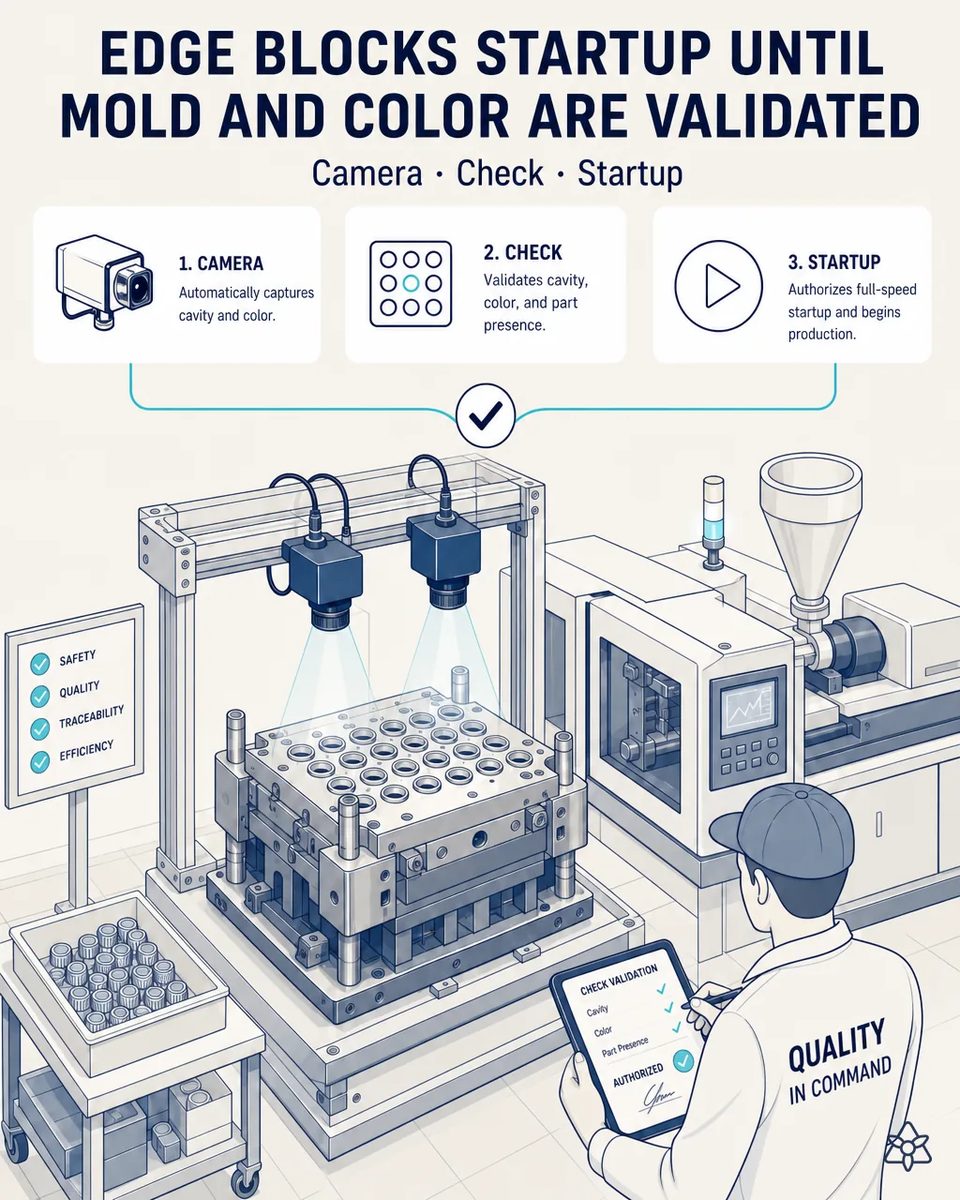
The riskiest moment in a closure plant is signed off by eye.
A mold or color change is the moment of highest risk: a wrongly mounted cavity or residual color can ruin the first tens of thousands of pieces. Verifying that 'mold and color are correct' today depends on a technician confirming it visually, with no structured evidence.
- A mold or color change is the moment of highest risk: a wrongly mounted cavity insert, a blocked cavity left open by mistake or residual masterbatch still in the barrel.
- At closure cadence, a bad startup can ruin the first tens of thousands of pieces before anyone notices the shade is off or one cavity is short. Those closures still have to be sorted, reground or scrapped.
- Today, "mold and color are correct" depends on a technician confirming it visually, under time pressure, with no structured evidence behind the signature.
- When a bottler finds mixed shades in a batch, nobody can show what the press looked like at startup. The changeover left a tick on a sheet and nothing else.
Edge with JIDOKA AI and SMED AI — no full speed until every camera says OK.
ILEAN Edge places fixed cameras at the press's critical points that compare the current state against the active order's reference. It won't let the press start at full speed until every camera says OK and the quality supervisor signs off with visual evidence. SMED AI speeds up validation so it doesn't penalize changeover time.
The cameras do not replace the quality supervisor: they give her something to sign on. Each critical point is compared with the active order's reference, the press only goes to full speed when everything matches, and SMED AI keeps the validation from adding time to the changeover. Production gets its full speed; quality gets its evidence; nobody waits for the other. The changeover ends with proof, not with a hope that the first bags are right.
Mold and color changeover today versus changeover on evidence
| Aspect | Today | With iLEAN Edge |
|---|---|---|
| What "correct" is based on | A technician's look | Images against the order reference |
| Cavity inserts and blocked cavities | Assumed | Checked by camera |
| Residual color after purge | Judged by eye | Compared with the order shade |
| Mismatch at closure startup | Found in the bags | JIDOKA AI blocks full speed |
| Time added to the mold change | — | Not penalized: SMED AI |
| Record of the mold change | A tick on a sheet | Before/after images and signature |
Eyeballed verification on every changeover → startup based on visual evidence, with automatic blocking.
Impact estimate — tied to how often you change mold and color.
The block below is an estimate to be validated against your plant's actual data. We put it forward so the committee has an order of magnitude; we refine it during the assessment.
- We do not fix a payback range here, because it depends on your mold and color changeover frequency; we calculate it with your own changeover count.
- Less startup scrap after every changeover: the first shots at full speed are made with the right mold, cavities and shade. Fewer closures to sort, regrind or scrap after every change.
- Protection against color cross-contamination, which is what turns a single bad startup into a bottler's batch rejection. Mixed shades in a bag are among the complaints bottlers tolerate least.
- And every changeover leaves before/after images and a signature that the audit dossier can use later without extra work from quality. The changeover documents itself while it happens.
Payback depends on changeover frequency · cuts startup scrap. Reduced startup scrap after every changeover and protection against color cross-contamination. Payback depends on mold/color changeover frequency. Estimate to validate.
And the fair question from the production manager
“Won't the camera hold up a changeover for nothing, with the bottler's order waiting?” — it stops on a verifiable mismatch against the order's reference, not on uncertainty. Comparing a known mold and shade with its reference image is an anchored task, where the best models drop below 1.5% error [1]. When the doubt is the model's, it escalates to the quality supervisor instead of blocking silently. The supervisor sees the two images side by side and decides in seconds. Nobody is left wondering why the press will not go to full speed. The reason is on the screen, with the image that triggered it.
[1] OpenAI paper "Why Language Models Hallucinate", 2025 — on the reliability of AI in anchored tasks.
What people ask about camera-validated mold and color changeovers
Which points do the changeover cameras check?
The ones that define the order: cavity layout and blocked cavities, inserts, the color of the first shots against the order shade and part presence. They are agreed with your toolroom at commissioning. Each mold and color combination has its own reference.
Can a camera judge a closure color reliably?
Against a reference under controlled lighting, yes: it compares the first shots with the approved shade for that order, not with a generic color. That removes from the floor the debate about whether a shade is close enough.
How much time does validation add to a closure changeover?
Seconds. SMED AI runs the check in parallel with the last steps of the change, so the press reaches full speed no later than it does today. The time saved by not double-checking by hand usually compensates for it.
Who gives the final go for full-speed production?
The quality supervisor. The cameras supply the evidence and JIDOKA AI blocks on a mismatch; the sign-off stays human. What changes is that she signs on images, not on someone's word.
What if production must start and a camera reports a color mismatch?
An exception can be signed by the quality supervisor and is recorded as such, with the images. What disappears is the startup with no trace of who decided it. The exception itself becomes part of the dossier.
More cases from this series
- Connect listens to the lab's Excel and pushes it to the ERPILEAN absorbs the lab's quality-control Excel and pushes it to the ERP after validation. Saves ERP…
- External camera on a legacy press panelAn external camera reads a veteran press's panel without touching it; its parameters are digitized batch…
- Human-verification tablet next to the pressEvery iLEAN capture passes through a tablet by the press; the technician confirms with two taps before…
- Photo to the order at mold startupThe technician photographs the production order and startup sheet; the batch exists in the system at…
- Photo to the delivery note and the resin octabin labelPhoto the delivery note and resin octabin label; iLEAN extracts the batch and pushes it to the ERP after…
- ILEAN silently copied on the resin supplier's emailILEAN silently reads the resin supplier's alert and suggests replanning before the press goes idle.
Tell us how many mold and color changes your presses run each week.
We work on your plant's real data, not ours. Assessment with no commitment.
Request estimated ROI within 48h ‹ See all cases of plastic closures See packaging