Agents organizes the evidence pack by certification standard
When the BRCGS or ISO 22000 auditor arrives, someone today spends weeks reconstructing the traceability of the period's mold, color and resin changes. The plant shows loose papers; the auditor raises a non-conformity for documentation gaps.
Before every audit, someone rebuilds months of changes from paper.
When the BRCGS or ISO 22000 auditor arrives, someone today spends weeks reconstructing the traceability of the period's mold, color and resin changes. The plant shows loose papers; the auditor raises a non-conformity for documentation gaps.
- When the BRCGS or ISO 22000 auditor arrives, someone spends weeks reconstructing the traceability of every mold, color and resin change in the period.
- The evidence exists, but scattered: startup sheets in folders, lab results in Excel, receiving data in the ERP and the rest in people's memory. Each source has its own format and its own person who knows where things are.
- The plant shows loose papers, the gaps show, and the auditor raises a non-conformity for documentation gaps — not for a bad closure, but for missing proof. The closures may be perfect; the file is what fails.
- And bottlers audit too. Each one with audit rights means the same reconstruction repeated with a different checklist and a different date.
Edge and Connect capture each change; Agents files it by standard.
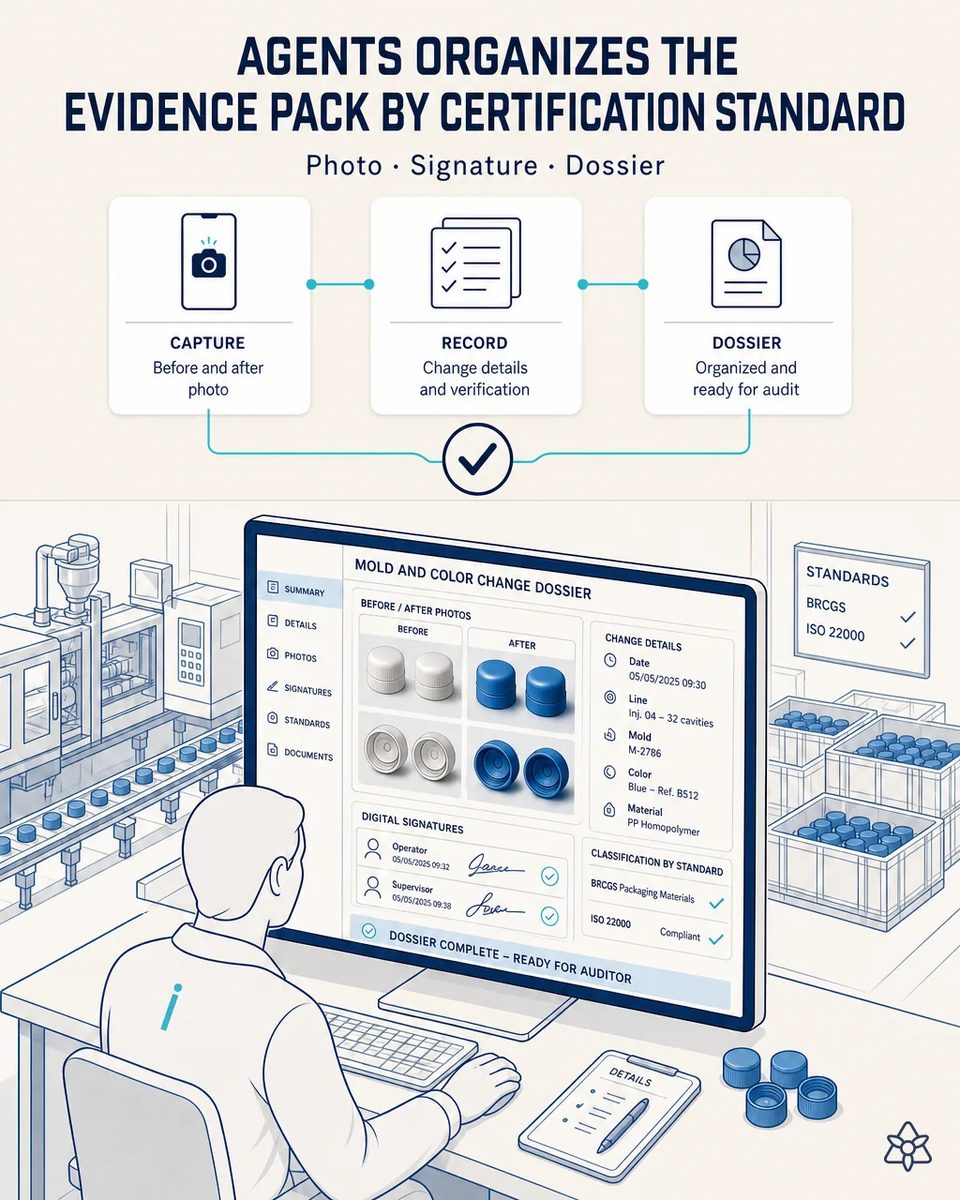
Every critical mold or color change already generates before/after photos of the critical points, a decision log and a timestamped signature. Agents automatically classifies that material by certification standard — BRCGS, ISO 22000, ISO 9001 — with zero human work afterward.
Every critical change already leaves before/after photos of the critical points, a decision log and a timestamped signature. Agents classifies that material by standard — BRCGS, ISO 22000, ISO 9001 — as it happens, so the dossier is closed the moment the change is, with zero work afterward. Quality stops being the team that compiles and becomes the team that reviews. The auditor's visit stops being a project and becomes a review of what is already filed. Bottlers notice the difference in the first audit after go-live.
Audit preparation today versus the dossier filed as it happens
| Aspect | Today | With iLEAN Agents |
|---|---|---|
| Rebuilding changes before an audit | Weeks | None |
| Mold, color and resin change history | Loose papers | Photos, log and signature per change |
| Indexing by certification standard | Done by hand per audit | BRCGS, ISO 22000, ISO 9001 automatically |
| Missing evidence for a change | Found by the auditor | Flagged when it should exist |
| Each bottler's own audit | Rebuilt again | Same evidence, filtered view |
| Dossier delivery | Days of compiling | Downloadable instantly |
Weeks spent rebuilding traceability before every audit → dossier downloadable instantly.
Impact estimate — to be validated with your BRCGS and bottler audit calendar.
The block below is an estimate to be validated against your plant's actual data. We put it forward so the committee has an order of magnitude; we refine it during the assessment.
- Estimated payback 6-12 months, depending on how many audits you face per year. Plants audited by several bottlers recover it fastest.
- Pre-audit reconstruction goes from weeks to zero: the dossier is built as each change happens. Nobody has to stop the quality team for weeks before the visit.
- Documentation non-conformities lose their main cause, because missing evidence is flagged when it should have been generated, not on audit day. The audit becomes a review of evidence, not a search for it.
- Each bottler with audit rights gets the same evidence filtered for their checklist, instead of a new round of compiling by the quality team. The same evidence answers every checklist.
Payback 6-12 months · weeks of rebuilding reduced to zero. From weeks of pre-audit reconstruction to zero. Estimated payback of 6 to 12 months depending on audit frequency. Estimate to validate.
And the fair question from the production manager
“Will a BRCGS auditor accept a dossier filed by AI?” — the AI files, it does not judge: the images come from the cameras and the signature is the quality supervisor's. Assigning a known evidence type to the clause it supports is an anchored task, where the best models drop below 1.5% error [1], and the classification rules are reviewed by your quality manager before go-live. Any rule can be adjusted later without touching the evidence itself. The auditor sees original evidence, organized. Nothing is rewritten after the fact, which is exactly what an auditor wants to see.
[1] OpenAI paper "Why Language Models Hallucinate", 2025 — on the reliability of AI in anchored tasks.
What people ask about the closure plant's audit dossier
Does one set of evidence serve BRCGS, ISO 22000 and ISO 9001?
Yes. The evidence is the same; what changes is the scheme it is indexed against. That is precisely the work that is repeated today for every audit. A new standard or a bottler's own checklist is added as another index, not as another dossier.
What does each mold or color change record contain?
Before/after photos of the critical points, the decision log, who signed and when, and the order, mold, color and resin batch involved. Lab results and resin receiving data for that batch are linked as well.
Does it warn before an evidence gap becomes a non-conformity?
Yes. If a change has no signature or a missing image, it is flagged at once, when it can still be corrected. The quality team gets a short list of open gaps instead of finding them all on the eve of the audit.
Can a bottler's auditor see only their own scope?
Yes. They get a view filtered to their period, products and checklist, and download from there without entering your systems. Their access is limited in time and logged.
What about mold changes made before deployment?
They stay where they are. The dossier builds from day one onward; bringing older records in is optional. One full audit cycle after go-live is usually enough to see the difference.
More cases from this series
- Connect listens to the lab's Excel and pushes it to the ERPILEAN absorbs the lab's quality-control Excel and pushes it to the ERP after validation. Saves ERP…
- External camera on a legacy press panelAn external camera reads a veteran press's panel without touching it; its parameters are digitized batch…
- Human-verification tablet next to the pressEvery iLEAN capture passes through a tablet by the press; the technician confirms with two taps before…
- Photo to the order at mold startupThe technician photographs the production order and startup sheet; the batch exists in the system at…
- Photo to the delivery note and the resin octabin labelPhoto the delivery note and resin octabin label; iLEAN extracts the batch and pushes it to the ERP after…
- ILEAN silently copied on the resin supplier's emailILEAN silently reads the resin supplier's alert and suggests replanning before the press goes idle.
Tell us how many weeks your last BRCGS or ISO 22000 audit took to prepare.
We work on your plant's real data, not ours. Assessment with no commitment.
Request estimated ROI within 48h ‹ See all cases of plastic closures See packaging