Four coordinated verification rings, across both plants
The biggest risk for a food-contact packaging manufacturer with two plants is a hold triggered by poorly traced varnish migration or adhesion. The iLEAN flagship system coordinates Connect, Edge and Agents in 4 cross-checking rings before the pallet leaves the plant.
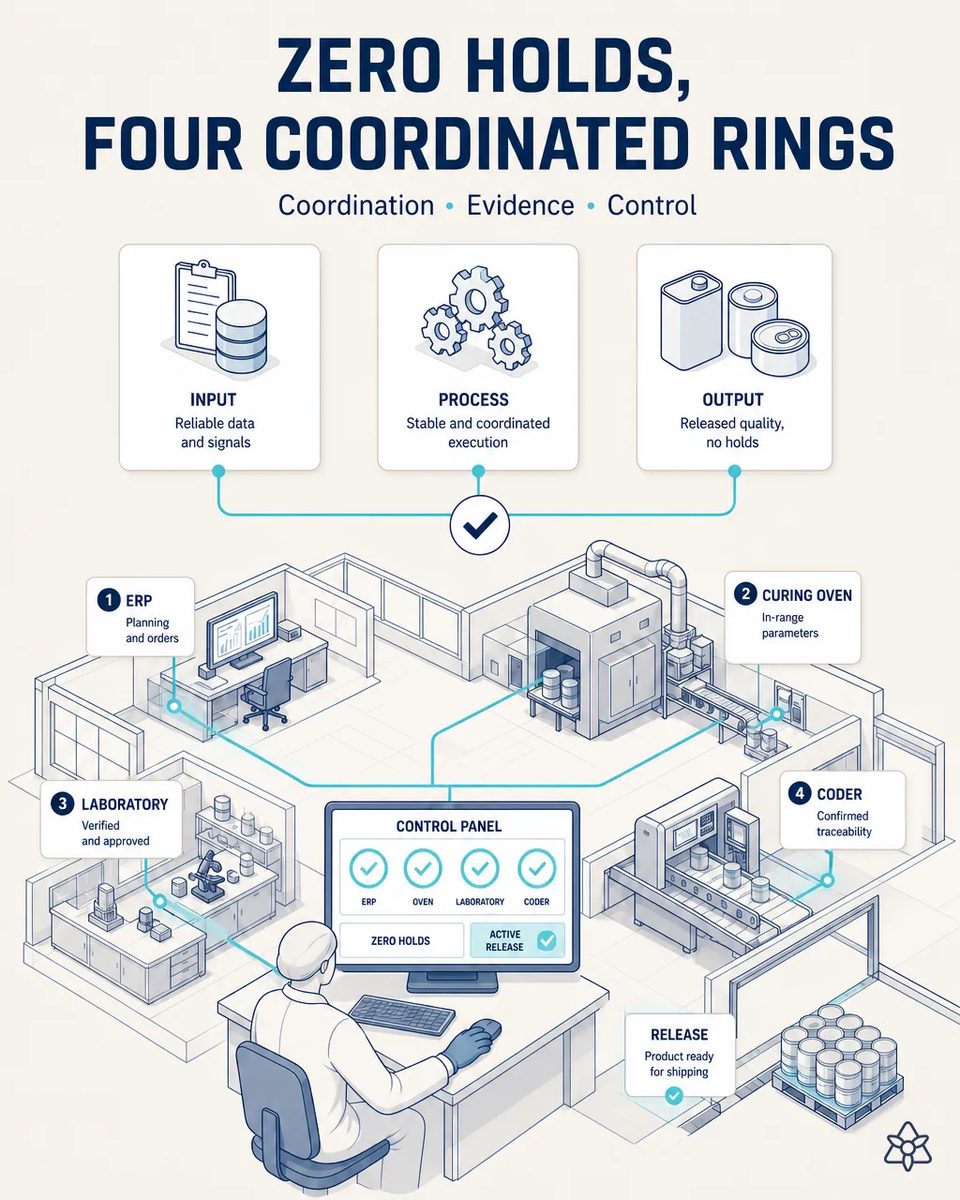
A migration hold is never one failure: it is four records that never met.
A single incident destroys the packer client's trust, forces a precautionary hold across both plants, and puts the BRC certification at risk for the whole portfolio.
- The biggest risk for a food-contact packaging maker with two plants is a hold triggered by poorly traced varnish migration or adhesion.
- The work order, the curing curve, the lab result and the code on the can each live in a different place, and nothing checks them against each other. Each looks correct on its own, which is exactly why the mismatch is not seen until the packer client sees it.
- A single incident destroys the packer client's trust and forces a precautionary hold across both plants, because nobody can bound the affected runs.
- And it puts the BRCGS certification at risk for the whole portfolio, not just for the run in question.
Four rings across both plants — Connect, Edge and Agents orchestrated with JIDOKA AI.
Ring 1 (ERP): batch and varnish spec per work order. Ring 2 (curing oven): digitized curve linked to the run. Ring 3 (lab): migration result automatically cross-checked. Ring 4 (coder/Edge): what's printed is compared against the active work order. If anything doesn't match, JIDOKA AI stops the line; SMED AI speeds up the switch between chemical and food-contact references.
No ring is new: each one is built from the previous cases. The protection comes from the cross-check, because a run that passes each control separately can still fail when the work order, the curve, the lab and the code disagree.
The four rings, the cases behind them and what each one closes
| Ring | Which cases it draws on | What it closes |
|---|---|---|
| 1 · ERP | Run startup (1) + coil receiving (7) + validation (5) | Batch, coil and varnish spec per work order |
| 2 · Curing oven | Oven panel (2) | Digitized curve linked to the run |
| 3 · Laboratory | Migration spreadsheet (6) | Migration result cross-checked automatically |
| 4 · Coder and Edge | Coder (8) + print vision (9) | What is printed, compared with the active work order |
| Stop and switch | Changeover cleaning (10) | JIDOKA AI stops on a mismatch; SMED AI speeds up chemical-to-food switches |
| Evidence and context | Evidence pack (11) + alerts (3) + earpiece (4) | One dossier per pallet, across both plants |
1-3 incidents/year with partial hold risk → zero. Discrepancy detection on the line, not at the packer client.
Impact estimate — to be validated with quality and general management.
The block below is an estimate to be validated against your plant's actual data. We put it forward so the committee has an order of magnitude; we refine it during the assessment.
- Estimated payback 6-12 months, measured against the first hold avoided.
- From 1-3 incidents a year with partial hold risk to zero.
- Discrepancies detected on the line, not at the packer client's plant. The pallet stays at the plant until the four records agree.
- And protection of the multi-year relationship with the packer client, which one poorly traced run can undo. Plus the BRCGS certification of both plants, which a single incident can put on the table.
Estimated payback of 6 to 12 months against the first hold avoided, protecting both the one-off incident and the multi-year relationship with the packer client. Estimate to validate with quality and general management.
And the fair question from the production manager
“Do we need all twelve cases before this works?” — no. The rings are built in layers and each case pays on its own; with the run startup and the curing oven you already have rings 1 and 2. Where the rings compare records, matching batch, curve and result is an anchored task where the best models drop below 1.5% error [1], and JIDOKA AI stops on a verifiable discrepancy, never on model doubt, leaving the call to a person. When the doubt is the model's, the case goes to a person; when the records disagree, the pallet stays.
[1] OpenAI paper "Why Language Models Hallucinate", 2025 — on the reliability of AI in anchored tasks.
What people ask about zero migration holds
Which ring is built first?
Usually ring 1, with the run startup capture, because it has the fewest dependencies and gives every other ring a work order to check against. Each layer pays on its own, so the order is chosen by your priorities, not imposed by the system.
What does the cross-check catch that each control misses in metal packaging?
The run where every record looks fine alone but they disagree together: a curve slightly under profile, a borderline migration result and a code from the previous order. Each passes its own control; together they are the run that ends in a hold.
How does it work across two plants?
Both plants feed the same rings, so a hold can be bounded to the affected runs at one site instead of extended to both as a precaution. That difference, one site against two, is usually the largest share of what a hold costs.
What does SMED AI add in metal packaging?
It speeds up the switch between chemical and food-contact references, so the stricter changeover control does not cost line time. One ring brakes, the other shortens, and together they keep the shared line productive.
Can the return be calculated before committing?
Yes: with your holds history, the cost of the last incident and your food-contact share, we estimate the return layer by layer before choosing the order. The estimate is always framed as a figure to validate with quality and general management.
More cases from this series
- The lab spreadsheet stops living in a world apart from the ERPiLEAN absorbs the lab's varnish migration and adhesion spreadsheet and pushes it to the ERP after…
- The truck no longer waits while the delivery note is typedA photo of the delivery note and heat-number labels digitizes tinplate receiving and pushes it to the…
- A supplier alert that doesn't cost 90 minutes of stopped lineiLEAN reads a coil delay alert instantly and replans the work order before the lithography line stops.
- The curing curve, without touching the ovenAn external camera digitizes the varnish curing curve of an isolated vintage oven, with no replacement…
- Nothing enters the central system without human validationEvery iLEAN capture passes through a tablet with a visual summary before crossing into the ERP: the…
- Information that no longer dies at the end of the shiftWith a Bluetooth earpiece, the line manager dictates issues while walking and iLEAN structures and saves…
Tell us what your last precautionary hold cost across both plants.
We work on your plant's real data, not ours. Assessment with no commitment.
Request estimated ROI within 48h ‹ See all cases of metal packaging See packaging